canitbebuilt
Your hardware idea, inspected. Verdict, BOM, 3D model.

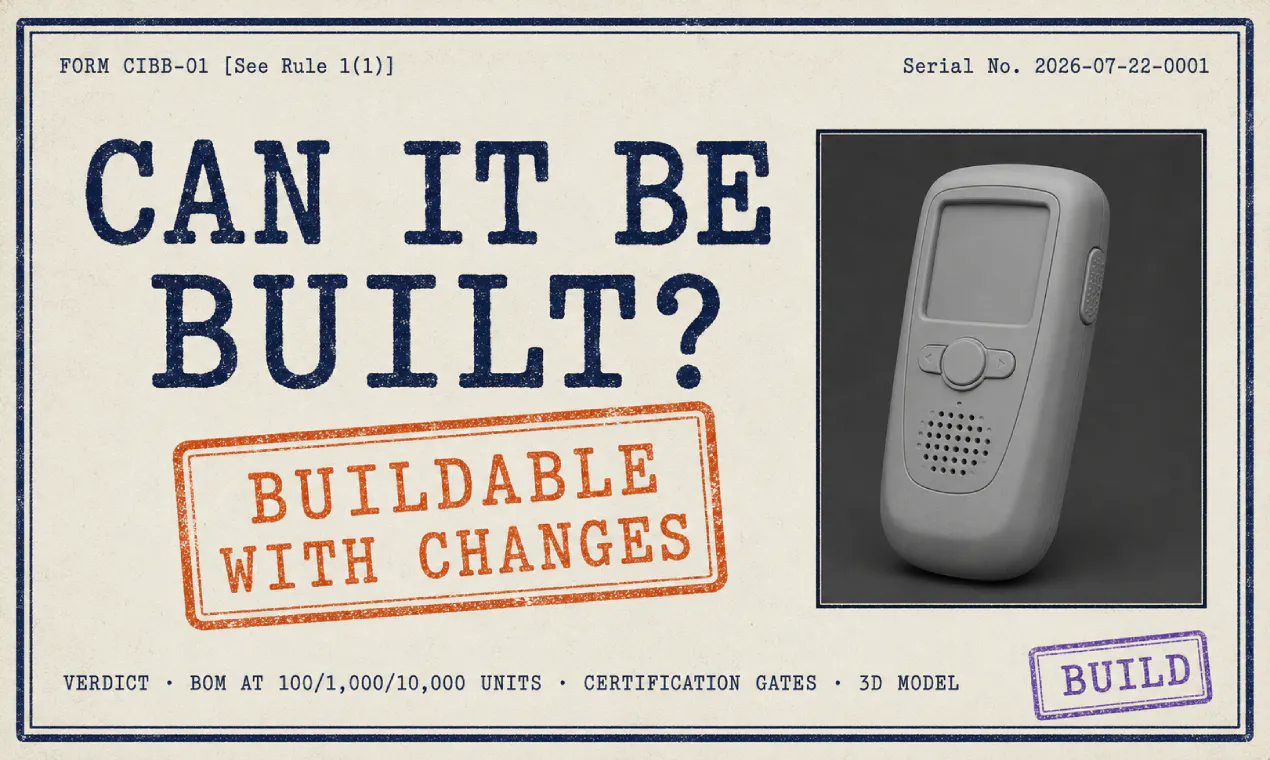
Have a hardware idea? Describe it in a sentence. You get back a verdict (Buildable / Buildable with changes / Heavy lift / Not viable), a bill of materials costed at 100, 1,000 and 10,000 units, subsystem risk ratings, certification gates for your market, and a 3D concept model. Two minutes, no signup. Criteria come from 23 years of hardware building. Running on GPT-5.6 Terra.
AI Analysis
CanItBeBuilt allows users to describe a hardware idea in one sentence and instantly receive an expert analysis: buildability verdict (Buildable/Buildable with changes/Heavy lift/Not viable), costed BOM for 100/1K/10K units, subsystem risk ratings, certification gates, and a 3D concept model. Takes 2 minutes with no signup. Powered by AI (GPT-5.6 Terra) based on 23 years of hardware building experience. It addresses the high uncertainty, cost and risk in hardware development by offering quick, data-driven insights, empowering makers, entrepreneurs and innovators to validate ideas efficiently before committing resources.
The market timing is favorable for 2025-2026 as advanced AI models for multimodal generation (text-to-3D, cost estimation) are maturing rapidly. Growing demand for agile hardware innovation tools in IoT, consumer electronics and sustainable tech amid pressure to cut R&D costs and accelerate time-to-market. Supportive economic policies for manufacturing and tech startups further boost adoption. Excellent Timing.
Technical difficulty is moderate, relying on existing LLMs with specialized prompts for hardware knowledge, 3D generation and cost databases. Low-medium development costs for the web interface; operational costs may rise with AI API usage at scale. Minimal supply chain or compliance risks as a SaaS tool. Strong scalability potential with cloud infrastructure. Fits well with AI/product teams. Overall rating: High, as the core tech is proven and already running.
Main target segments: Hardware entrepreneurs, indie makers, product designers/engineers, early-stage startups. Industries: Consumer electronics, IoT, robotics, wearables. Geographic distribution: Global, concentrated in US, Europe, China. Estimated market size: TAM ~$1B (hardware design/validation software), SAM ~$200M (AI-assisted tools), SOM ~$20M. Core pain points: Expensive failed prototypes, lack of quick expert validation. Potential willingness to pay: Medium-high, as insights can save significant development costs.
Competition level: Medium. Direct competitors: 1. Makersite (makersite.io) - AI for BOM and sustainable design. 2. OpenBOM (openbom.com) - cloud BOM and product data management. 3. Flux.ai (flux.ai) - AI for electronics/PCB design. 4. Arena PLM (arenasolutions.com) - hardware lifecycle management. 5. Custom GPT-based hardware advisors. Advantages: Instant one-sentence input, unique integrated verdict/3D/risk analysis with no signup, grounded in 23y real experience. Disadvantages: May have AI accuracy limitations vs specialized PLM tools; narrower scope than full CAD suites.
Upgrade Pro to unlock full AI analysis
Similar Products

Fuzzy AI
We warm your prospects before reaching out
▲ 527 votes

Midjourney Scanner
60 second ultrasound-based full-body scanner that beats MRI
▲ 206 votes

Gaming services by IFTTT
Level up the way you play with Steam, Dota 2, and more
▲ 125 votes

React UI Kit V7
All the chat components you need. None of the complexity
▲ 115 votes

NanoKVM-Go
Give your AI agent physical control over any screen
▲ 110 votes

BioScript
Self-hosted white label link-in-bio
▲ 0 votes