
DungeonQ
Divert suspicious sessions into persistent decoy worlds
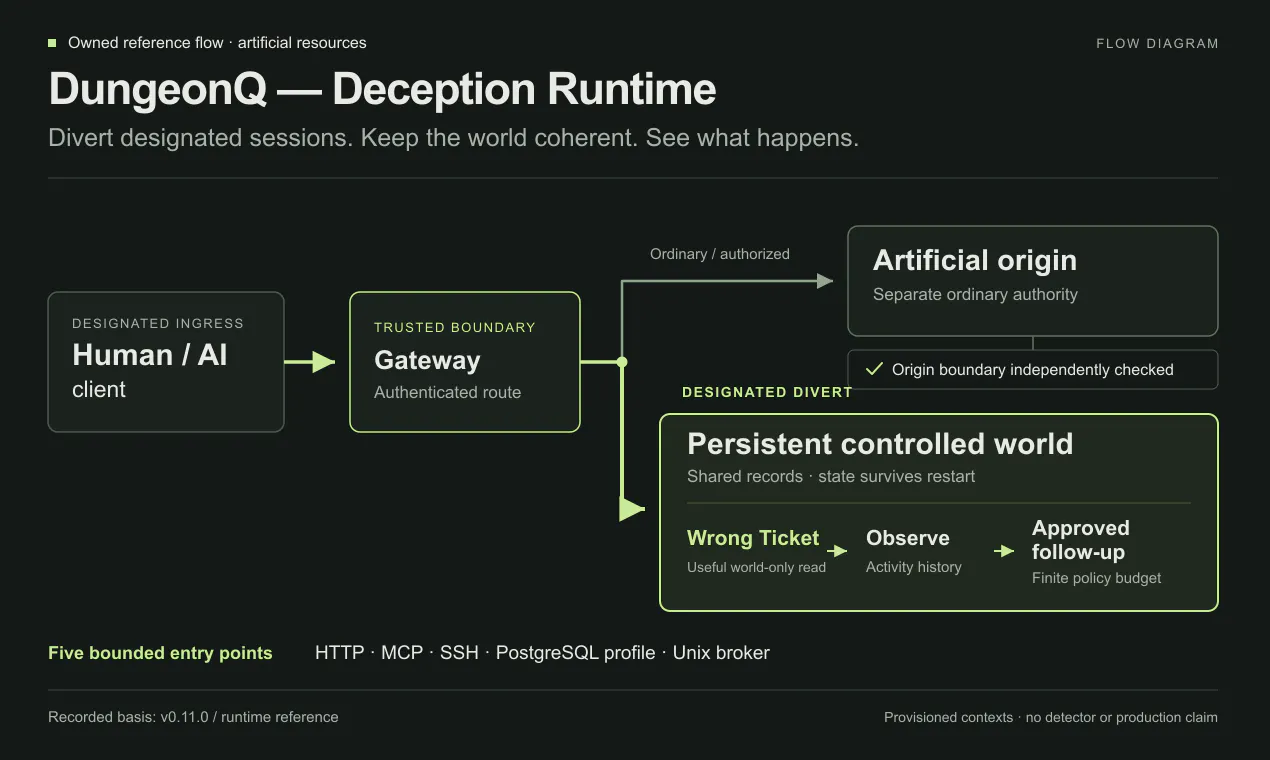
DungeonQ diverts designated suspicious sessions into persistent synthetic worlds. Human and AI clients use world-only tickets; operators observe and approve bounded adaptation. Inspect recorded runtime checks and the original Astra experiment.
AI Analysis
DungeonQ diverts suspicious sessions into persistent synthetic decoy worlds for safe observation. Core features include world-only tickets for human and AI clients, operator-approved bounded adaptations, recorded runtime checks, and roots in the Astra experiment. It solves key pain points of safely handling and analyzing threats without exposing real systems, particularly in AI-driven attack scenarios. The unique selling point is creating believable, ongoing decoy environments that enable detailed monitoring and response. Overall value proposition: advanced deception technology blending cybersecurity with AI for proactive threat intelligence and mitigation.
In 2025-2026, rising AI agent adoption and sophisticated cyber threats create strong demand for deception tools that handle both human and AI interactions. Technology for synthetic environments is maturing with AI advances, while regulatory pushes for better cybersecurity favor innovative solutions. Changing demands for proactive threat analysis align well. This is an opportune time as security teams seek differentiated AI-integrated defenses amid growing attack surfaces. Excellent Timing.
Technical difficulty is significant for building realistic, persistent synthetic worlds that support AI clients and bounded adaptations. Development and operation costs may be high due to resource-intensive environments and monitoring tools. Compliance risks exist around data recording and security standards. Scalability is promising if optimized, with potential good team fit for AI/security experts. Overall rating: Medium. Supported by novel concept but challenged by implementation complexity.
Primary segments: cybersecurity operators, DevSecOps engineers, and security teams in tech, fintech, and enterprise IT (mainly North America and Europe). Estimated market: cybersecurity deception tech TAM ~$2B+, SAM for AI-enhanced decoys ~$300-500M, SOM for early adopters smaller. Core pain points: safely investigating suspicious (incl. AI) sessions and gathering intelligence without risk. High willingness to pay for tools reducing breach impact and providing observability.
Competition level: Medium. Direct competitors: 1. Thinkst Canary (thinkst.com), 2. Cowrie Honeypot (github.com/cowrie/cowrie), 3. Illusive Networks (illusive.io), 4. Acalvio ShadowPlex (acalvio.com). Advantages: persistent synthetic worlds for AI+human clients, operator-controlled adaptation, unique Astra experiment tie-in for stronger differentiation in AI era. Disadvantages: newer/less established, potentially complex onboarding, limited public info on pricing and proven scale compared to mature honeypot solutions.
Upgrade Pro to unlock full AI analysis
Similar Products

Cohere Parse 5
Turn complex docs, tables & images into AI-ready data
▲ 158 votes

Adapt
The company brain that gets work done
▲ 124 votes

Tapfree for Chrome
Voice dictation that adapts to what’s on your screen
▲ 122 votes

React UI Kit V7
All the chat components you need. None of the complexity
▲ 115 votes

Replay QA Security Scan
Automated Penetration Testing for AI-Built Apps
▲ 102 votes

CodeBurn
See where your AI coding spend actually goes
▲ 101 votes