KeptWell
Your family's medical binder, replaced.

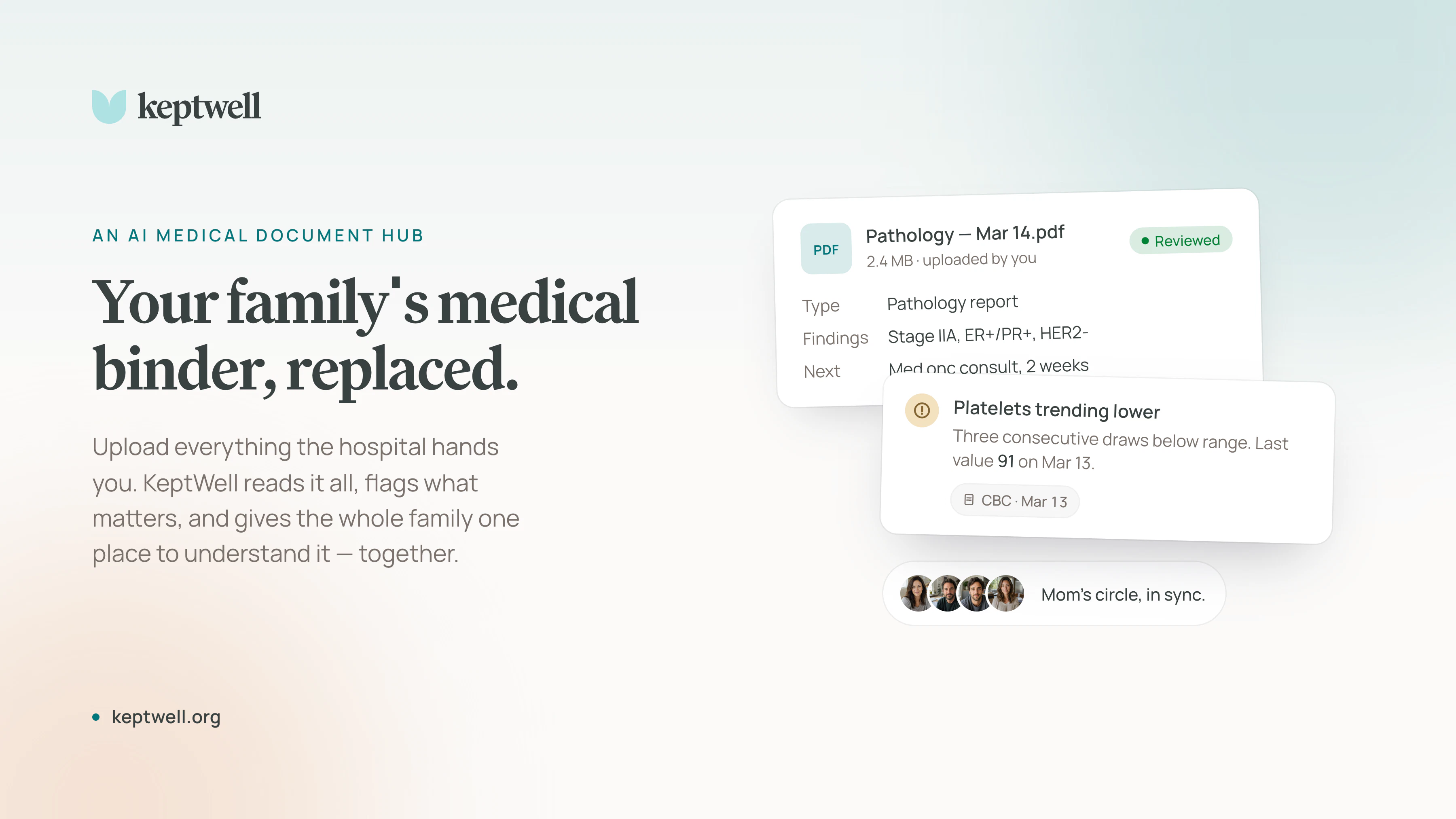
KeptWell is an AI medical document hub for families navigating a serious illness or an aging parent's care. Upload the scans, lab reports, discharge summaries, even audio of appointments — KeptWell reads them, organizes everything into one timeline, and lets the whole family ask questions and stay on the same page. Free to use, private by design.
AI Analysis
KeptWell is an AI medical document hub that replaces the traditional family medical binder. It allows users to upload scans, lab reports, discharge summaries, and appointment audio. The AI reads, organizes all records into a single timeline, and enables family members to ask questions for shared understanding. Core USPs are its privacy-by-design approach, free usage, and intelligent organization for complex care scenarios. It solves key pain points like fragmented medical information, difficulty tracking histories during serious illnesses or elder care, and lack of family alignment, delivering a centralized, accessible, and smart value proposition for caregivers.
The timing is favorable for 2025-2026 as AI technologies for document understanding and NLP have matured sufficiently for reliable medical summarization. Global aging populations and rising family caregiver burdens are increasing demand for digital tools. Healthcare digitization trends, post-pandemic emphasis on remote care, and growing acceptance of AI in health support align well. Economic pressures on healthcare systems further favor efficient personal tools. Excellent Timing.
Technically feasible using existing OCR, speech-to-text, and LLM APIs for processing and timeline creation. Development costs are moderate for an MVP, with good scalability via cloud infrastructure. However, HIPAA/GDPR compliance for medical data introduces high regulatory risks, legal costs, and security demands. Privacy-by-design helps but requires substantial investment. Overall rating: Medium, mainly due to compliance and data sensitivity challenges.
Primary users are middle-aged adults (35-60 years old) acting as caregivers for aging parents (65+) or family members with serious/chronic illnesses, often in the US and other English-speaking developed countries. Estimated TAM for digital health records and caregiver tools exceeds $50B globally, with SAM for AI-powered family medical management around $5-10B and SOM smaller for early adopters. Core pain points include disorganized records and poor family coordination. Potential willingness to pay is moderate-to-high for premium features despite current free model, driven by emotional value and time savings.
Medium. Direct competitors: 1. Picnic Health (picnichealth.com), 2. CareZone (carezone.com), 3. MyMedical (mymedical.com), 4. Health Companion apps like Florence (florence.ai). Advantages: Superior AI for audio processing, unified timeline, natural language Q&A, completely free with strong privacy focus. Disadvantages: Newer player with less brand trust, potentially fewer hospital integrations or established user base compared to incumbents that have been in market longer.
Upgrade Pro to unlock full AI analysis
Similar Products

Oasis Browser for Mac
A privacy-first AI browser you can train anonymously
▲ 211 votes

Runtime
Sandboxed coding agents for everyone on your team
▲ 200 votes

Jotform Claude App
Build, edit, and analyze forms directly in Claude
▲ 157 votes

Polygram
AI-native design and coding app to build mobile & web apps
▲ 81 votes
Drafted
Design a home instantly with AI
▲ 77 votes

DecisionBox for Databricks
Connect DecisionBox to your Databricks to validate findings
▲ 72 votes