KugelAudio
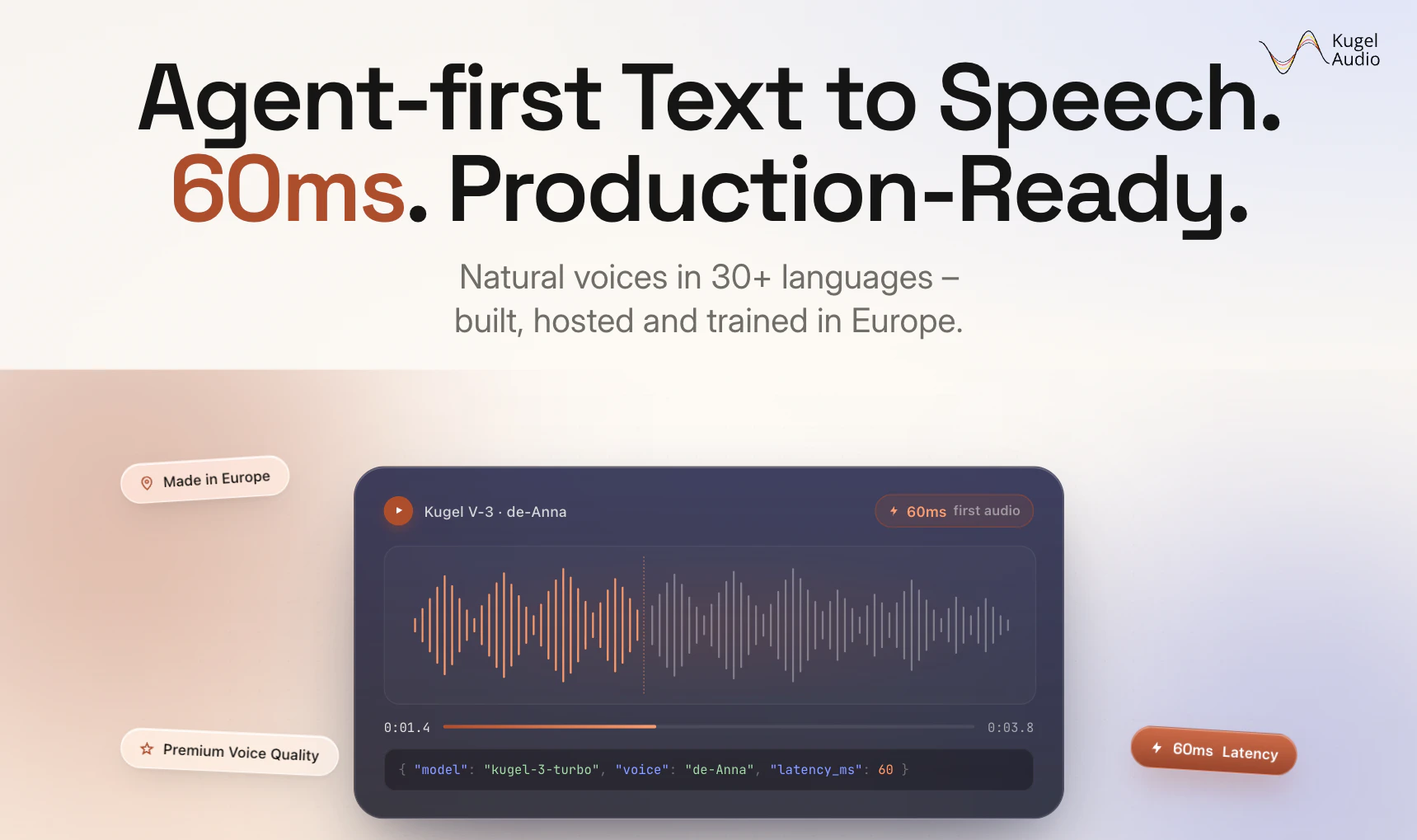
Real-time text-to-speech model you can self-host

Most natural real-time TTS with voice cloning and sub-60ms latency, on-prem or via API. Grammar-aware normalization reads phone numbers, IBANs, addresses, and medications naturally across 25+ languages, with word-level timestamps and IPA support. Adapters for LiveKit, Pipecat, and Vapi. Built by 4 in Berlin.
AI Analysis
KugelAudio is a self-hostable real-time TTS model delivering highly natural speech with voice cloning and sub-60ms latency, available on-prem or via API. Core features include grammar-aware normalization for natural rendering of phone numbers, IBANs, addresses, and medications across 25+ languages, plus word-level timestamps, IPA support, and adapters for LiveKit, Pipecat, and Vapi. It solves key pain points such as high latency in conversational AI, unnatural prosody in complex text, limited customization, and privacy risks from cloud-only services. Built by a 4-person team in Berlin, its value proposition is enabling developers to create low-latency, privacy-friendly voice experiences with production-ready quality and easy integrations.
The market timing is favorable for 2025-2026 due to booming demand for real-time voice AI agents, conversational interfaces, and on-prem AI solutions driven by privacy regulations and reduced cloud dependency. Neural TTS technology has matured to support sub-60ms latency at high quality, aligning with trends in live voice platforms and developer tools. Economic push for sovereign AI further boosts adoption. Excellent Timing.
Feasibility is High. The compact Berlin team has already delivered a production-capable model with advanced features, demonstrating manageable technical difficulty. On-prem deployment lowers long-term operational costs for users while API option aids scalability. Compliance risks are reduced for sensitive sectors via self-hosting; main challenges are ongoing model maintenance across languages and user hardware requirements for self-hosting. Strong scalability potential via integrations.
Primary segments: AI/ML developers, voice application engineers, and startups/enterprises building real-time conversational AI (e.g. voice agents, virtual assistants). Industries include developer tools, customer service, accessibility, and healthcare. Geographic focus: Europe and North America, with global API reach. TTS market TAM exceeds $5B (2025), real-time/self-hosted SAM estimated $500M-$1B. Core pains: latency, unnatural normalization, privacy. High willingness to pay for API credits or enterprise self-host licenses.
Competition level: Medium. Direct competitors: 1. ElevenLabs (elevenlabs.io) - cloud-focused high-quality TTS/voice cloning. 2. Cartesia (cartesia.ai) - real-time generative voice AI. 3. Play.ht (play.ht) - multi-language TTS with real-time options. 4. Piper TTS (github.com/rhasspy/piper) - lightweight open-source on-device TTS. Advantages: unique self-host + sub-60ms latency combo, grammar-aware normalization, specific platform adapters, IPA/timestamps. Disadvantages: smaller team/brand vs well-funded rivals, potentially higher setup complexity for self-hosting.
Upgrade Pro to unlock full AI analysis
Similar Products

Graphbit PRFlow - AI Code Review Agent
AI code reviewer that catches what others miss
▲ 175 votes

Jotform Claude App
Build, edit, and analyze forms directly in Claude
▲ 157 votes

Polygram
AI-native design and coding app to build mobile & web apps
▲ 81 votes

Mantel
Stop confusing your Claude Code sessions & terminal windows
▲ 72 votes

DecisionBox for Databricks
Connect DecisionBox to your Databricks to validate findings
▲ 72 votes

Stagent
Drive Claude Code through long tasks it would otherwise drop
▲ 58 votes