Linchpin

Linchpin

Open-source, self-hostable runtime for managed AI agents

Developer ToolsArtificial IntelligenceGitHubOpen Source
▲ 72 votes5 commentsLaunched May 13, 2026
Visit Website
Daily #32Weekly #94
Linchpin screenshot 1

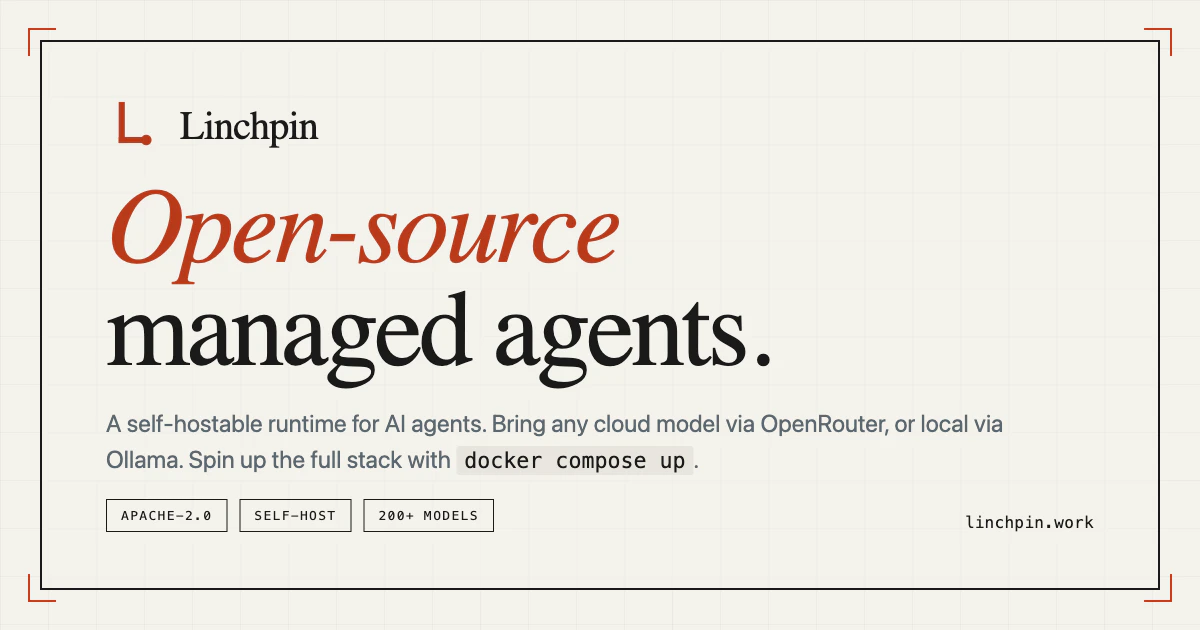
Linchpin is an open-source, self-hostable runtime for managed AI agents. Apache-2.0. One `docker compose up` and you get a full agent platform — REST + SSE API, per-session Docker sandbox, MCP tools, encrypted vaults. Bring any cloud model via OpenRouter, or local via Ollama.

AI Analysis

📝 Summary

Linchpin is an open-source (Apache-2.0), self-hostable runtime for managed AI agents. A single 'docker compose up' command delivers a full platform with REST+SSE API, isolated per-session Docker sandboxes, MCP tools, and encrypted vaults for secure credential storage. It supports any cloud LLM via OpenRouter or local models via Ollama. It solves key developer pain points: complex AI agent infrastructure setup, security risks from untrusted agent code execution, vendor lock-in, and high cloud costs. The value proposition is a simple, private, customizable, and secure agent runtime that puts full control back into developers' hands without sacrificing power or ease of deployment.

📈 Market Timing

2025-2026 is an excellent period as AI agent adoption surges, enterprises prioritize data privacy and cost control amid rising LLM API prices, and tools like Ollama and Docker have reached high maturity. Regulatory focus on AI transparency and self-hosting further supports open-source solutions. Excellent Timing.

✅ Feasibility

High feasibility. Leverages mature, widely available technologies (Docker, Ollama, OpenRouter). One-command deployment keeps operational costs and complexity low. No significant supply chain or compliance barriers for open-source distribution. Excellent scalability potential within self-hosted environments. Main challenge is ongoing maintenance of sandbox security. High.

🎯 Target Market

Primary users: AI engineers, full-stack developers, indie hackers, and small-to-medium tech teams building autonomous agents. Industries: Software development, AI research, automation services. Geographic: Global with strong adoption in US, Europe, and Asia tech hubs. TAM for AI developer tools exceeds $10B; SAM for self-hosted agent platforms ~$1B; SOM for open-source runtimes in hundreds of millions. Core pains: security, control, and setup friction. Willingness to pay moderate for premium support, managed hosting, or enterprise features.

⚔️ Competition

Medium. Direct competitors: 1. Dify (dify.ai), 2. Langflow (langflow.org), 3. CrewAI (crewai.com), 4. AutoGen Studio (microsoft.github.io/autogen), 5. Open WebUI with agent extensions. Advantages: true one-command self-hosting, strong per-session Docker sandbox isolation, built-in encrypted vaults, and MCP tool support. Disadvantages: newer project with likely smaller community/ecosystem compared to Langflow or Dify, and may lack polished UI or extensive pre-built agent templates.

Upgrade Pro to unlock full AI analysis