PieceKeeper
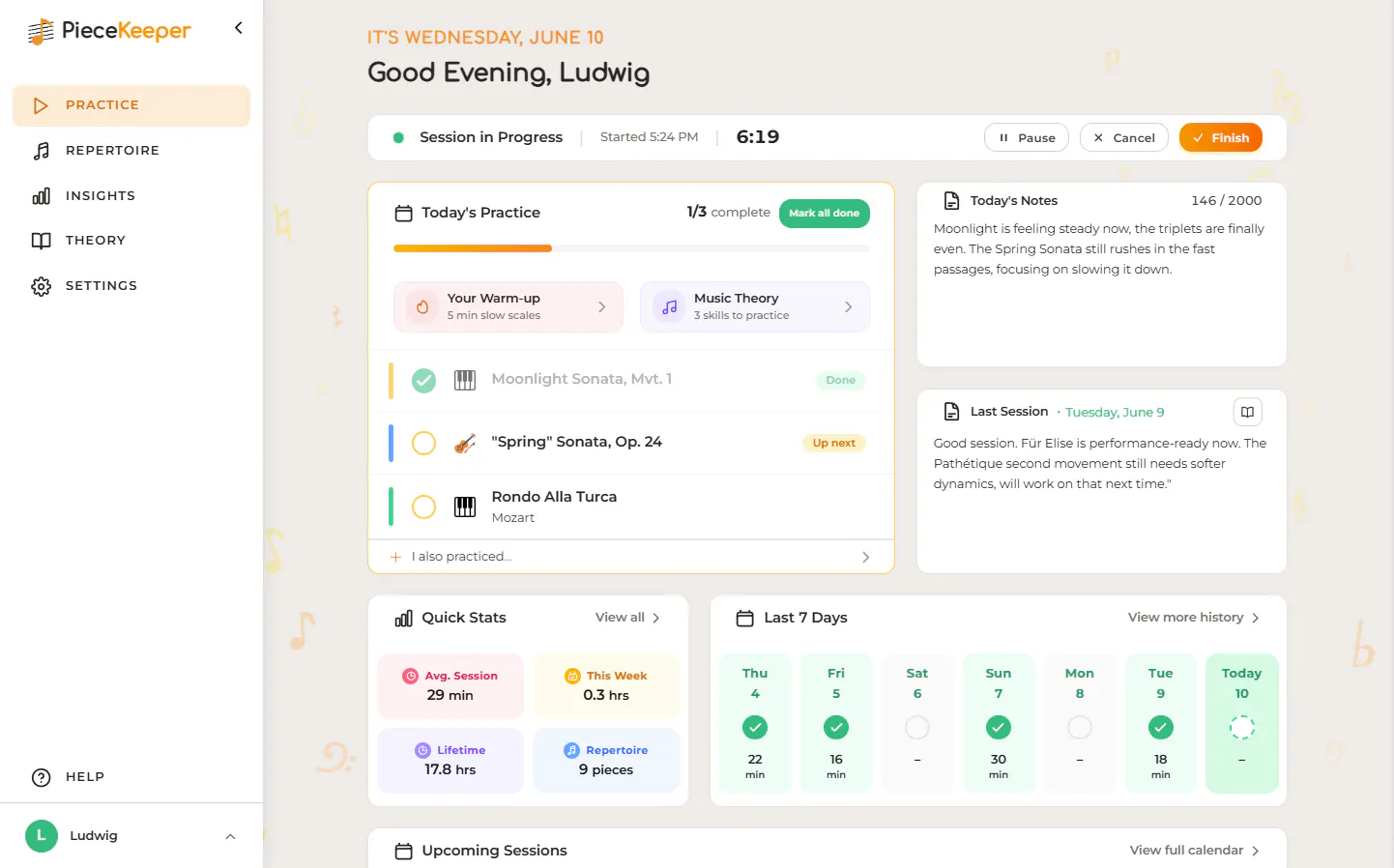
Track your music repertoire and practice

Never lose track of a piece again. PieceKeeper helps musicians manage their repertoire, run focused practice sessions based on a customized practice schedule, get insights and trends about their practice, and learn music theory through interactive drills and exercises aimed at improving both reading and listening skills.
AI Analysis
PieceKeeper helps musicians manage repertoire, create customized practice schedules for focused sessions, gain insights and trends on practice habits, and improve via interactive music theory drills for reading and listening skills. It solves key pain points like losing track of learned pieces, unstructured routines, lack of progress analytics, and weak theory knowledge. USP is its all-in-one, data-driven approach tailored for classical musicians, delivering efficient mastery and never losing a piece again.
In 2025-2026, timing is favorable with maturing AI for personalized learning, growth in edtech and self-directed music apps, rising demand for analytics-driven practice post-pandemic, and mobile tech enabling interactive drills. Classical music education is embracing digital tools. Excellent Timing.
High feasibility. Technical needs (databases, schedulers, analytics dashboards, web-based interactive quizzes via audio APIs) are standard and not overly complex. Development/operation costs are moderate for SaaS. No major supply chain issues; compliance low risk. Strong scalability potential on cloud platforms, though content creation for drills requires expertise. Suitable for small dev team with music interest.
Primary segments: Classical music students (teens to young adults), amateur and professional performers, music educators. Demographics: Ages 12-45, dedicated hobbyists/professionals. Industries: Music education/performance. Geographic: Concentrated in North America, Europe, East Asia. TAM for music edtech large (billions), SAM for practice tools hundreds of millions, SOM niche for repertoire trackers smaller. Pain points center on organization and progress tracking. Moderate to high willingness to pay for premium features via subscriptions.
Medium. Direct competitors: forScore (forscore.co) - sheet music manager; SmartMusic (makemusic.com) - interactive band/orchestra tool; Yousician (yousician.com) - gamified lessons; Flowkey (flowkey.com) - piano learning; Tonara (tonara.com) - practice tracker. Advantages: Deeper repertoire focus, practice analytics/trends, classical-specific theory drills and custom schedules. Disadvantages: Newer entrant with likely smaller library/user base, less emphasis on real-time accompaniment than some rivals.
Upgrade Pro to unlock full AI analysis
Similar Products

Nada
Compose music with just your voice
▲ 191 votes

Backbeat Forge
Turn drum audio into a score you can actually edit
▲ 111 votes

Orchestria
AI music engine with granular stem control
▲ 111 votes

loopclub
The shared drum machine to jam with strangers or with Claude
▲ 83 votes
MCP 2000
AI Drum Machine MPC in your browser
▲ 80 votes

iVox
The first app dedicated to 1980s tape-edit effects.
▲ 80 votes