Restaurant Menu Visualizer

Restaurant Menu Visualizer

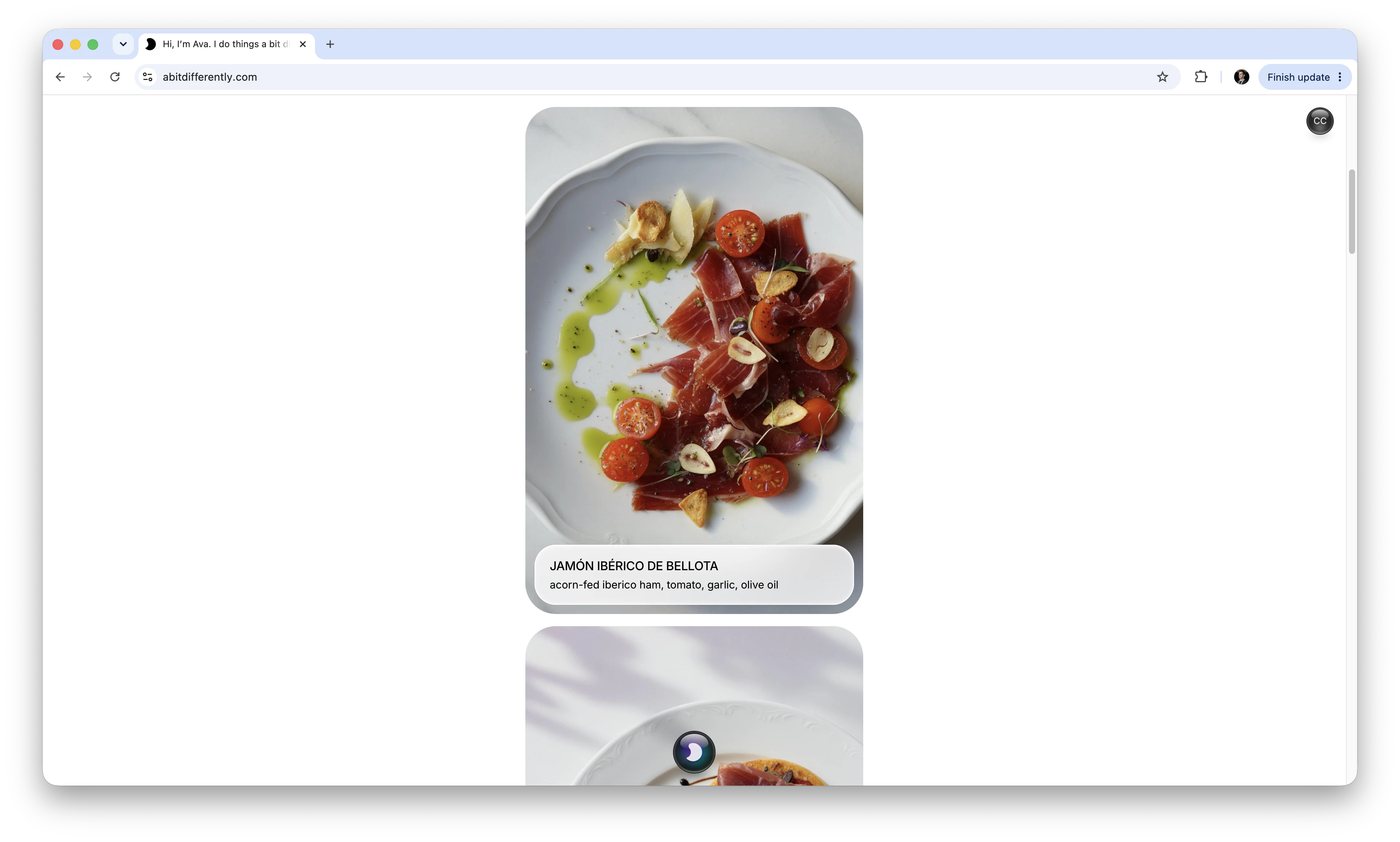
Share the menu with Ava and see what each dish may look like

TravelArtificial Intelligence
▲ 70 votes3 commentsLaunched Jun 17, 2026
Visit Website
Daily #60Weekly #98
Restaurant Menu Visualizer screenshot 1

Sometimes you go to a restaurant, take a seat at the table, start reading the menu and then... "What even is this? Too many French terms. I don’t even know what I should order." You’ve been there, right? That’s why I built this feature, so Ava could show me what a dish may look like, without asking the waiter. Ava is not fully baked yet, so when you talk to her, she may say stupid things. It's all part of growing up.

AI Analysis

📝 Summary

Restaurant Menu Visualizer enables users to share a restaurant menu with AI assistant Ava, which generates visualizations of each dish. It directly addresses the pain point of confusing menu descriptions, especially those with unfamiliar foreign terms, helping diners decide what to order without consulting waitstaff. The core USP is its specialized, conversational AI for menu-to-image translation, adding value for travelers and curious eaters. Though Ava is still maturing and may give imperfect responses, the tool simplifies dining decisions through accessible AI visuals.

📈 Market Timing

In 2025-2026, generative AI and multimodal vision models are reaching practical maturity, aligning with rising global travel, demand for seamless dining experiences, and AI integration in mobile apps. User expectations for instant visual assistance are growing while economic recovery supports travel tech adoption. Excellent Timing.

✅ Feasibility

High. Relies on mature existing image-generation APIs, resulting in moderate technical difficulty and development costs. Operational AI inference expenses and refining output accuracy are primary risks. Strong scalability as a digital tool with limited compliance issues for a consumer travel feature.

🎯 Target Market

Primary segments: international travelers and tourists aged 25-45, food enthusiasts in urban dining scenes, concentrated in Europe, Asia, and North America. TAM for AI travel assistants exceeds $15B; SAM for menu tools ~$800M; SOM smaller for this niche. Core pain points include menu ambiguity and language barriers. Moderate willingness to pay via app subscriptions or freemium upgrades.

⚔️ Competition

Medium. Direct competitors: 1. OpenAI ChatGPT + DALL-E (openai.com), 2. Google Gemini (gemini.google.com), 3. Microsoft Copilot (copilot.microsoft.com), 4. Specialized apps like VizDish or menu scanners on TripAdvisor (tripadvisor.com). Advantages: focused conversational menu flow with Ava. Disadvantages: Ava's admitted immaturity vs. more polished, general-purpose AI tools that can replicate the function via prompts.

Upgrade Pro to unlock full AI analysis