Rixx
The Perplexity alternative that organizes your research

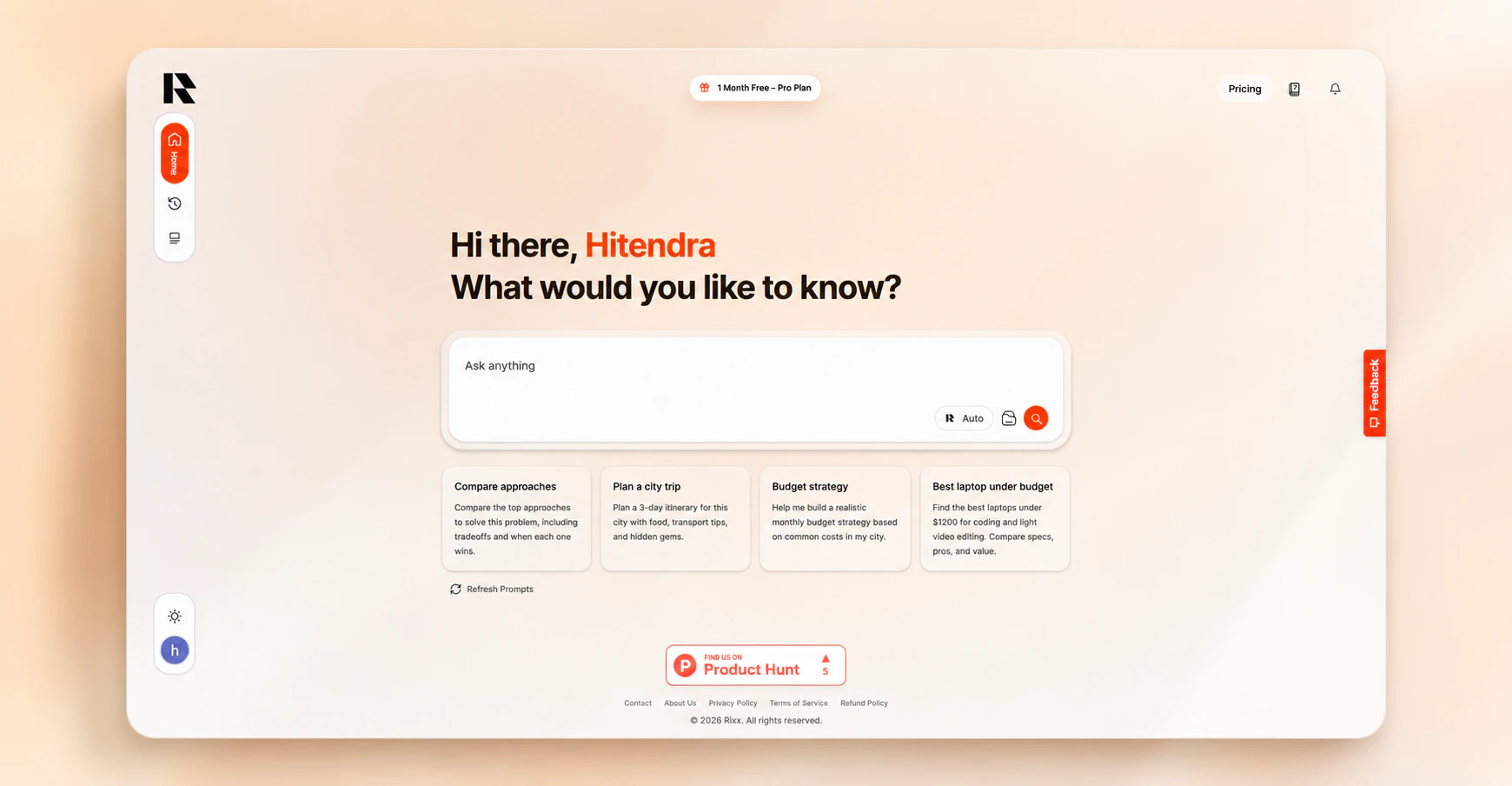
AI search engines lie. Rixx doesn't. Search the web and get answers backed by real citations so you can verify every claim, not just trust it. → See data visually with charts and graphs → See images inline with your results → Upload PDFs, docs, and links as context → Multimodal search: text, images, docs together → Organize research into Insights folders Stop guessing. Start knowing.
AI Analysis
Rixx is an AI search engine positioned as a truthful alternative to Perplexity. Core features include web searches with verifiable real citations, visual data presentation via charts and graphs, inline images in results, uploading PDFs/docs/links for context, multimodal search across text/images/documents, and organizing findings into Insights folders. It addresses key user pain points such as unreliable AI hallucinations, lack of source verification, fragmented research processes, and difficulty visualizing or combining different data types. The value proposition is empowering users to move from guessing to knowing through accurate, cited, visual, and well-organized research outcomes.
In 2025-2026, AI search and productivity tools are maturing amid rising concerns about hallucinations and misinformation. Technology for citations, multimodal AI, and data visualization has advanced sufficiently. User demand is shifting toward trustworthy, organized research solutions as AI adoption grows in professional workflows. Economic environment favors productivity-enhancing SaaS. This aligns perfectly with post-hype focus on reliable AI applications. Rating: Excellent Timing.
Technical difficulty is significant, requiring integration of LLMs, real-time web search, accurate citation systems, chart generation, and multimodal processing. Operational costs for inference and crawling are high. Supply chain/compliance risks are moderate (data privacy for uploads). Scalability is strong with cloud infrastructure, but maintaining search quality is ongoing. No specific team info available. Overall rating: Medium, feasible via existing AI APIs but resource-intensive to differentiate and scale reliably.
Main segments: Researchers, students, analysts, journalists, and knowledge workers in academia, consulting, data analysis, and content creation industries. Geographically distributed globally with concentration in North America and Europe. Core pain points are unverifiable AI outputs and disorganized research. Estimated market is part of the rapidly growing AI productivity sector (large TAM), though specific TAM/SAM/SOM numbers not provided in sources. Professionals show strong willingness to pay for time-saving, reliable tools, likely via subscriptions.
Competition level: High. Direct competitors: 1. Perplexity (perplexity.ai), 2. You.com, 3. Elicit (elicit.org), 4. Scite (scite.ai), 5. Consensus (consensus.app). Advantages vs competitors: Superior research organization via Insights folders, inline visuals/charts, and strong multimodal upload/search capabilities. Disadvantages: As a newer entrant, potentially less brand recognition, smaller data index, or less mature backend compared to Perplexity; pricing not detailed but must compete with established freemium models. Differentiation in organization and visuals is promising but faces intense pressure in the AI search space.
Upgrade Pro to unlock full AI analysis
Similar Products

FileFlan
Instant private universal file sharing
▲ 100 votes

Kosshi
Simple, fast outliner for Mac and iPhone.
▲ 90 votes

Polygram
AI-native design and coding app to build mobile & web apps
▲ 81 votes

Arkiv
Modern Asset Protection for Designers
▲ 68 votes

Tweetmonials
Turn X praise into testimonials and trust signals
▲ 67 votes

Stagent
Drive Claude Code through long tasks it would otherwise drop
▲ 58 votes