Uselink

Uselink

host your html, share the link, and get comments

Developer ToolsArtificial IntelligenceProductivity
▲ 124 votes29 commentsLaunched Jun 3, 2026
Visit Website
Daily #16Weekly #31
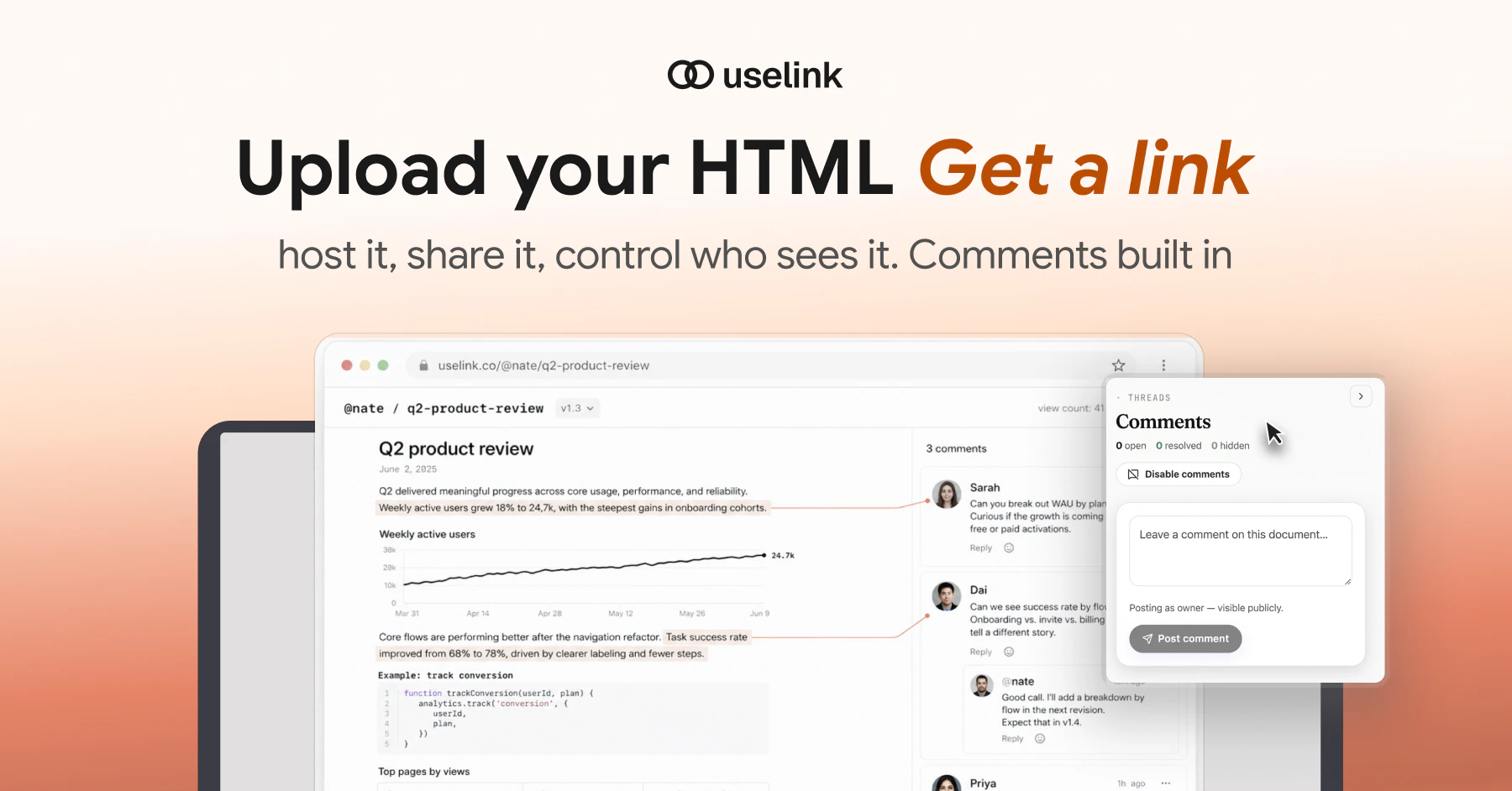
Uselink screenshot 1

uselink turns any HTML or Markdown into a clean link you control. paste a doc, get a url under your handle, decide who can read and who can comment. readers reply in threads with no account, which Google Docs and Notion can't do. interactive HTML actually runs. add a password, an expiry, or a view limit, and keep every version. new this launch: a visual editor to edit live pages with no code, and an MCP server so Claude, Cursor, or n8n can publish for you.

AI Analysis

📝 Summary

Uselink transforms HTML or Markdown into personalized, controlled shareable links under your handle. Core features include reader/commenter access controls, threaded comments without requiring accounts, executable interactive HTML, password protection, expiry/view limits, full version history, a no-code visual editor, and an MCP server enabling AI tools like Claude, Cursor, or n8n to publish directly. It solves key pain points of tools like Google Docs and Notion by supporting truly interactive content and frictionless anonymous feedback. USP lies in combining secure hosting, real-time collaboration, version control, and AI automation. Value proposition: simple, secure sharing of dynamic documents with complete control and seamless AI integration for developers and creators.

📈 Market Timing

Favorable in 2025-2026 due to the rapid maturation of agentic AI and no-code tools, with surging adoption of Claude, Cursor, and automation platforms like n8n. User demand is shifting toward frictionless, account-free collaboration and interactive web content sharing amid remote work trends. Economic environment supports productivity SaaS, while policy focus on AI integration creates tailwinds. The launch of visual editing and AI publishing aligns perfectly with these shifts. Excellent Timing.

✅ Feasibility

High. Technical foundation for HTML/Markdown rendering and hosting is mature, though secure sandboxing for interactive code is essential to mitigate risks. Visual editor and MCP server leverage existing web/AI APIs, keeping development costs moderate. Operational costs (hosting, bandwidth) are scalable via cloud infrastructure. Low compliance risks; strong fit for developer teams. High scalability potential once security and versioning are solidified. Main risks are usage-based cost management if virality occurs.

🎯 Target Market

Primary segments: software developers, AI engineers, product managers, technical writers, and indie hackers. Demographics: tech professionals aged 25-40, high digital literacy. Industries: software development, AI/productivity tools, digital content creation. Geographic: global with concentration in US, Europe, and East Asia tech hubs. TAM for online collaboration/software sharing tools exceeds $10B; SAM for developer-focused sharing ~$2B; SOM for AI-integrated interactive hosting niche ~$300M. Core pains: lack of easy runnable HTML sharing with comment control and no sign-up barriers. High willingness to pay for privacy, limits, and AI features.

⚔️ Competition

Medium. Direct competitors: 1. Notion (notion.so), 2. Google Docs (docs.google.com), 3. CodePen (codepen.io), 4. Coda (coda.io), 5. Glitch (glitch.com). Advantages vs competitors: true no-account threaded comments, executable interactive HTML (beyond static embeds), AI/MCP publishing automation, built-in visual no-code editor, granular controls (expiry, view limits) and version history. Disadvantages: newer entrant with less ecosystem/brand recognition than Notion/Google; may have higher initial setup complexity; pricing (freemium likely) must compete with generous free tiers of incumbents. Strong differentiation in AI integration and comment freedom.

Upgrade Pro to unlock full AI analysis