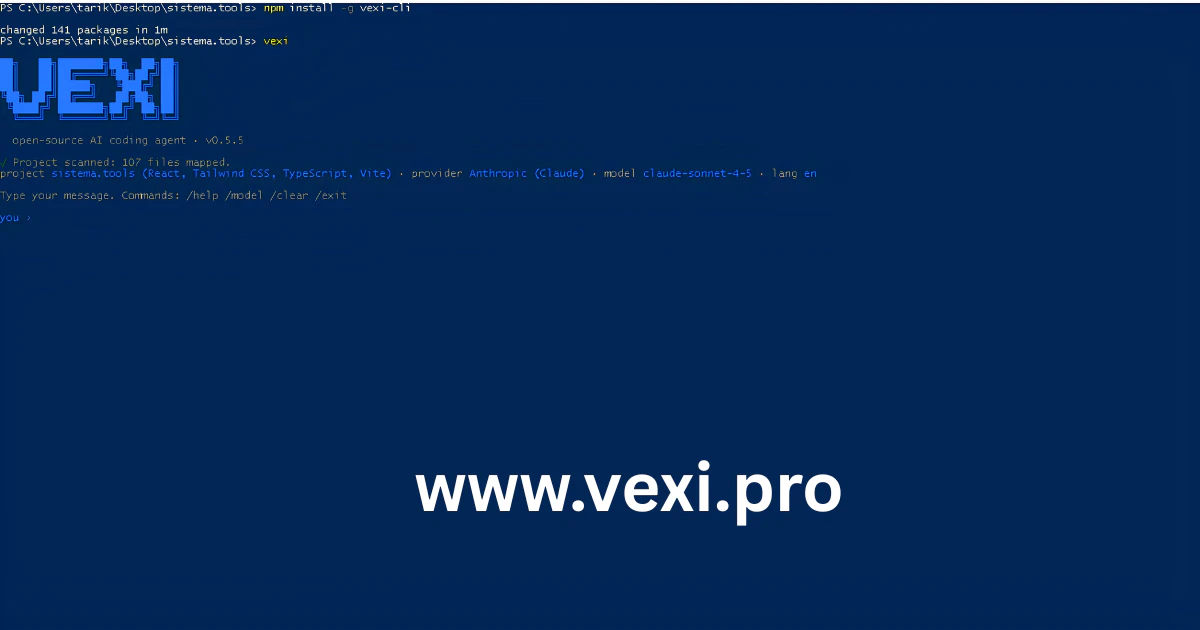
VEXI
Open-source AI coding agent for your terminal

VEXI is an open-source AI coding agent built for developers who prefer the terminal. Bring your own API keys, connect OpenAI, Anthropic, and other providers, and accelerate coding, debugging, refactoring, and automation through a lightweight, multilingual, privacy-friendly CLI.
AI Analysis
VEXI is an open-source AI coding agent designed for developers who prefer working in the terminal. It enables users to bring their own API keys for providers like OpenAI and Anthropic, facilitating accelerated coding, debugging, refactoring, and task automation. As a lightweight, multilingual, and privacy-friendly CLI tool, it addresses key pain points including disruptive context-switching from terminal to web-based AI platforms, concerns over code privacy and data security, and inefficiencies in manual development workflows. The core value proposition is enhancing productivity within the developer's native environment without added complexity or privacy trade-offs.
The current market timing is highly favorable for 2025-2026. LLM and AI agent technologies have reached sufficient maturity for practical coding applications, while developer demand for integrated, privacy-focused tools is surging amid rising data security regulations and economic pressures for efficiency. The shift toward open-source solutions and terminal-native workflows aligns with industry trends in remote/CLI-heavy development. Excellent Timing.
Overall feasibility is High. Technical difficulty is moderate, relying on established LLM API integrations and CLI development which are well-documented. Development and operation costs are low due to its open-source, lightweight design with community contributions. Minimal supply chain or compliance risks (standard OSS licensing), strong scalability via external LLM providers, and good fit for solo or small dev teams. Key risks are prompt quality and API dependency.
Main target segments: Software developers, full-stack engineers, DevOps professionals, and open-source contributors who favor terminal/CLI workflows (ages 25-45, tech-savvy). Industries: Software development, IT services, startups. Geographic: Global with concentration in North America, Europe, and Asia tech hubs. TAM for AI developer tools projected multi-billion by 2026; SAM for terminal AI agents ~$300-500M; SOM for open-source segment smaller but growing. Core pain points: workflow interruptions and privacy risks. High willingness to pay via API usage or potential premium support.
Medium. Direct competitors: 1. Aider (aider.chat), 2. Continue (continue.dev), 3. OpenDevin (github.com/OpenDevin/OpenDevin), 4. GitHub Copilot CLI (github.com/features/copilot), 5. Roo Code (roocode.com). Advantages vs competitors: Strong emphasis on privacy (BYO keys, no data sharing), fully open-source and lightweight for pure terminal use, multilingual support. Disadvantages: Potentially less feature-rich or polished than IDE-integrated tools like Cursor or Copilot; relies entirely on user-provided API keys which add external costs and variability.
Upgrade Pro to unlock full AI analysis
Similar Products

Juno
Free, local voice layer for Mac. Stop typing, start talking.
▲ 139 votes

Boxes.dev
Run Claude Code and Codex in your own cloud environment
▲ 101 votes

Recursi
Self improving vibe coding env with no API fees
▲ 92 votes

FableWatch
Know the second Fable 5 is back
▲ 75 votes

Mantel
Stop confusing your Claude Code sessions & terminal windows
▲ 72 votes

Stagent
Drive Claude Code through long tasks it would otherwise drop
▲ 58 votes