
Adapt
The company brain that gets work done
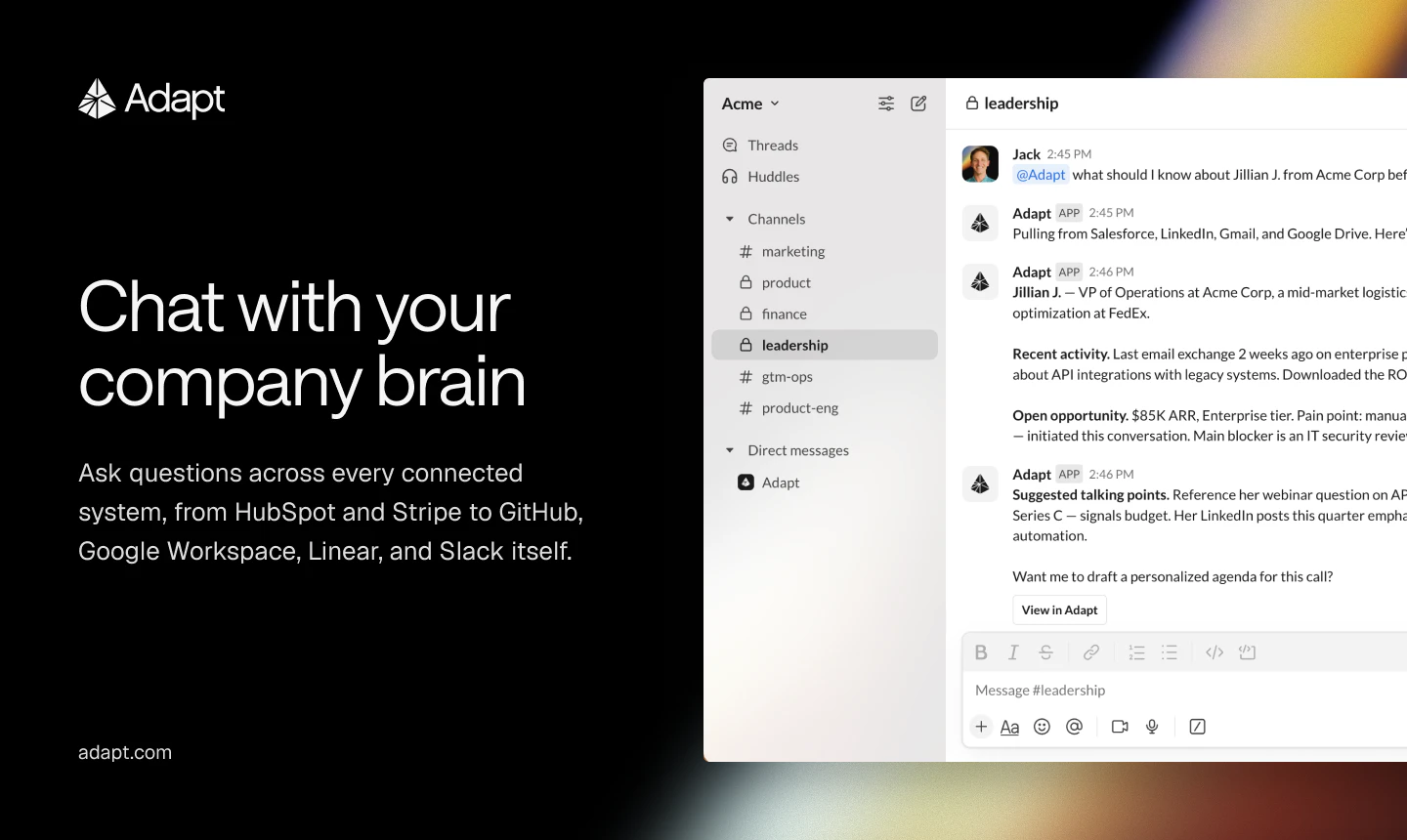
Transform your Slack into an AI workspace with a shared company brain. Set it up once, connect to every tool, and anyone can tag @Adapt to answer questions, build apps, and get work done. Unlike other Slack-native AI agents, Adapt has a complete web app where you can view agent traces, build robust apps with connected context, share skills, and get visibility into scheduled tasks and accrued company knowledge. Adapt isn't just an assistant - it's a system for teams to work AI native together.
AI Analysis
Adapt transforms Slack into an AI workspace with a shared company brain. After one-time setup connecting various tools, anyone can tag @Adapt to answer questions, build apps, and complete work. It includes a full web app for viewing agent traces, building robust context-connected apps, sharing skills, and gaining visibility into scheduled tasks and accumulated knowledge. It solves key pain points like fragmented company knowledge, inefficient information retrieval, repetitive queries, and lack of transparency in AI-driven workflows. The value proposition is evolving teams from using individual AI assistants to collaborating AI-natively with a collective intelligence system.
In 2025-2026, market timing is favorable due to maturing LLM and agentic AI technologies, surging enterprise adoption of AI for productivity, and demand for tools that integrate seamlessly with existing platforms like Slack without major workflow changes. Growing emphasis on knowledge management and AI governance in companies further supports this. Economic pressures to boost efficiency also align well. Excellent Timing.
Overall feasibility is High. Technical challenges exist in reliable multi-tool integrations, accurate shared knowledge base maintenance, and trustworthy AI agents, but current mature AI APIs and frameworks make it achievable. Development and operation costs (especially inference) are significant but manageable in SaaS model. No major supply chain or compliance barriers beyond data privacy. Strong scalability potential via cloud. Best fit for teams with AI and integration experience. High.
Main target segments: Tech and SaaS companies, startups to mid-sized enterprises using Slack heavily; knowledge workers, PMs, ops teams aged 25-45. Geographic focus: Primarily US and Europe. Estimated TAM for enterprise AI productivity tools ~$80B+, SAM for Slack-integrated AI solutions ~$8B, SOM for shared AI brain tools ~$1B. Core pain points: siloed knowledge, time lost searching info or asking colleagues, inconsistent AI results. Potential willingness to pay is high for teams seeing productivity gains, via per-user or per-workspace subscriptions.
Medium. Direct competitors: 1. Slack AI (slack.com/features/ai), 2. Lindy (lindy.ai), 3. Moveworks (moveworks.com), 4. Glean (glean.com), 5. Dust (dust.tt). Advantages: Stronger emphasis on shared company brain with persistent knowledge, full web app for trace visibility, app building and task monitoring vs. simple chat agents. Better team collaboration focus. Disadvantages: Newer player may have less brand trust and integrations than incumbents; potentially higher learning curve than basic Slack bots; pricing not specified but AI tools often face cost sensitivity.
Upgrade Pro to unlock full AI analysis
Similar Products

Cohere Parse 5
Turn complex docs, tables & images into AI-ready data
▲ 158 votes

Tapfree for Chrome
Voice dictation that adapts to what’s on your screen
▲ 122 votes

CodeBurn
See where your AI coding spend actually goes
▲ 101 votes
Kosshi
Simple, fast outliner for Mac and iPhone.
▲ 90 votes

Thoughts for Mac
Capture notes from your menubar using text, images or voice
▲ 90 votes

Saldor
Speed up procurement and AP.
▲ 78 votes