Backbeat Forge
Turn drum audio into a score you can actually edit
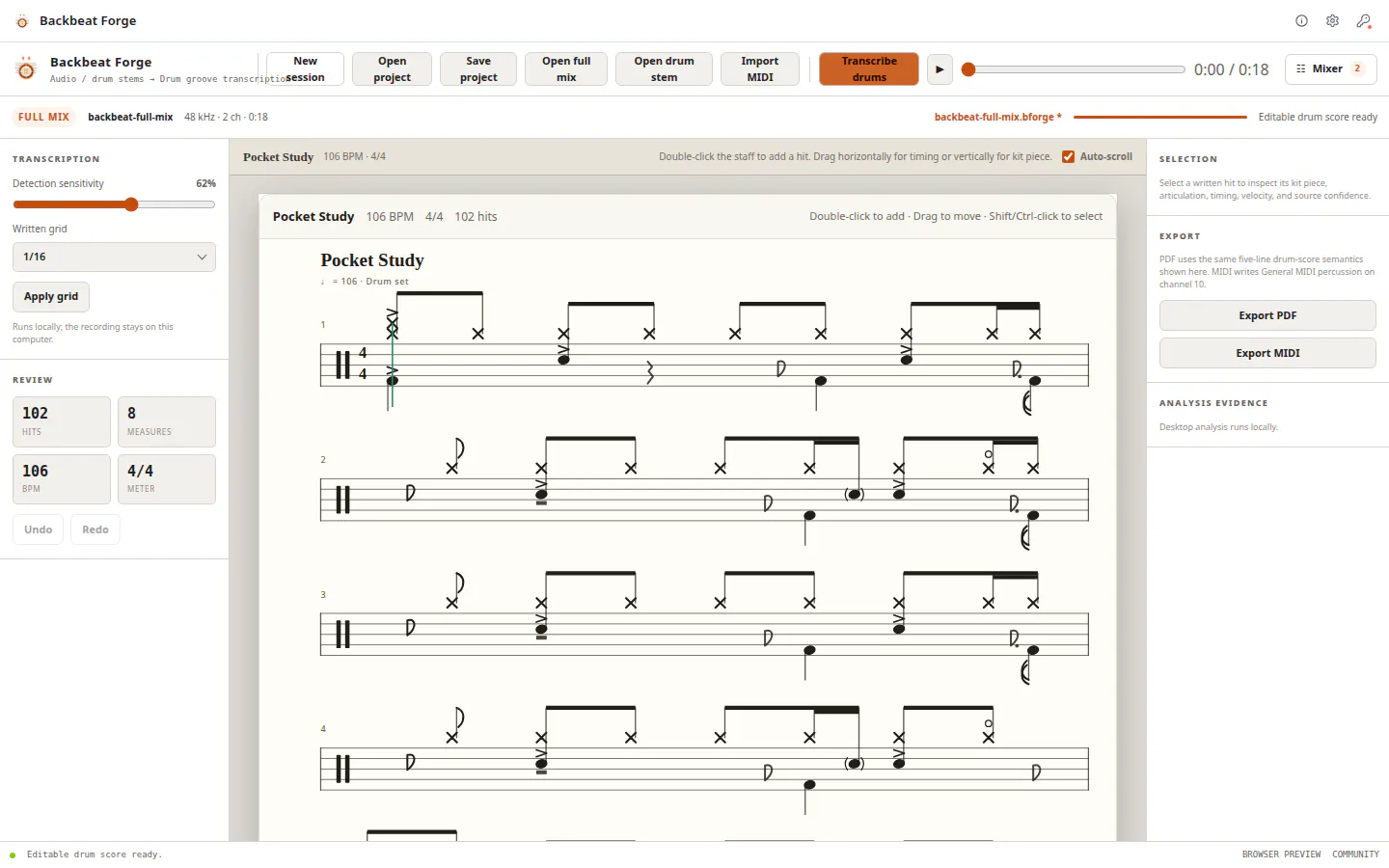
Drop in a full mix or an isolated drum stem. Backbeat Forge puts the performance on a five-line drum score you can check against playback and correct by hand. When the chart feels right, export it as a printable PDF or General MIDI file. It all runs locally.
AI Analysis
Backbeat Forge converts drum audio from full mixes or isolated stems into an editable five-line drum score. Users can verify against playback and make manual corrections before exporting as printable PDF or General MIDI. It runs entirely locally for privacy and offline access. Core features include AI transcription, interactive editing, and seamless export. It solves the pain of tedious, error-prone manual drum transcription for musicians. USP is its drum-specific focus, hand-correction workflow, and local processing without cloud dependency. Value proposition: transforms raw drum performances into professional, editable notation quickly and privately.
In 2025-2026, market timing is favorable due to maturing local AI models (e.g. on-device ML for audio), growing demand for AI-assisted music production tools amid rising content creation, and emphasis on data privacy reducing cloud reliance. Music tech trends favor specialized notation tools integrated with DAWs. Economic environment supports creative software with remote work and digital music booming. Excellent Timing.
High feasibility. Technical difficulty is moderate leveraging existing audio ML for beat/drum detection runnable locally (e.g. via established frameworks). Low development costs for a focused desktop tool, no supply chain or major compliance risks as pure software. Strong scalability as digital download/product. Main risk is transcription accuracy across genres; assumes competent AI/team fit. Overall strong potential with limited operational overhead.
Main segments: amateur/professional drummers, music producers, composers, and educators (ages 18-45, tech-savvy). Industries: music production, recording, education. Geographic: global with concentration in North America/Europe. Estimated market: music creation software TAM ~$2B, SAM for AI transcription tools ~$150M, SOM for drum-specific ~$20M. Core pain points: time-intensive inaccurate manual transcription of complex rhythms. Willingness to pay: medium-high for accurate, local tools (likely one-time purchase or freemium).
Medium. Direct competitors: 1. Celemony Melodyne (celemony.com), 2. Moises.ai (moises.ai), 3. iZotope RX (izotope.com), 4. Hit'n'Mix RipX (hitnmix.com), 5. Neuratron AudioScore (neuratron.com). Advantages: drum-specific five-line score focus, local-only processing for privacy/offline, intuitive hand-correction with playback. Disadvantages: narrower scope (drums only vs full audio/MIDI), newer product with potentially less ecosystem integration, unknown pricing vs established subscription models of competitors. Strong differentiation in targeted workflow but faces competition from general audio-to-MIDI tools.
Upgrade Pro to unlock full AI analysis
Similar Products
Dograh
The open source VAPI alternative
▲ 466 votes

VoiceOS App Store
The App Store for Your Voice.
▲ 263 votes
Wispro
Stop typing, start talking, get perfectly written text
▲ 135 votes
Clarity
Mute the room, keep the speaker, in real time
▲ 78 votes
Patchcord
Studio sound for your mic in every Mac meeting with EQ
▲ 64 votes

AutoChart.eu
Turn any song into a full-band chart for YARG and Clone Hero
▲ 0 votes