
Cilantro
Watches your accounts and tells you what changed
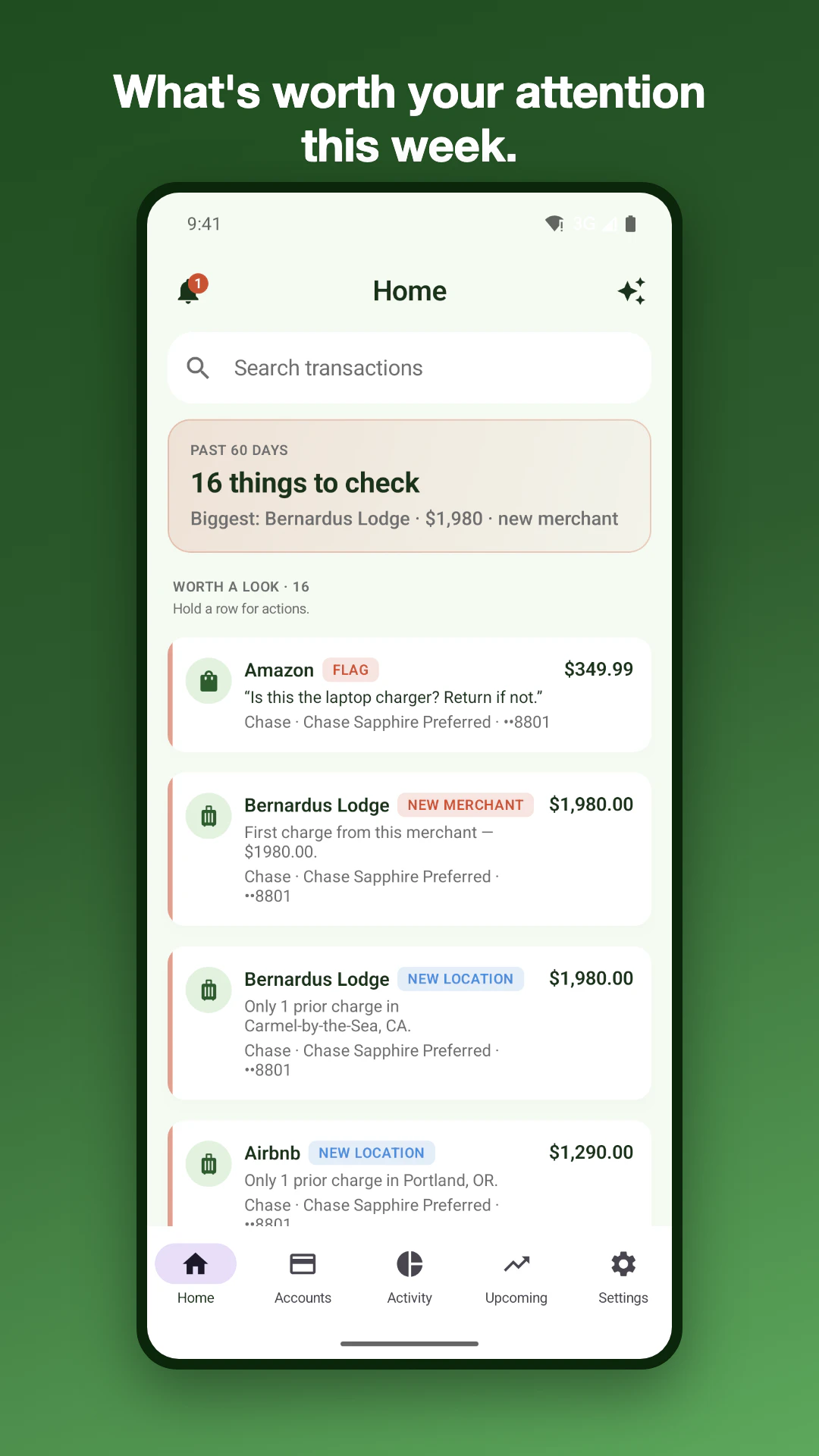
Connect your bank accounts once and Cilantro does the watching - odd charges, bill creep, auto-detected trip recaps, and a weekly "here's what changed." No budgets, no tagging. Works solo, better with a partner. Read-only, no ads, no data sales.
AI Analysis
Cilantro is an iOS fintech app that connects read-only to users' bank accounts to passively monitor activity. Core features include alerts for odd charges and bill creep, auto-detected trip recaps, and weekly 'what changed' summaries. It solves key pain points like unnoticed fees, manual tracking fatigue, and lack of financial visibility without requiring budgets, transaction tagging, or heavy user input. USPs include strong privacy (no ads, no data sales), seamless solo or couple usage, and effortless insights. The value proposition is simple, hands-off financial awareness and peace of mind in a world of complex subscriptions and spending.
In 2025-2026, market timing is favorable due to maturing open banking APIs, rising AI-driven personalization in fintech, and growing consumer frustration with subscription creep and inflation-driven hidden fees. User demand is shifting toward passive, low-effort tools rather than complex budgeting apps. Economic uncertainty increases desire for better account oversight, while privacy concerns post-data scandals boost read-only solutions. Overall, this aligns well with trends. Rating: Excellent Timing.
Overall feasibility is Medium. Technical integrations with bank APIs (e.g. Plaid) are established but require ongoing maintenance as APIs change. iOS app development is straightforward with moderate costs. High compliance and regulatory risks in fintech (data security, financial regs) despite read-only access; potential supply chain risks if relying on third-party APIs. Scalability is good as a SaaS tool with low marginal costs. Team needs fintech experience for success. Key challenges are regulatory hurdles and API reliability.
Main target segments: Tech-savvy millennials and Gen Z (25-40 years old), middle-to-upper income individuals and couples in the US who use iOS devices and seek simple finance tools. Geographic focus: Primarily United States due to bank connectivity. Estimated market size: TAM for personal finance apps ~$2B+, SAM for automated monitoring tools ~$500M, SOM for this passive niche ~$50M. Core pain points: Overwhelm from manual tracking, surprise charges, and bill creep. Potential willingness to pay: Moderate to high for a privacy-first, effortless subscription (~$4-10/month).
Competition level: Medium. Direct competitors: 1. Rocket Money (rocketmoney.com) - subscription tracking and cancellation. 2. Monarch Money (monarchmoney.com) - comprehensive budgeting and net worth tracking. 3. Copilot (copilot.money) - AI-powered money management. 4. YNAB (youneedabudget.com) - proactive budgeting tool. 5. Simplifi (simplifimoney.com) - by Quicken, focuses on spending insights. Advantages: Far more passive (no tagging/budgeting), unique weekly change digests and trip recaps, strong privacy emphasis. Disadvantages: Less comprehensive features, potentially narrower integrations, iOS-focused which limits audience compared to cross-platform rivals.
Upgrade Pro to unlock full AI analysis
Similar Products

Equitybee Benchmark
Compare your startup equity grant for free.
▲ 218 votes

Orus
Claude for investing in perpetuals
▲ 121 votes

Loot
Collect your favorite things in real life
▲ 115 votes

Open Finance MCP
Access your bank data in ChatGPT & Claude via Open Finance
▲ 100 votes

Mirlo
Social media for real connections. No likes, no algorithm.
▲ 94 votes

Poke Battle Announcer
Give your Pokémon Champions battles a live announcer
▲ 64 votes