
Dental Scope
Explore dental anatomy in 3D, tooth by tooth
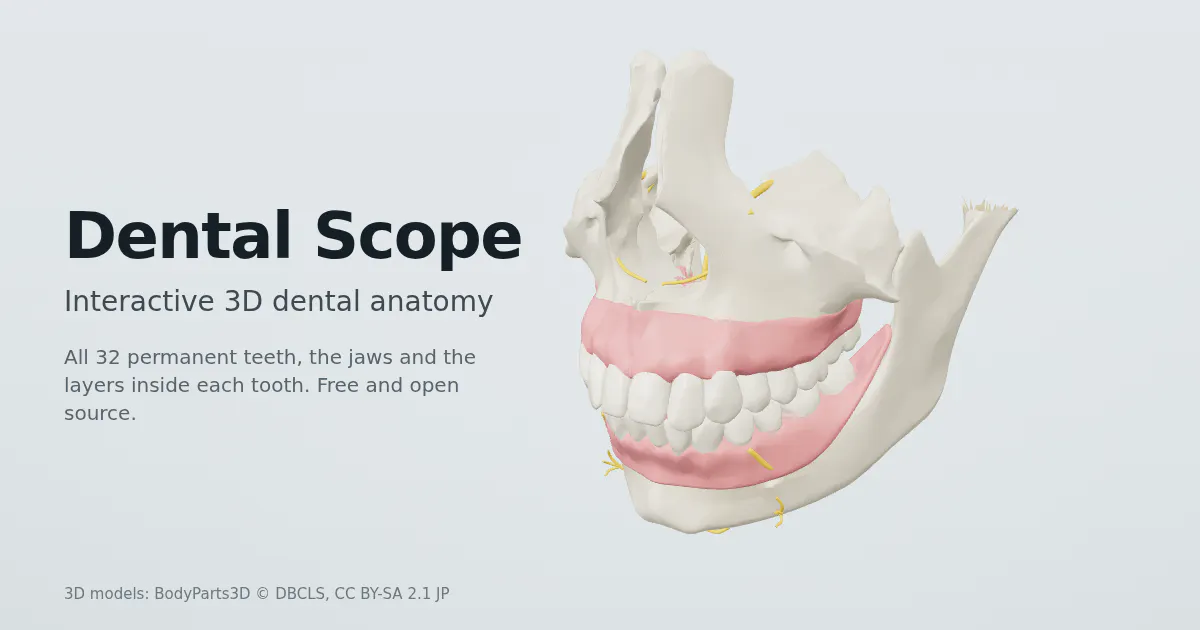
Dental Scope is a free, open source 3D dental learning tool for exploring teeth and surrounding structures in detail. Explore all 32 permanent teeth, switch between FDI, Universal and Palmer numbering systems, and study structures from enamel and dentin to pulp, root canals, jaws, nerves and vessels.
AI Analysis
Dental Scope is a free, open-source 3D dental learning tool for exploring all 32 permanent teeth and surrounding structures including enamel, dentin, pulp, root canals, jaws, nerves, and vessels. Core features include interactive visualization and switching between FDI, Universal, and Palmer tooth numbering systems. It solves key pain points in dental education such as difficulty understanding complex 3D anatomy from static 2D textbooks or images. USP is its accessibility as a completely free GitHub-hosted open source project enabling collaborative development. Overall value proposition is delivering an immersive, detailed, and cost-free way to enhance dental anatomy learning for students and professionals.
For 2025-2026, timing is favorable with maturing web-based 3D technologies, rising demand for interactive digital tools in healthcare education, increased adoption of self-paced remote learning post-pandemic, and growing support for open-source educational resources amid budget constraints in training. These trends align well despite general economic uncertainties. Rating: Excellent Timing.
High feasibility overall. Technical difficulty is medium as it requires specialized 3D modeling of accurate dental anatomy and graphics programming, but open-source tools and community contributions lower barriers. Development and operation costs are low due to its free open-source model on GitHub. Minimal supply chain or compliance risks for a non-medical device educational tool. Strong scalability as a web/digital platform with good team fit for developers with anatomy/3D expertise. Key risks are maintaining model accuracy and user adoption.
Main target segments: dental/medical students (ages 18-35), dental educators, and practicing dentists, distributed globally with concentration in US, Europe, China, India, and other countries with strong dental programs. Estimated market size: TAM for digital health/medical education tools in billions USD, SAM for 3D anatomy visualization in hundreds of millions, SOM for dental-specific tools in tens of millions. Core pain points: poor spatial comprehension of tooth structures and relations from traditional methods. Potential willingness to pay: high among institutions for premium features, but students strongly favor free solutions like this.
Medium. Direct competitors: 1. Complete Anatomy (3d4medical.com), 2. Visible Body (visiblebody.com), 3. BioDigital (biodigital.com), 4. Anatomy.tv (anatomy.tv). This product's advantages include being free/open-source, highly focused on dental anatomy with support for multiple numbering systems (FDI/Universal/Palmer), and detailed tooth-by-tooth exploration. Disadvantages: likely narrower scope (teeth only vs full anatomy), potentially fewer interactive features/quizzes/polish compared to established commercial platforms that charge subscriptions.
Upgrade Pro to unlock full AI analysis
Similar Products

Paradigm
Turn any goal into a personalized, adaptive learning path.
▲ 464 votes

CodeBurn
See where your AI coding spend actually goes
▲ 101 votes

Juggler
A visual AI coding harness
▲ 94 votes

gg-friggin-ez
Fast, cheap profanity and toxicity screening via Jev & Laya
▲ 88 votes

Blop
Describe your app and Blop tests it and repairs broken tests
▲ 80 votes

Prowler Cloud
Where your AI agent becomes a cloud security defender
▲ 64 votes