
Dictoterix
Language learning service built around the dichotic method
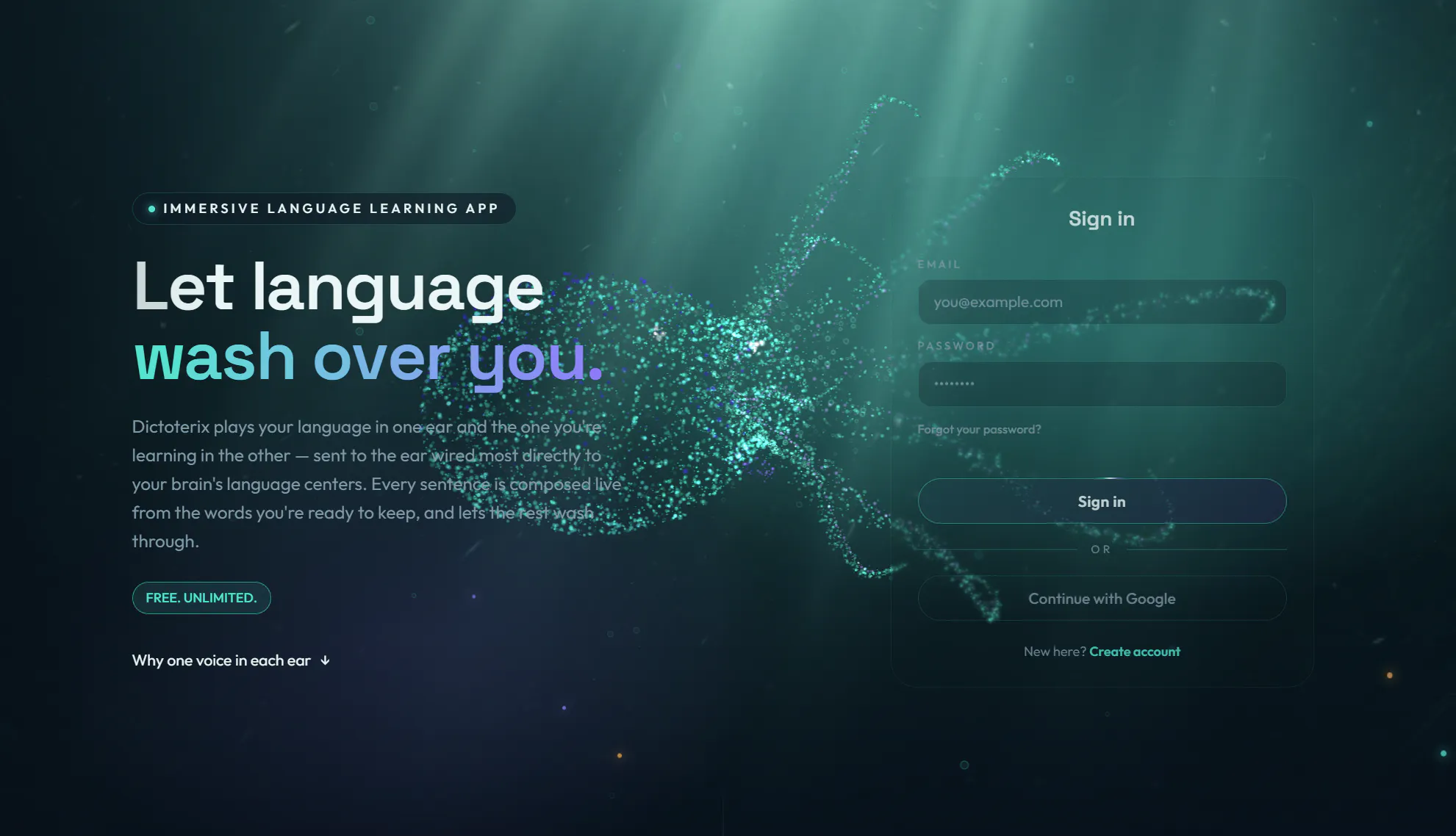
Dictoterix is the first online learning service built end-to-end around the bilingual-dichotic method: your native language in one ear, the language you're learning in the other, at the same moment. Most apps teach “words”. The question that matters is which words — so every level in Dictoterix is measured against a reference inventory of what an A1–C1 learner actually needs. No card. No trial clock. It's just free.
AI Analysis
Dictoterix is a free web-based language learning service centered on the bilingual-dichotic listening method, playing the user's native language in one ear and the target language in the other simultaneously. It focuses on curating vocabulary aligned with real A1-C1 CEFR learner needs rather than generic words, eliminating flashcards, gamification, and trial limits. This solves key pain points like ineffective traditional apps that teach irrelevant content, poor listening immersion, and paywalls. The value proposition is accessible, neuroscience-inspired immersion that prioritizes practical language acquisition without barriers.
For 2025-2026, market timing is favorable due to rising global demand for language skills driven by remote work, international mobility, and AI-enhanced education trends. Audio and web tech for synchronized playback is mature, while users seek alternatives to gamified apps like Duolingo amid growing interest in evidence-based, neuroscience-backed methods. Economic factors support free tools. However, saturation in edtech could pose challenges. Rating: Excellent Timing.
Technical implementation via web app on Vercel is straightforward for audio syncing, but scaling high-quality bilingual dichotic content across languages and CEFR levels requires substantial recording/TTS investment and curation effort, increasing development and operational costs. No mentioned supply chain issues; compliance for education apps is manageable. Scalability is strong digitally, but free model raises long-term sustainability questions without clear monetization. Team with language and audio expertise would fit well. Rating: Medium.
Primary segments: Adults 18-40 interested in self-paced language learning, including students, professionals, expats, and travelers; strong interest from non-English speakers learning English and vice versa. Geographically global with concentration in Europe, East Asia, and North America. Language learning market TAM exceeds $50B, with online digital segment SAM around $15B; SOM for specialized audio methods estimated at several hundred million. Core pains: Ineffective listening practice and mismatched vocabulary. Users show high willingness to pay for proven tools, though free access broadens appeal.
Competition level: Medium. Direct competitors: Duolingo (duolingo.com), Babbel (babbel.com), Rosetta Stone (rosettastone.com), Pimsleur (pimsleur.com), LingQ (lingq.com). Advantages: Novel dichotic simultaneous listening, strictly CEFR-aligned essential vocab, completely free with no ads/trials, avoids flashcard fatigue. Disadvantages: Lacks community features, progress tracking depth, or broad language support compared to giants; method is less known and may require user education to prove superior efficacy over established audio programs.
Upgrade Pro to unlock full AI analysis
Similar Products

Fuzzy AI
We warm your prospects before reaching out
▲ 527 votes

Paradigm
Turn any goal into a personalized, adaptive learning path.
▲ 464 votes

Cito
Hybrid academic search over 236M papers, built for agents
▲ 107 votes

FableWatch
Know the second Fable 5 is back
▲ 75 votes

Inbix
Cloudflare-native Email Infrastructure for Developers
▲ 73 votes

Hyperdream
The Cursor of AI filmmaking
▲ 66 votes