
Emdash
One app. Every coding agent. Open-source.
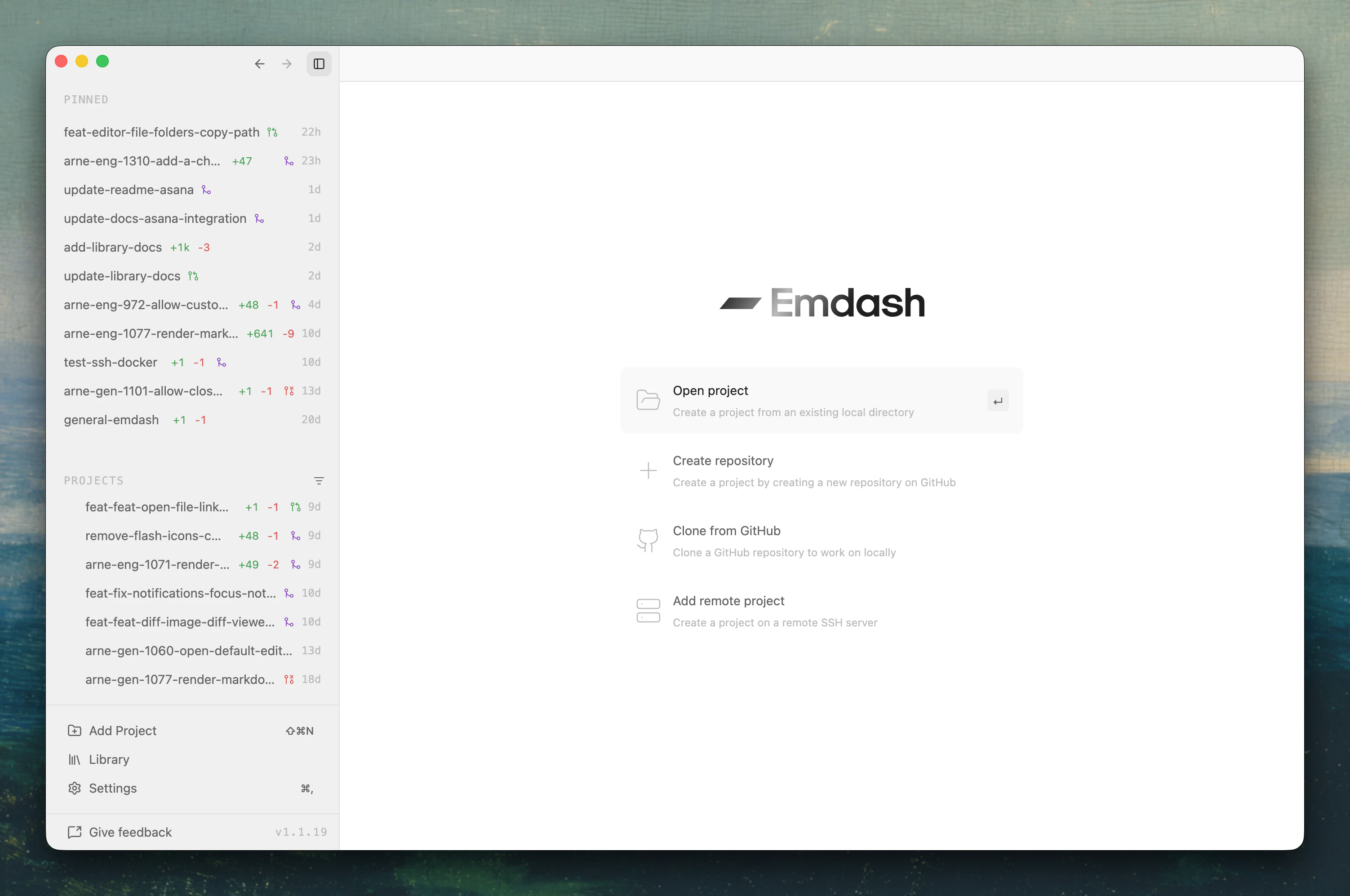
Emdash is an open-source desktop app for running multiple coding agents in parallel; one place to monitor sessions, review diffs, and turn issues into PRs.
AI Analysis
Emdash is an open-source desktop app that unifies multiple AI coding agents, enabling parallel execution in one interface. Core features include session monitoring, diff reviews, and converting issues directly into GitHub PRs. It solves key developer pain points like fragmented tool management, inefficient oversight of AI sessions, and slow workflows from issue to code deployment. The USP is its all-in-one, open-source approach to AI agent orchestration, boosting productivity without vendor lock-in. Overall value proposition: Streamlined AI-assisted coding for faster development cycles.
Favorable in 2025-2026 due to surging adoption of AI coding agents, maturing LLM technologies, and rising demand for integrated developer productivity tools. Industry trends favor multi-agent orchestration amid GitHub and open-source growth. User demands are shifting toward efficient parallel AI workflows. Economic environment supports AI investment in tech. Excellent Timing.
High feasibility. Technical difficulty is moderate using existing desktop frameworks (e.g., Electron/Tauri) and AI API integrations; open-source model reduces costs via community contributions. Low supply chain/compliance risks for a desktop app. Strong scalability potential with parallel processing. Main risks involve maintaining compatibility with rapidly evolving AI agent APIs. Team fit is good for developer-focused open-source projects.
Primary users: Software developers, full-stack engineers, open-source contributors, and dev teams (ages 25-40, tech-savvy). Industries: Software development, IT services. Geographic: Global, concentrated in US, Europe, China tech hubs. TAM for AI developer tools ~$5-10B by 2026; SAM for agent management ~$500M; SOM for open-source desktop segment ~$50M. Core pains: Managing disparate AI coding tools and slow PR cycles. High willingness to pay for pro features despite open-source base.
Medium. Direct competitors: 1. OpenDevin (github.com/OpenDevin/OpenDevin), 2. Aider (aider.chat), 3. Continue.dev (continue.dev), 4. Cursor (cursor.com), 5. GitHub Copilot Workspace (github.com). Advantages: True parallel multi-agent support in one open-source desktop app, seamless issue-to-PR flow, strong GitHub integration. Disadvantages: Newer entrant may lack maturity/polish; desktop-only vs integrated editors; potential performance overhead in parallel runs compared to specialized single-agent tools.
Upgrade Pro to unlock full AI analysis
Similar Products

Adapt
The company brain that gets work done
▲ 124 votes

Replay QA Security Scan
Automated Penetration Testing for AI-Built Apps
▲ 102 votes
Kosshi
Simple, fast outliner for Mac and iPhone.
▲ 90 votes

WikiFix for Confluence
Find and fix issues in your knowledge base
▲ 86 votes

Audryo
Customer email your agent can operate.
▲ 68 votes
Refoid
Automate App Store refund responses and track every outcome
▲ 68 votes