
Keiki
Build one customer-facing AI agent and launch it everywhere
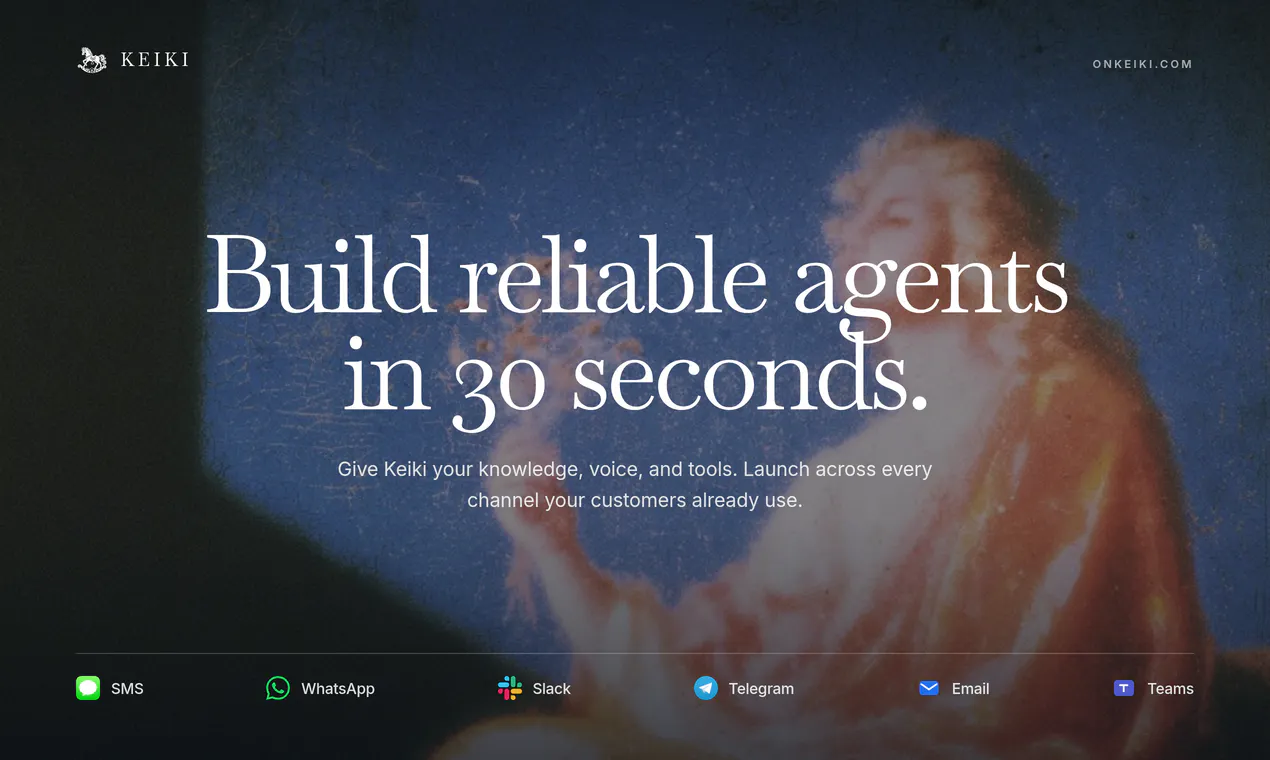
Build one customer-facing AI agent and launch it across SMS, iMessage, WhatsApp, Slack, Telegram, and email. Give it your knowledge, memory, voice, tools, and boundaries so it can answer questions, use business systems, complete work, and hand off when human judgment is needed. Keiki runs the shared infrastructure behind every channel and gives you one place to inspect conversations, approve sensitive actions, and improve the agent over time.
AI Analysis
Keiki enables building one customer-facing AI agent deployable across SMS, iMessage, WhatsApp, Slack, Telegram, and email. Core features include custom knowledge base, conversation memory, voice support, tool integrations for business systems, operational boundaries, and seamless human handoff. It addresses pain points of fragmented multi-channel bot management, inconsistent customer experiences, and lack of unified oversight. The unified infrastructure allows inspecting conversations, approving actions, and iteratively improving the agent. USP is 'build once, launch everywhere' with centralized control, delivering efficient automation, reduced support costs, and scalable customer engagement.
In 2025-2026, market timing is favorable due to maturing LLM and multi-modal AI tech, surging demand for automated customer service amid rising labor costs, and widespread adoption of messaging platforms. Industry trends favor omnichannel AI agents as businesses seek efficiency. Economic environment supports AI investment for ROI in support ops. Policy focus on AI ethics may add compliance needs but doesn't hinder growth. Excellent Timing.
Technical difficulty is medium-high due to complex integrations with diverse channel APIs (esp. iMessage), reliable memory systems, voice synthesis, and secure tool use. Dev/operation costs are significant for LLM inference, infrastructure, and monitoring. Compliance risks around data privacy (GDPR, CCPA) for customer messages are notable. Strong scalability potential via cloud. Team needs AI and integration expertise. Overall: Medium. Supported by leveraging existing APIs but challenged by cross-platform consistency and AI hallucination management.
Main targets: SaaS companies, e-commerce brands, customer support teams, and developers in tech/retail/finance sectors. Demographics: Mid-market to enterprise ops managers, aged 25-45, tech-savvy. Geographic: Global with strong US/Europe (iMessage/Slack) and emerging markets (WhatsApp). TAM for AI customer service ~$20B by 2026; SAM for multi-channel agents ~$3B; SOM ~$300M. Core pains: High support ticket volume, channel fragmentation, training multiple bots. High willingness to pay via subscriptions for cost savings and efficiency gains.
Competition level: Medium. Direct competitors: 1. Intercom (intercom.com) with Fin AI, 2. Zendesk (zendesk.com) AI agents, 3. ManyChat (manychat.com), 4. Voiceflow (voiceflow.com), 5. Botpress (botpress.com). Advantages: True single-agent multi-channel (incl. iMessage/email), built-in memory/voice/boundaries, unified inspection & improvement dashboard. Disadvantages: Likely higher learning curve, newer so less proven enterprise reliability and integrations vs. incumbents; pricing unknown but may compete on flexibility. Strong differentiation in 'build once, launch everywhere' approach reduces competition pressure somewhat.
Upgrade Pro to unlock full AI analysis
Similar Products

Cohere Parse 5
Turn complex docs, tables & images into AI-ready data
▲ 158 votes

Cercle
The bat signal for your closest friends.
▲ 121 votes

Orus
Claude for investing in perpetuals
▲ 121 votes

WikiFix for Confluence
Find and fix issues in your knowledge base
▲ 86 votes

Audryo
Customer email your agent can operate.
▲ 68 votes

Refoid
Automate App Store refund responses and track every outcome
▲ 68 votes