
Linguar
Language exchange with real people — and AI on your side
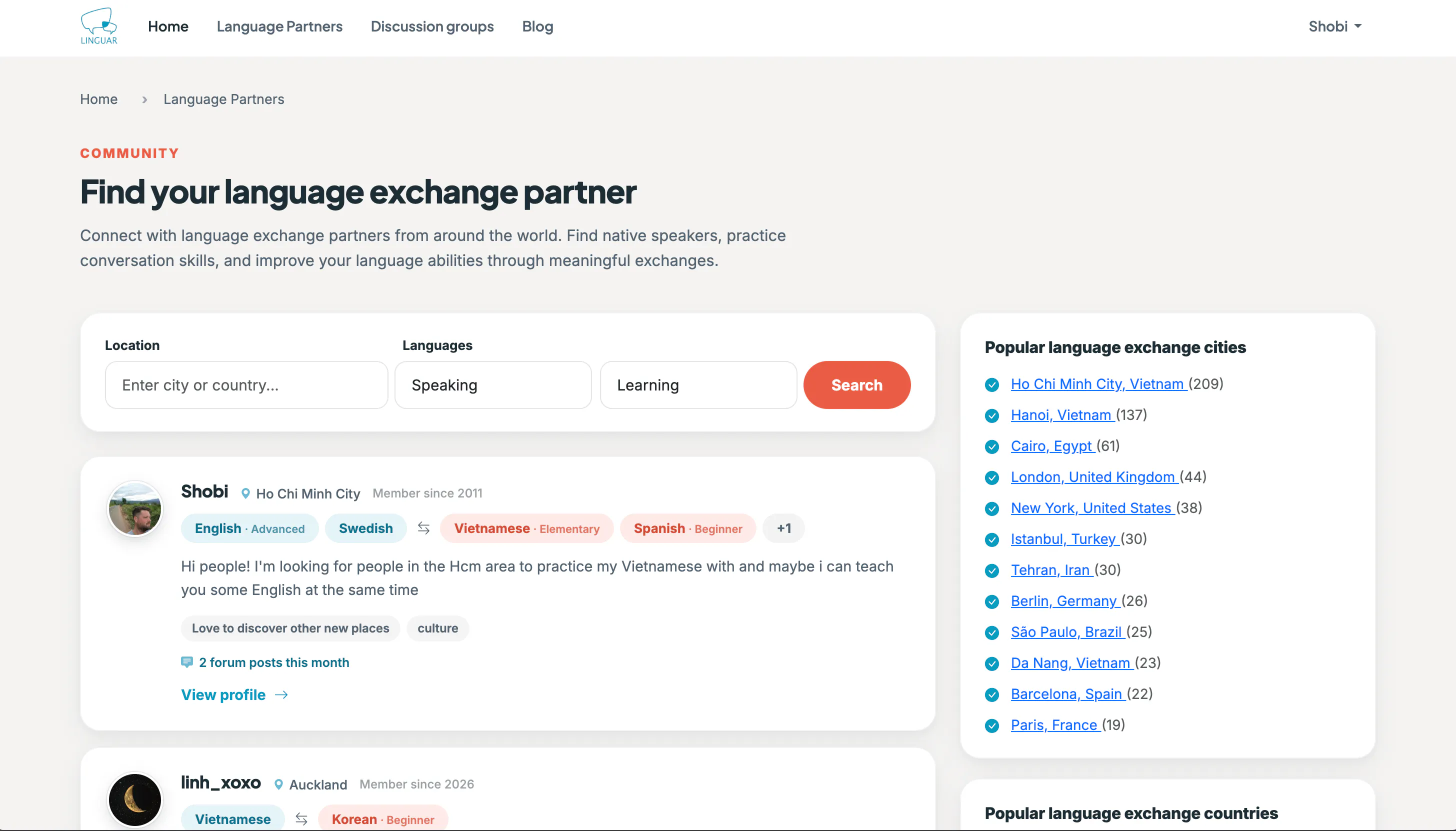
Linguar pairs you with a tandem partner — you're learning their language, they're learning yours. Text, voice, and video are built in, with AI on your side: inline translations and explanations without leaving the chat. Highlight any word or correction and it becomes a spaced-repetition flashcard. Unlike lesson apps, everything you learn comes from real conversations with a real person. Free to use, built by a solo founder learning Vietnamese in Ho Chi Minh City.
AI Analysis
Linguar connects users with tandem language partners for mutual learning through built-in text, voice, and video chats. Core features include AI-powered inline translations, explanations, and automatic conversion of corrections into spaced-repetition flashcards. It solves key pain points like lack of structured support in casual language exchanges and poor retention from real conversations without tools. Unlike lesson-based apps, learning emerges organically from authentic interactions with real people. The value proposition is effective, contextual language acquisition enhanced by AI, offered completely free by a solo founder.
The current market timing for 2025-2026 is favorable. AI integration in education is maturing rapidly with accessible LLMs enabling real-time assistance. User demand is shifting from gamified solo apps toward authentic conversational practice amid globalization, remote work, and emphasis on soft skills. Economic recovery supports edtech investment, and policies promoting multilingualism in regions like Southeast Asia align well. Excellent Timing.
Overall feasibility is Medium. Technical difficulty includes real-time comms (WebRTC), AI API integration for translations and NLP-based flashcards, and a reliable matching algorithm. Development/operation costs are manageable for a solo founder initially but rise with video bandwidth, AI usage fees, and moderation. Low supply chain risk but compliance with privacy laws (GDPR) and content safety are concerns. Scalability is promising with network effects, and founder domain knowledge (learning Vietnamese) fits well. Rating: Medium.
Main target segments: 18-35 year old language enthusiasts, students, professionals, expats and digital nomads interested in conversational practice, with focus on languages like English, Vietnamese, Spanish. Geographically global but strong in urban Asia, Europe, and Americas (e.g. Ho Chi Minh City expats). Language learning app market TAM exceeds $15B, SAM for social exchange ~$2B, SOM for AI-enhanced ~$500M. Core pain points: finding consistent partners, retaining vocab from unstructured chats, and lack of instant help. Potential willingness to pay is moderate for premium features like advanced AI or better matching.
Competition level: Medium. Direct competitors: 1. Tandem (tandem.net), 2. HelloTalk (hellotalk.com), 3. Busuu (busuu.com), 4. Speaky (speaky.com), 5. Slowly (slowly.app). Advantages vs competitors: seamless AI inline support and automatic SRS flashcards derived from real chats (deeper integration than most); pure focus on exchange without forced lessons. Disadvantages: smaller initial user base as a new solo-developed product; competitors have larger communities, more established moderation, and freemium models with extra features that may drive revenue and retention.
Upgrade Pro to unlock full AI analysis
Similar Products

Paradigm
Turn any goal into a personalized, adaptive learning path.
▲ 464 votes
Nitro 4.0
The first human translation platform built for AI agents
▲ 218 votes

Build Club Campus
Virtual AI School: Upskill in AI and Become Great at it Fast
▲ 173 votes

Yomi
A little cat who loves being read to
▲ 134 votes

WebTerm Learn
Learn the terminal like a game — in a browser sandbox
▲ 127 votes
looquee
Copilot for college applications
▲ 58 votes