
Lumina
Stop Feeling Like a Fraud. Start Owning Your Success.
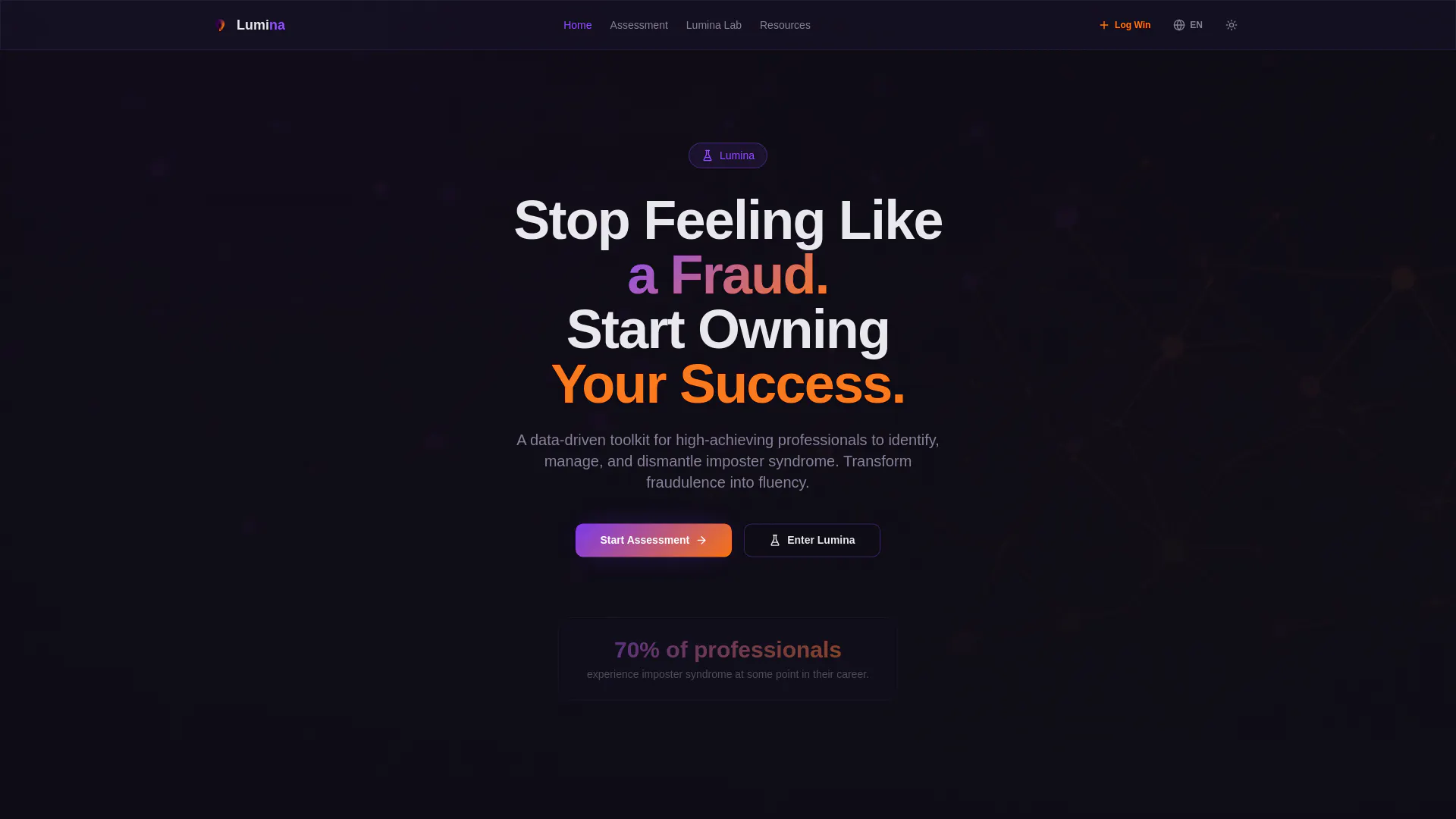
A data-driven toolkit for professionals to identify, manage, and dismantle imposter syndrome. Transform fraudulence into fluency.
AI Analysis
Lumina is a data-driven toolkit for professionals to identify, manage, and dismantle imposter syndrome. It offers assessments, progress tracking, personalized insights, and practical strategies to convert self-doubt into confidence. Core pain points addressed include persistent feelings of fraudulence despite achievements, especially in remote work, education, and writing. Its USP lies in the evidence-based, fluency-focused approach that empowers users to own their success and transform fraudulence into professional fluency.
Favorable in 2025-2026 due to rising mental health awareness post-pandemic, increased remote work causing isolation and self-doubt, maturing AI for personalized data insights, and workplace focus on employee well-being. Economic uncertainty heightens the need for confidence tools. Excellent Timing.
High. Technical implementation as a SaaS with data analytics is straightforward with current AI/ML tools. Moderate development and operation costs. Standard privacy compliance risks exist but are manageable. Strong scalability as a digital product with low supply chain issues. Fits well for teams experienced in edtech or wellness apps.
Primary segments: Professionals aged 28-45 in remote work, education, and writing/creative fields; high-achievers experiencing self-doubt (often women in tech/academia). Mainly English-speaking users in US, UK, Europe. TAM for mental wellness apps ~$6B+, SAM for imposter syndrome solutions ~$300-500M, SOM ~$15-30M. Pain points: fear of being exposed as fraud, hindered career growth. Moderate to high willingness to pay for proven results via subscription.
Medium. Direct competitors: BetterUp (betterup.com), Wysa (wysa.com), Woebot (woebothealth.com), Reflectly journaling app, and Udemy imposter syndrome courses. Advantages: highly specific data-driven focus on imposter syndrome with toolkit for fluency vs. general mental health. Disadvantages: newer player with less brand awareness, may have higher pricing perception and fewer established case studies compared to scaled coaching platforms.
Upgrade Pro to unlock full AI analysis
Similar Products

Paradigm
Turn any goal into a personalized, adaptive learning path.
▲ 464 votes

Kosshi
Simple, fast outliner for Mac and iPhone.
▲ 90 votes

Thoughts for Mac
Capture notes from your menubar using text, images or voice
▲ 90 votes

LayerProof Kraft
Co-write insightful long form content
▲ 84 votes

Keyboard Copilot
AI keyboard that rephrases, translates, and more in any app
▲ 73 votes
looquee
Copilot for college applications
▲ 58 votes