
Opyt
Turn what you follow on X and Substack into a knowledge base
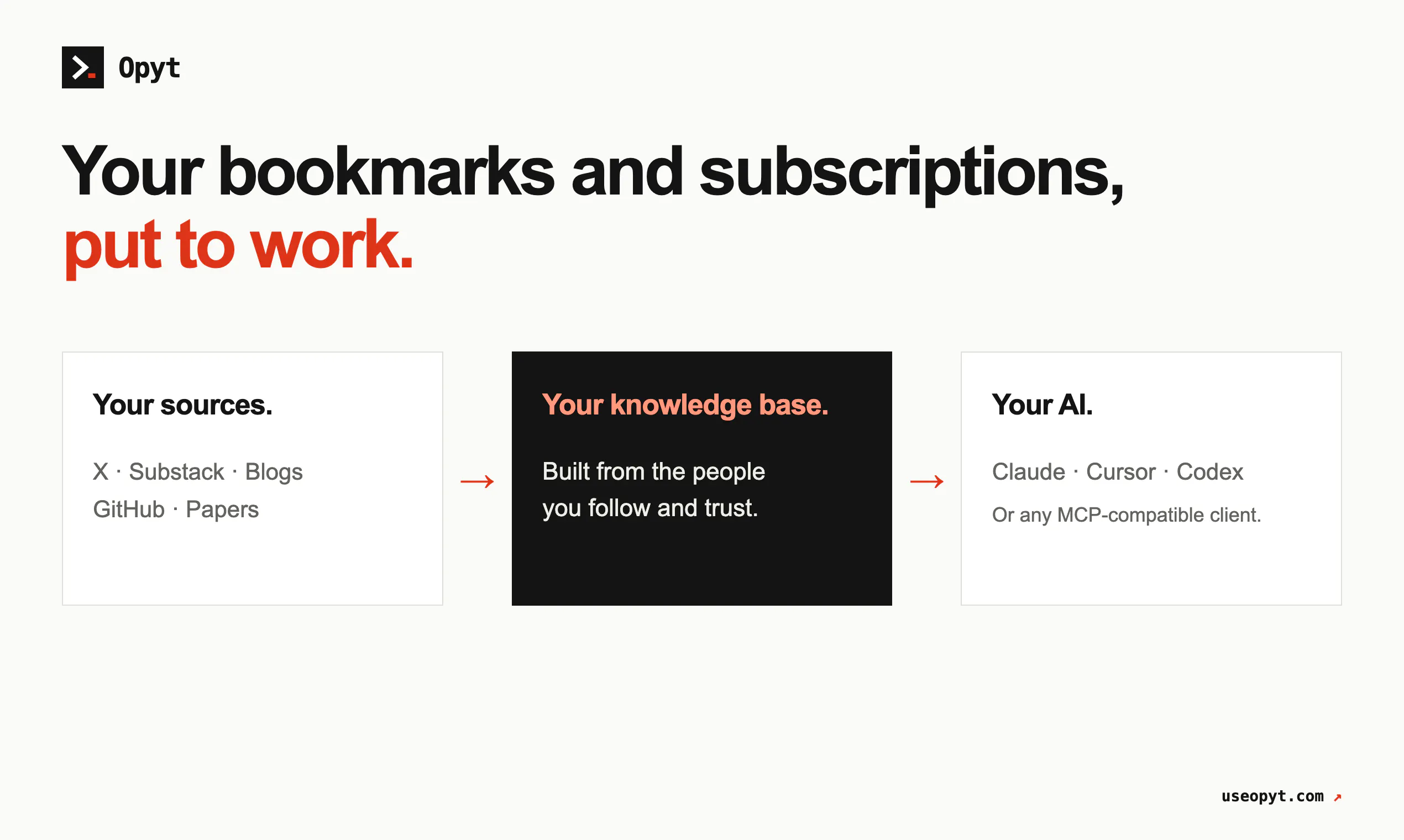
Opyt turns the people and topics you already follow into a knowledge base. Point it at your X bookmarks, Substack subscriptions, blogs, GitHub repos or arXiv papers, and it pulls in their archives. It reads a topic through, writes its own follow-up questions, and keeps looking for new work that builds on what you've collected. Share what your knowledge base, keep exploring, and let your AI read it all. Free, MIT licensed, and your knowledge base can stay local.
AI Analysis
Opyt turns what you follow on X, Substack, blogs, GitHub repos, or arXiv papers into a dynamic personal knowledge base. It imports archives from X bookmarks and subscriptions, reads through content, autonomously generates follow-up questions, and seeks new related works. Users can share knowledge bases, continue exploration, and leverage AI to process everything. Core features include local-first operation for privacy, proactive research, and continuous updates. It solves pain points of information overload, fragmented content across platforms, and difficulty in connecting ideas from followed sources. USP: free, MIT-licensed open source, local storage option, and AI-driven evolving knowledge from existing follows. Value proposition: build an intelligent, self-improving knowledge companion from content you already consume.
The market timing is favorable for 2025-2026. With maturing LLM and agentic AI technologies, rising demand for AI-powered personal knowledge management, and trends toward local/privacy-focused tools amid data privacy regulations, Opyt aligns well. User needs to synthesize scattered content from social media and newsletters are increasing. Open-source AI tools are gaining traction economically. This represents Excellent Timing as core tech for semantic analysis and autonomous research has reached practical maturity without being oversaturated.
Overall feasibility is High. Technical difficulty is manageable using existing LLMs, scrapers, and vector databases; local operation minimizes compliance and cloud costs. As an MIT-licensed open-source project, it benefits from community support lowering development costs. Scalability is strong for personal use with potential for growth. Low supply chain risks as a pure software tool. Team fit is suitable for indie/open-source developers experienced in AI integrations. Main risks are API dependencies if not fully local and content scraping reliability.
Primary target segments: researchers, software developers, academics, analysts, and content creators (ages 25-45, tech-savvy) who heavily use X/Twitter and Substack for staying updated. Industries: tech, science, AI/ML, journalism. Geographic focus: global, with high adoption in North America, Europe. TAM for AI knowledge tools ~$2B by 2026, SAM for PKM ~$500M, SOM for this niche ~$50M. Core pain points: managing high-volume incoming content, discovering connections, and avoiding knowledge rot. Willingness to pay: moderate; users may pay for cloud hosting, advanced AI models, or collaboration features despite current free model.
Competition level: Medium. Direct competitors: 1. Mem (mem.ai) - AI knowledge workspace; 2. NotebookLM (notebooklm.google.com) - document synthesis tool; 3. Reflect (reflect.app) - networked notes with AI; 4. Obsidian (obsidian.md) - extensible local knowledge base; 5. Tana (tana.inc) - flexible outliner with AI. Advantages vs competitors: deeply integrated with X bookmarks/Substack/GitHub/arXiv, proactive autonomous questioning and discovery, fully local and open-source (free vs many paid tools). Disadvantages: potentially less polished UI, narrower initial source focus, may require more setup than all-in-one commercial alternatives, limited marketing reach as indie project.
Upgrade Pro to unlock full AI analysis
Similar Products

NanoKVM-Go
Give your AI agent physical control over any screen
▲ 110 votes

CodeBurn
See where your AI coding spend actually goes
▲ 101 votes

Juggler
A visual AI coding harness
▲ 94 votes

Recursi
Self improving vibe coding env with no API fees
▲ 92 votes
Blop
Describe your app and Blop tests it and repairs broken tests
▲ 80 votes

Stagent
Drive Claude Code through long tasks it would otherwise drop
▲ 58 votes