
Overly
Search and ask questions inside lecture videos
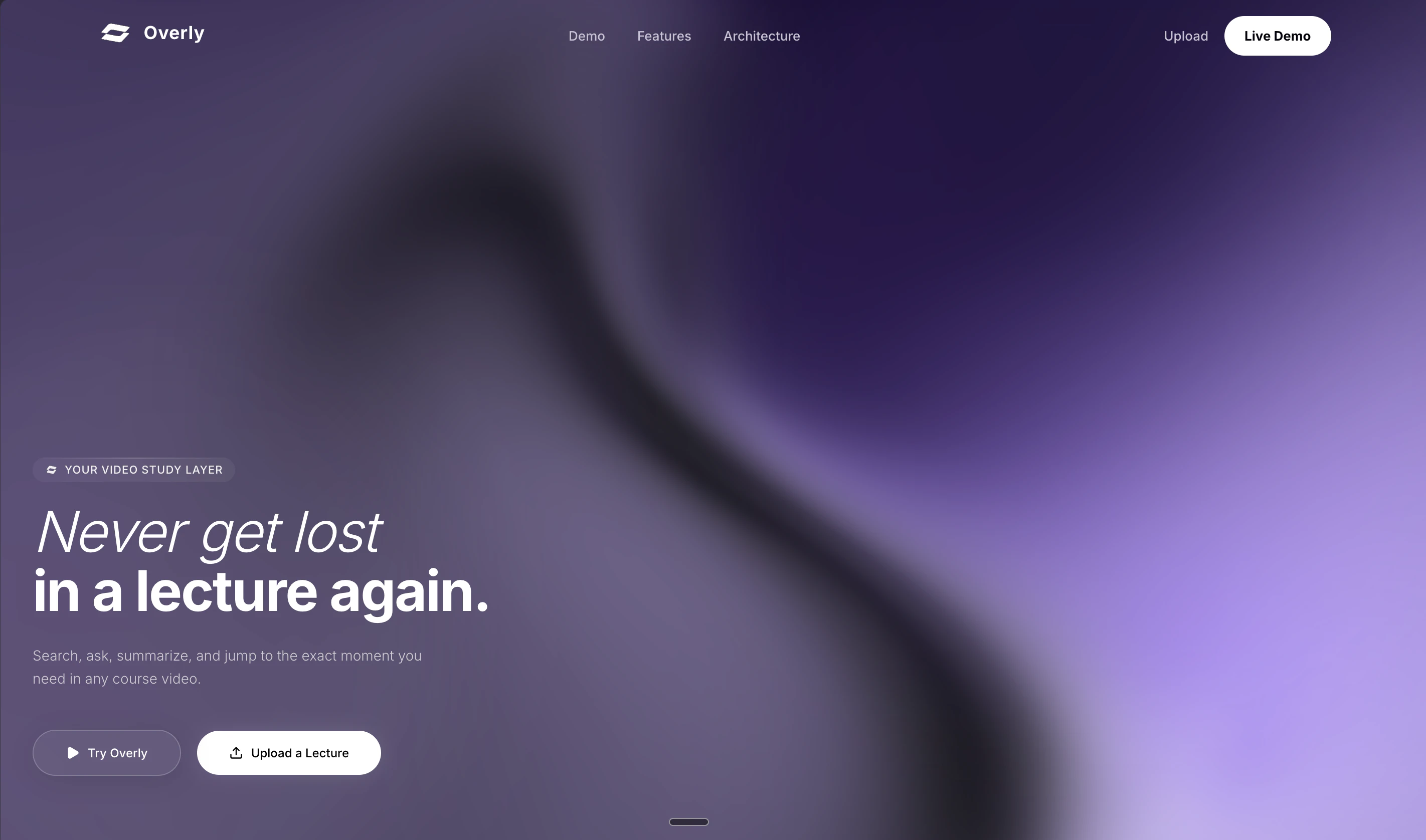
Overly is an AI-powered study layer for lecture videos. Students can search inside long lectures, ask questions, generate summaries, and jump to the exact timestamp where a topic is explained. I built it during a hackathon after noticing how painful it is to revise from long recorded lectures. The MVP is working, tested by a few students, and documented.
AI Analysis
Overly is an AI-powered study layer for lecture videos, enabling students to search inside long lectures, ask questions, generate summaries, and jump directly to exact timestamps where topics are explained. It solves the major pain point of inefficient revision from lengthy recorded lectures by making video content interactive and searchable. The unique selling point is its specialized focus on educational videos with precise navigation and Q&A capabilities. Built as an MVP during a hackathon and tested by students, it offers significant value by boosting study efficiency and comprehension in education and tech fields.
The current market timing is favorable for 2025-2026. AI technologies for video understanding, transcription, and semantic search have matured significantly with models like advanced LLMs and multimodal AI. User demand is shifting towards efficient tools for online/hybrid education as video lectures proliferate on platforms like Zoom and YouTube. Economic pressures favor productivity-enhancing edtech solutions amid growing student enrollments in digital learning. Policy support for AI in education further aids adoption. Excellent Timing.
Overall feasibility is Medium. Technically achievable using existing tools like speech-to-text APIs, vector search, and LLMs for Q&A/summaries, as evidenced by the working MVP built in a hackathon. Development costs are relatively low initially, but operational expenses for video processing, storage, and AI inference could scale significantly. Potential compliance risks around student data privacy (e.g., GDPR/FERPA). Good scalability potential via cloud services, but requires a team experienced in AI and edtech for optimization. Key risks are cost management and accuracy of AI outputs.
Main target users are university and college students (ages 18-24) in education and tech-related fields, who frequently use recorded lectures for revision. Primarily English-speaking regions like US, UK, and other countries with high online learning adoption. TAM for global edtech is over $250B, with AI-powered learning tools SAM estimated at $20B+; SOM for lecture video AI niche could be $500M+. Core pain points: time wasted scrubbing through hours of video to find specific explanations. Potential willingness to pay is moderate via freemium model for premium AI features.
Competition level is Medium. Direct competitors: 1. StudyFetch (studyfetch.com) - AI lecture assistant for notes and tutoring. 2. Knowt (knowt.com) - AI-powered video to flashcards and summaries. 3. Summarize.tech (summarize.tech) - AI video summarization with timestamps. 4. NotebookLM (notebooklm.google) - Google's AI for synthesizing lecture content. 5. Glean (withyoutoo.com/glean). Advantages: Tight focus on timestamp-accurate search and interactive Q&A tailored for lectures, simple MVP validated with students. Disadvantages: Early-stage with limited brand awareness, smaller feature set and user base compared to more established tools, potential higher dependency on third-party AI APIs affecting pricing and reliability.
Upgrade Pro to unlock full AI analysis
Similar Products

Paradigm
Turn any goal into a personalized, adaptive learning path.
▲ 464 votes

Widgo
AI Sales rep for your website visitors
▲ 360 votes

Gaming services by IFTTT
Level up the way you play with Steam, Dota 2, and more
▲ 125 votes

React UI Kit V7
All the chat components you need. None of the complexity
▲ 115 votes

Coarena by Coasty
The arena where agents battle on real-world work
▲ 104 votes

AutoChart.eu
Turn any song into a full-band chart for YARG and Clone Hero
▲ 61 votes