
pixserp
Your LLM on the live web. One endpoint, ten answer shapes.
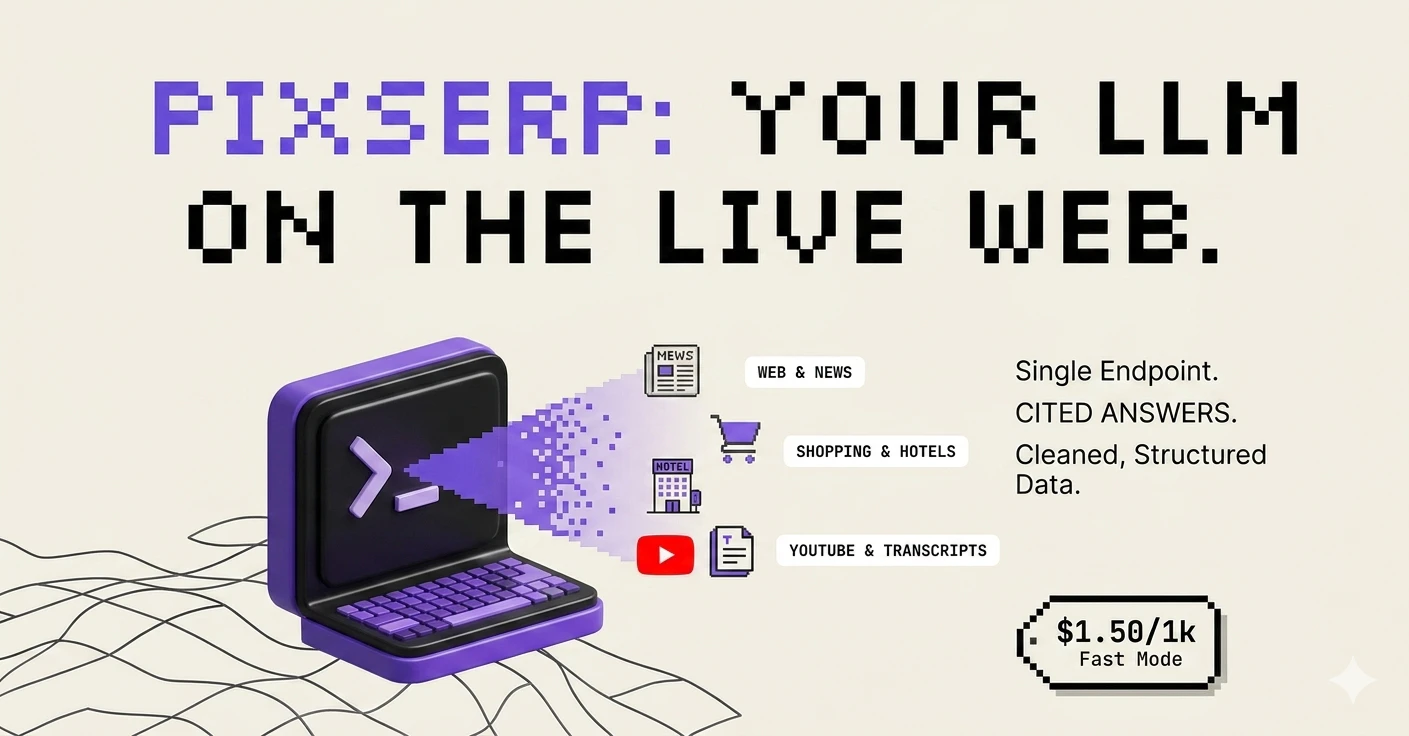
pixserp is the AI-native search engine for builders. One endpoint, ten live-web answer shapes — search, news, images, places, shopping, flights, hotels, YouTube, transcripts, any URL — cited by default. Drop-in for the OpenAI SDK. Flat $1.50 / 1k requests.
AI Analysis
pixserp is an AI-native search engine API for builders, offering one endpoint that delivers ten live-web answer shapes including search, news, images, places, shopping, flights, hotels, YouTube, transcripts, and any URL. Results are cited by default and it serves as a drop-in replacement for the OpenAI SDK with flat pricing of $1.50 per 1k requests. It solves key pain points for developers: integrating real-time web data into LLMs without hallucinations, managing multiple disparate APIs, and lacking structured, cited outputs. The value proposition is simplicity, versatility, and reliability for building AI applications that require current web intelligence.
The timing is favorable in 2025-2026 as LLM adoption explodes in applications and agents, driving massive demand for real-time, grounded web data to combat hallucinations. AI search and retrieval technologies have matured, user demand for cited answers is rising, and economic conditions support AI tool investment. Excellent Timing.
High. Technical implementation leverages existing search indexes, LLMs for formatting, and standard API frameworks, keeping difficulty manageable. Operational costs exist for web data access but are offset by flat pricing model. Scalability is strong via cloud infrastructure. Minor compliance risks around web data usage exist but are common in the sector. No complex supply chain issues.
Primary users are AI/ML engineers, indie hackers, and startups building LLM-powered applications (demographics: tech-savvy developers aged 25-40). Industries: AI software, SaaS, automation tools. Mainly US and Europe-based. TAM for AI search/retrieval APIs is part of the $50B+ AI infrastructure market; SAM ~$2B for web data APIs; SOM hundreds of millions for specialized SERP tools. Core pains: unreliable LLM outputs and integration complexity. High willingness to pay for seamless, cited real-time data.
Medium. Direct competitors: Tavily (tavily.com), Exa (exa.ai), SerpAPI (serpapi.com), Serper (serper.dev), Perplexity API. Advantages: unique 10 answer shapes from single endpoint, native OpenAI SDK drop-in, default citations, simple flat pricing. Disadvantages: newer player with potentially less brand recognition, may lack some depth in niche verticals compared to specialized competitors, and relies on underlying data quality.
Upgrade Pro to unlock full AI analysis
Similar Products

Auriko
Trading desk for LLM calls
▲ 332 votes
Nitro 4.0
The first human translation platform built for AI agents
▲ 218 votes

Cohere Parse 5
Turn complex docs, tables & images into AI-ready data
▲ 158 votes

Social Fetch - Social Media API
Social media scraper API for every major platform
▲ 138 votes

Scrape Anything by Context.dev
Turn any website into clean data with one API call.
▲ 98 votes

FableWatch
Know the second Fable 5 is back
▲ 75 votes