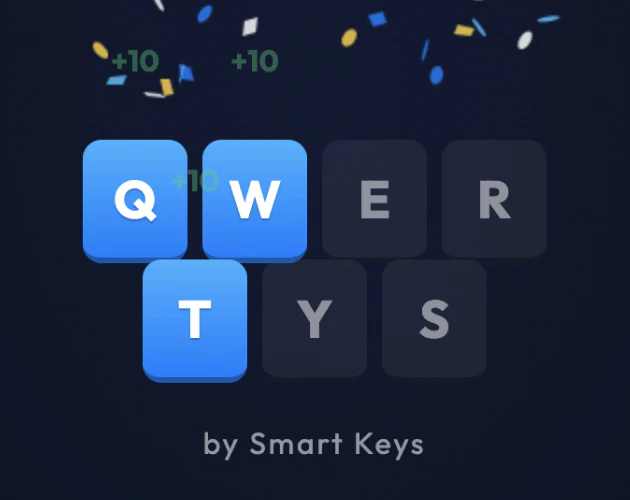
QWERTYS
My keyboard fell apart. Now it's your problem.
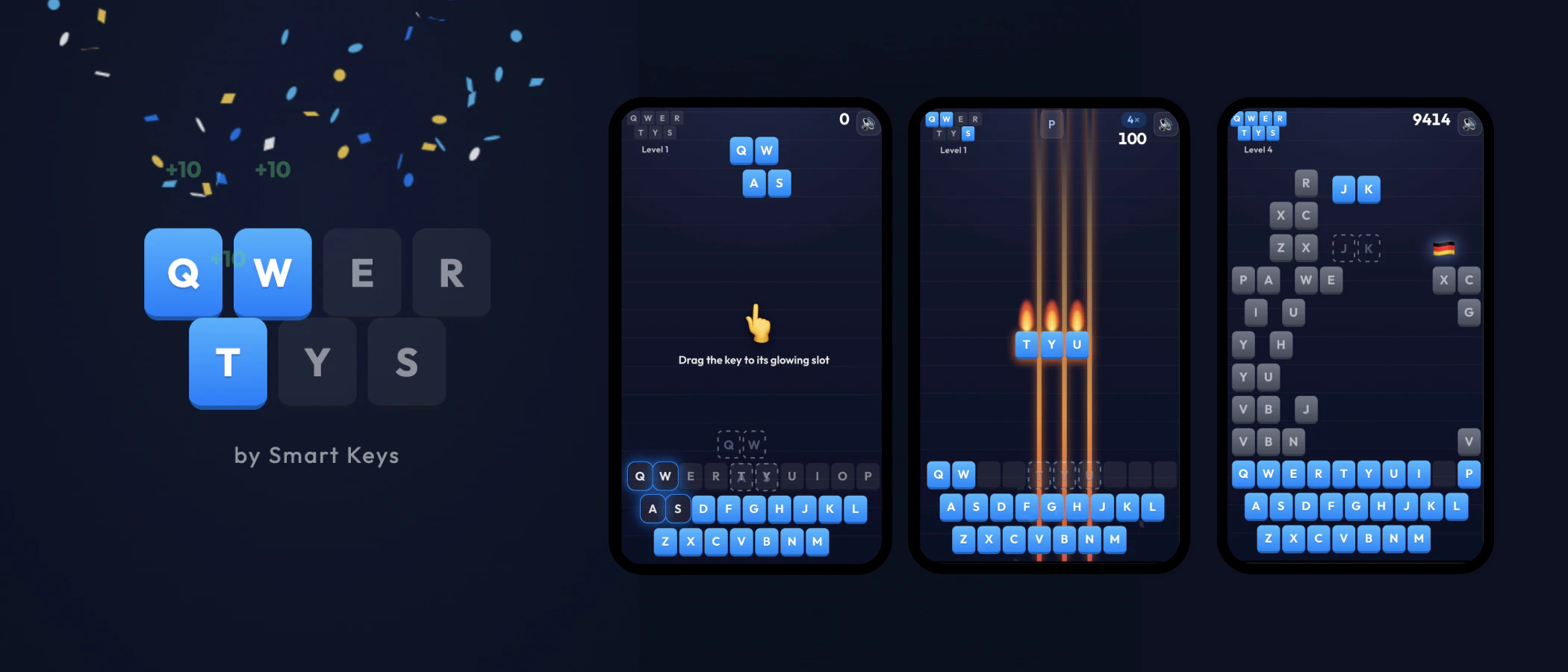
The keyboard fell apart, stack it back together. Tetris meets QWERTY.t's Tetris, except the blocks are keys and every single one has exactly one home. Drop the A on the A. The Z on the Z. You get it. Miss the spot, and that key turns into a useless gray brick that just sits there, bothering you until you explode it. Stack them right and the keyboard lights up blue, row by row, until the whole thing is whole again. Stack them wrong long enough and the junk piles to the top and it's over.
AI Analysis
QWERTYS is a puzzle game merging Tetris with QWERTY keyboard mechanics. Players drop falling keys onto their exact matching positions on a virtual keyboard layout. Accurate drops light up rows in blue progressively; misses create obstructive gray bricks that clutter the play area. The objective is to fully rebuild the keyboard before the stack overflows. Core USP is the thematic precision where every key has one specific home, delivering nostalgia and satisfaction for mechanical keyboard fans. It solves user pain points of repetitive generic puzzles by offering clever, skill-testing gameplay with humorous framing. Overall value: addictive, simple-to-learn casual entertainment with visual progression feedback.
In 2025-2026, puzzle and casual gaming continues to grow with demand for short-session, mobile/web-friendly games fitting busy schedules and mental wellness trends. Retro and nostalgia mechanics are popular amid AI content saturation, while simple 2D games have mature tech and low barriers. Economic pressures favor affordable or free-to-play entertainment. However, the genre is saturated, requiring strong differentiation for visibility. This is Moderate Timing: the keyboard niche taps dedicated communities but faces discovery challenges on app stores and Steam.
High. Technical difficulty is low as it is a 2D physics-based puzzle using proven engines like Unity or web tech (Canvas/WebGL). Development and operation costs are minimal for an indie digital title with no hardware components. No major supply chain or compliance risks beyond standard app store policies. Strong scalability via digital platforms (Steam, itch.io, web). Suitable for solo or small teams experienced in game dev; easy updates and monetization potential.
Primary segments: Ages 18-35, puzzle/retro gamers, mechanical keyboard enthusiasts (mech keyboard community), programmers, typists and tech professionals. Geographic focus: Global, with high density in North America, Europe, China, and Southeast Asia. TAM for mobile/puzzle games exceeds $10B; SAM for indie/niche puzzle approx. $1B; SOM for this themed title potentially $2-10M in first years. Core pain points: Boredom with generic match-3 or endless puzzles, desire for meaningful thematic challenge and short play sessions. Willingness to pay: Moderate (ads, $1-5 premium unlock or DLC).
Medium. Direct competitors: 1. Tetris (tetris.com), 2. 1010! by Gram Games (gram.gg), 3. Blockudoku by Easybrain (easybrain.com), 4. Suika Game clones on various platforms, 5. Puzzle & Dragons (gungho.co.jp). Advantages: Highly original keyboard theme with strict one-home-per-key rule, satisfying lighting feedback and humor not found in generics. Disadvantages: Potentially narrower appeal than abstract puzzles, less endless variety, and faces discovery pressure versus established free titles with larger marketing budgets.
Upgrade Pro to unlock full AI analysis
Similar Products
Prompt Golf
Prompt Engineering As a Sport
▲ 128 votes

Gaming services by IFTTT
Level up the way you play with Steam, Dota 2, and more
▲ 125 votes

Diiverge
Turn any picture into a playable AI adventure
▲ 106 votes

Poke Finder
Catch Pokémon while you browse and complete your Pokédex.
▲ 65 votes

Poddle
Swing your phone, play pickleball on any computer!
▲ 62 votes

AutoChart.eu
Turn any song into a full-band chart for YARG and Clone Hero
▲ 58 votes