
Reborn Medical
Real-time brain imaging for critical care teams
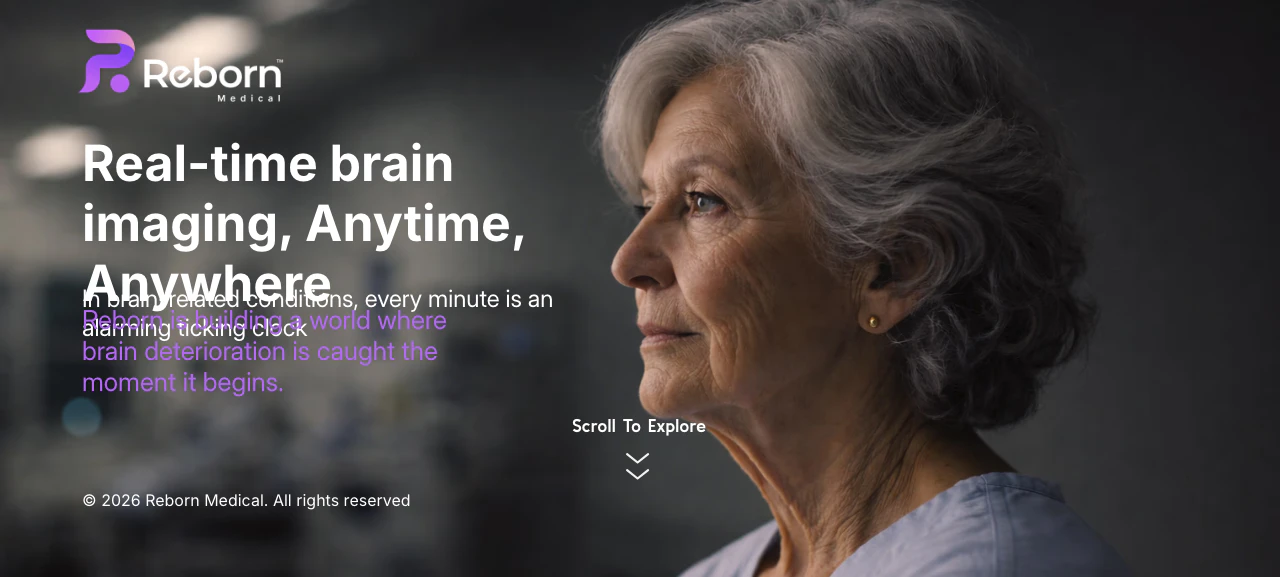
Reborn Medical is developing real-time brain imaging for critical care settings so teams can spot brain deterioration earlier and monitor patients outside traditional imaging workflows. The current site is sparse and still reads more like an early medtech landing page than a launch-ready product.
AI Analysis
Reborn Medical is developing real-time brain imaging for critical care settings. Core features enable continuous monitoring to detect brain deterioration earlier than traditional methods. It solves key pain points including delayed identification of neurological decline in ICU patients and the risks/logistics of transporting critically ill patients for CT/MRI scans. USP is bedside, real-time imaging integrated into critical care workflows without disrupting traditional imaging suites. Overall value proposition: faster interventions, improved patient outcomes, and more efficient care for critical care teams.
The 2025-2026 period shows favorable timing due to maturing AI/sensor tech for medical imaging, rising demand for continuous monitoring in aging populations with increasing neurocritical cases, healthcare efficiency pressures post-pandemic, and supportive innovation policies in medtech hubs like Israel. It is a good time as portable diagnostics gain traction, though regulatory pathways remain slow. Rating: Excellent Timing.
Technical difficulty is high for achieving safe, accurate real-time brain imaging. Development and clinical validation costs are substantial. Significant supply chain, regulatory (FDA/CE marking) and compliance risks for med devices. Scalability potential exists in hospitals but requires strong clinical evidence. Team fit unknown from sparse site. Overall rating: Medium. Key reasons: major technical/regulatory barriers offset by clear clinical need.
Main target segments: critical care teams (intensivists, neurologists, nurses) in hospital ICUs and neurocritical units, focused on developed markets (US, Europe, Israel). Estimated market size not detailed on site; neuromonitoring TAM is large but SAM/SOM for real-time bedside imaging is a specialized subset. Core pain points: delayed brain deterioration detection and imaging workflow inefficiencies. Potential willingness to pay: high for tools proven to improve outcomes and reduce risks.
Competition level: Medium. Direct competitors: 1. Hyperfine Swoop (hyperfine.io), 2. Ceribell Rapid Response EEG (ceribell.com), 3. Nihon Kohden neuromonitoring (nihonkohden.com), 4. Integra intracranial monitors (integralife.com), 5. Masimo Brain Monitoring (masimo.com). Advantages: specific focus on real-time imaging for deterioration detection outside traditional suites. Disadvantages: early-stage with sparse website, unproven vs established regulated devices; likely faces challenges in features validation, pricing (premium for novel tech), and market adoption.
Upgrade Pro to unlock full AI analysis
Similar Products
Bagel AI
Your Product Decisions Partner
▲ 73 votes
Xenaris
When a deal dies, nothing should be wasted
▲ 73 votes

Aiso
Rank your brand in ChatGPT, Gemini, and AI answers
▲ 67 votes

Crowded
Banking and finance platform for nonprofits
▲ 65 votes

SaolaAI
Autonomous quality for engineering teams
▲ 63 votes

Shopeaks
Social storefronts for posts, stories, and ads
▲ 60 votes