
Replay QA Security Scan
Automated Penetration Testing for AI-Built Apps
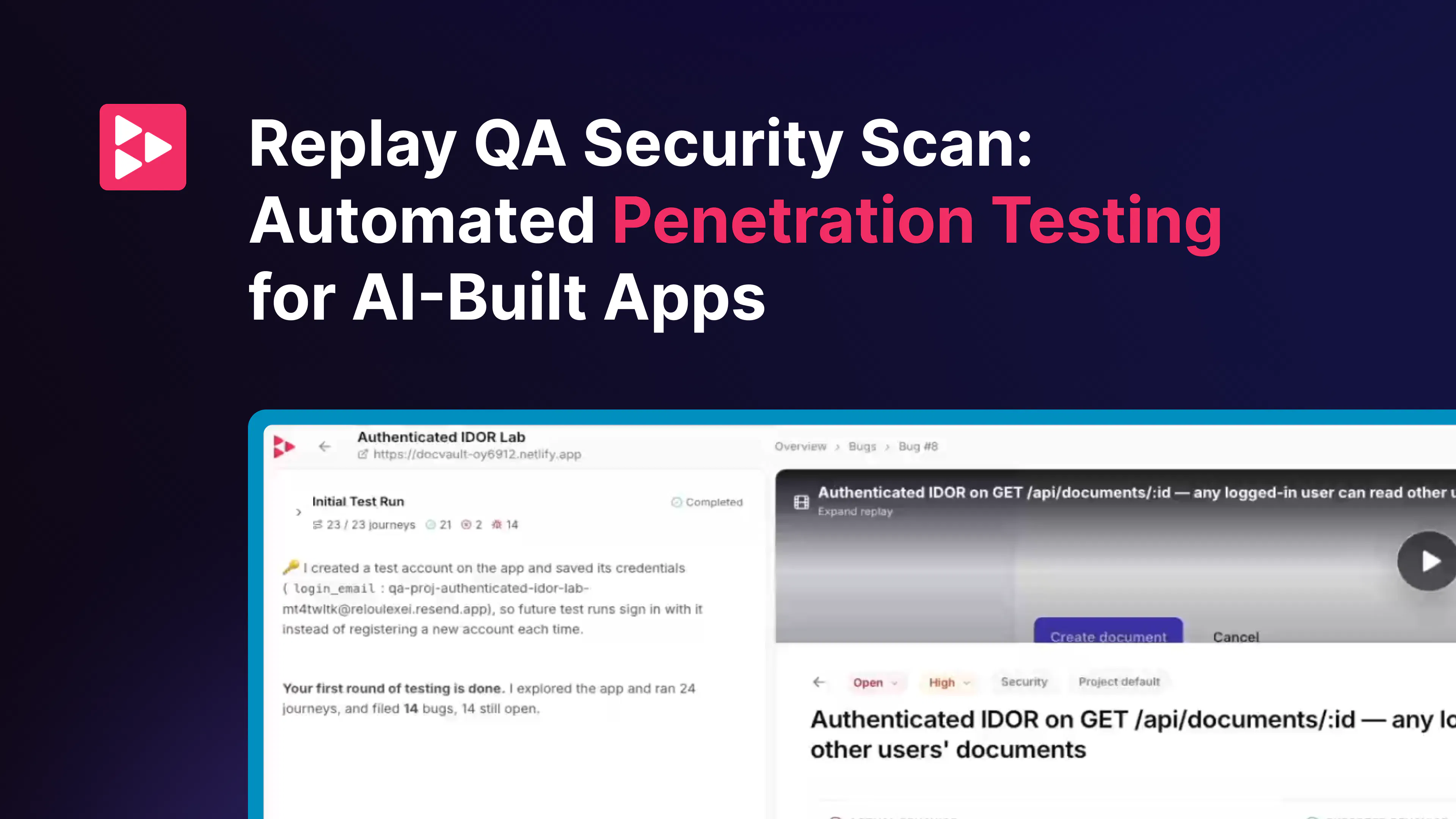
Replay pentests your web app on every QA pass now: injection flaws, broken access control, IDOR, the stuff AI-generated code tends to miss. Findings come back as full bug reports, evidence and suggested fix included. Schedule it daily or weekly and skip the "remember to test" step. You wake up to a queue of bugs already triaged. Same projects also test against dev, staging, prod, and localhost, so you're not maintaining separate QA setups per environment.
AI Analysis
Replay QA Security Scan is an automated penetration testing solution for AI-built web apps. It integrates into QA workflows to detect vulnerabilities like injection flaws, broken access control, and IDOR that AI-generated code commonly misses. Core features include full bug reports with evidence and suggested fixes, scheduled daily/weekly scans, and seamless testing across dev, staging, prod, and localhost environments without separate setups. It addresses key pain points such as overlooked security in AI dev cycles, forgotten manual testing, and complex multi-environment QA maintenance. The value proposition is effortless, proactive security that delivers pre-triaged bugs, allowing teams to build more secure applications with minimal overhead.
In 2025-2026, AI adoption in software development is exploding, leading to heightened risks from insecure AI-generated code. Industry trends favor DevSecOps integration, automated tools, and shift-left security. User demands for seamless security in CI/CD are rising amid increasing cyber threats and regulatory requirements (e.g., data privacy laws). Economic focus on efficient tools that reduce breach costs makes this Excellent Timing for a specialized AI-app security scanner.
Technical difficulty is high for building reliable automated pentesting with low false positives, accurate evidence, and fix suggestions, especially tailored to AI code patterns. Development and operation costs are significant due to security expertise and infrastructure needs. Compliance risks exist around handling sensitive app data. Scalability is strong post-MVP with cloud-based scheduling. Team fit requires security and AI specialists. Overall rating: Medium, as the tech is proven in adjacent tools but execution for this niche demands substantial investment.
Main target users: Developers, QA engineers, and AppSec professionals (ages 25-45) in tech startups and mid-sized software companies using AI coding tools. Industries: Software development, fintech, SaaS. Geographic: Primarily North America and Europe. Estimated market: AppSec testing TAM ~$12B (2025), SAM for automated/DAST tools ~$3B, SOM for AI-focused solutions ~$800M. Core pain points: Security gaps in fast AI dev cycles and time-consuming manual pentests. Willingness to pay: High (security is critical); users likely accept $100-1000+/mo subscriptions based on scan volume and environments.
Competition level: Medium. Direct competitors: 1. StackHawk (stackhawk.com) - automated DAST for developers. 2. Detectify (detectify.com) - continuous automated pentesting. 3. Burp Suite Enterprise (portswigger.net) - advanced scanning with reporting. 4. OWASP ZAP (owasp.org) - open-source automated scanning. 5. Snyk (snyk.io) - developer security with some DAST features. Advantages: Strong focus on AI-generated code pitfalls, easy QA integration with scheduling, full evidence-based reports, localhost support. Disadvantages: Likely higher pricing as a specialized tool, newer player with less brand recognition than incumbents, may have narrower vulnerability coverage initially compared to mature platforms.
Upgrade Pro to unlock full AI analysis
Similar Products

Auriko
Trading desk for LLM calls
▲ 332 votes

Opaline
PostHog for team Claude Code and Codex sessions.
▲ 141 votes

React UI Kit V7
All the chat components you need. None of the complexity
▲ 115 votes

CodeBurn
See where your AI coding spend actually goes
▲ 101 votes

Audryo
Customer email your agent can operate.
▲ 68 votes

Refoid
Automate App Store refund responses and track every outcome
▲ 68 votes