
Robynn AI - Self Improving Websites
Websites that improve and heal with self-learning
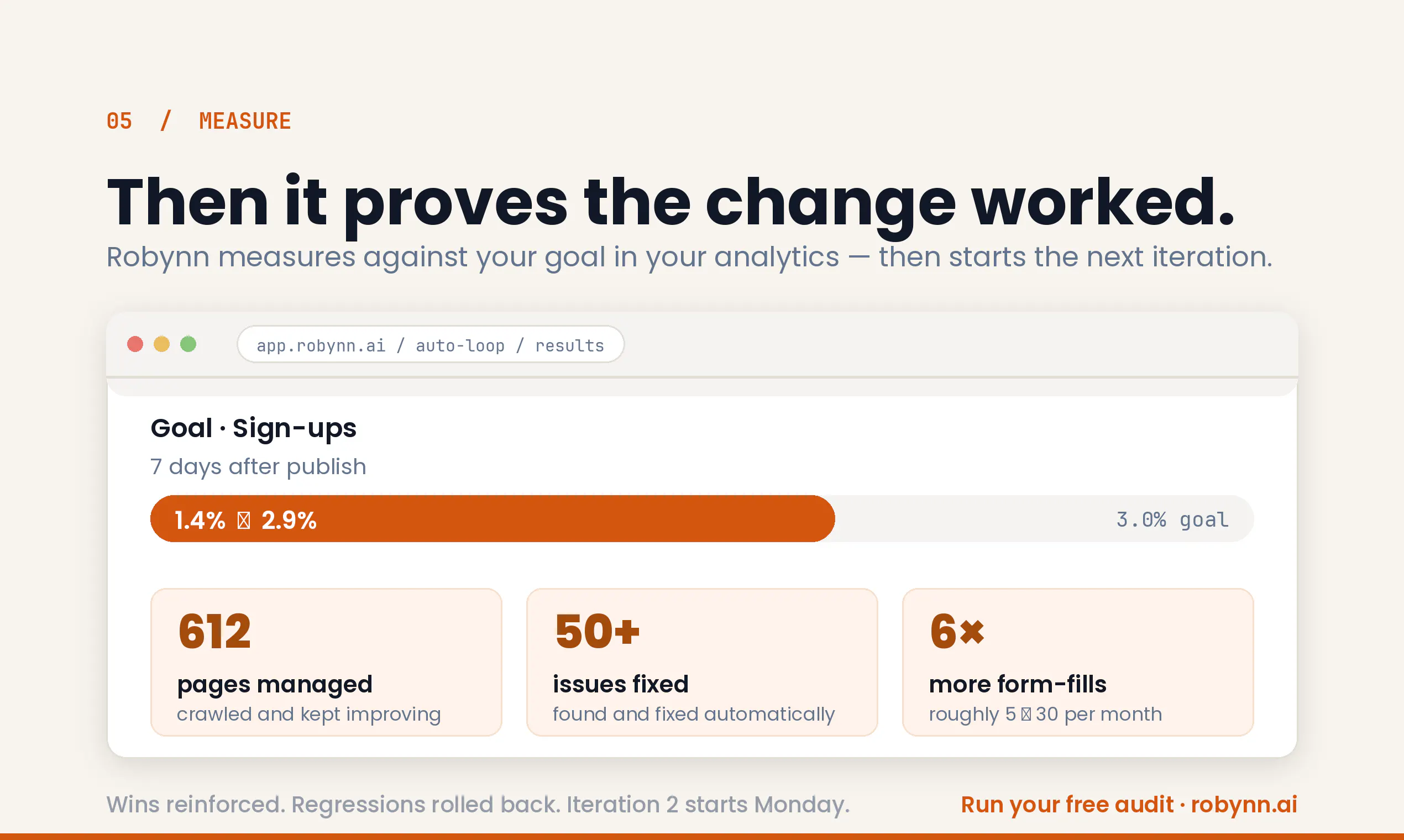
Your website starts decaying the day it ships. Broken links, stale pages, slipping rankings, invisible to ChatGPT. Robynn connects to your live site — no rebuild, no migration. It audits every page against your brand, ICP, and competitors, then proposes evidence-backed fixes. Point at any element, describe a change in plain English. Agents stage it, you approve, Robynn publishes and measures what moved in GA. Wins get reinforced. Regressions roll back. First audit is free.
AI Analysis
Robynn AI turns websites into self-improving systems that combat decay. It connects directly to live sites without rebuilds or migrations, performs audits against brand, ideal customer profile, and competitors, then suggests data-backed improvements. Users can point to elements and request changes in plain English; AI agents stage, test, and publish approved updates while tracking impact in Google Analytics. Successful changes are reinforced via self-learning, while poor ones are rolled back. It addresses pain points like broken links, stale content, declining SEO rankings, and poor AI visibility. The value proposition is autonomous, continuous optimization that enhances performance with minimal ongoing effort. First audit is free.
In 2025-2026, AI agents and autonomous systems are reaching practical maturity, AI-driven search (e.g. ChatGPT visibility) is becoming critical, and businesses face pressure to maintain digital assets efficiently amid rising costs and SEO volatility. Demand for hands-off, self-optimizing tools aligns perfectly with maturing LLM capabilities for code/website manipulation. This is an excellent window before the space becomes saturated. Excellent Timing.
Technically complex due to requirements for safe autonomous editing, accurate cross-site auditing, reliable reinforcement learning from GA metrics, and integration with varied CMS platforms. Operational costs include API usage and monitoring to prevent harmful changes. Compliance risks exist around unauthorized site modifications. Scalability is strong once core agents are proven. Feasible for a skilled AI/engineering team but requires significant upfront investment. Medium.
Primary segments: Marketing teams and founders at SaaS startups, e-commerce brands, digital agencies, and mid-market companies with existing websites (10-500 employees). Demographics: Tech-savvy marketing/SEO managers aged 28-45. Geographic focus: Primarily US and Europe. TAM within broader SEO/marketing automation software exceeds $80B; SAM for AI website optimization tools approx $4-6B; SOM for autonomous maintenance approx $800M-$1B. Core pains: high maintenance burden, SEO decay, and adapting to AI search. Strong willingness to pay $99-499/month for measurable traffic/lead lifts.
Medium. Direct competitors: 1. 10Web (10web.io) - AI WordPress builder/optimizer. 2. Dora AI (dora.ai) - AI site generation with some maintenance. 3. Framer (framer.com) - AI-powered design and prototyping. 4. ZipWP - AI WordPress automation. 5. Relume (relume.io) - AI site planning and Webflow integration. Advantages: Unique self-learning feedback loop using GA data, works on any existing live site without platform lock-in, natural language + autonomous publishing with reinforcement/rollback. Disadvantages: Early-stage product with limited proven case studies, higher perceived risk of autonomous changes compared to manual tools, potentially higher pricing for full autonomy.
Upgrade Pro to unlock full AI analysis
Similar Products

Fuzzy AI
We warm your prospects before reaching out
▲ 527 votes

Goose Ads Remixer
Remix the ads already winning in your niche
▲ 436 votes

Artifacts by Databox
Ask your AI Analyst and get back a ready-to-share report
▲ 345 votes

Deliveryman.ai
Cold email infrastructure on autopilot without Gsuite
▲ 155 votes

LayerProof Kraft
Co-write insightful long form content
▲ 84 votes

BioScript
Self-hosted white label link-in-bio
▲ 0 votes