
Savvy
An assistant that whispers what to say during a meeting
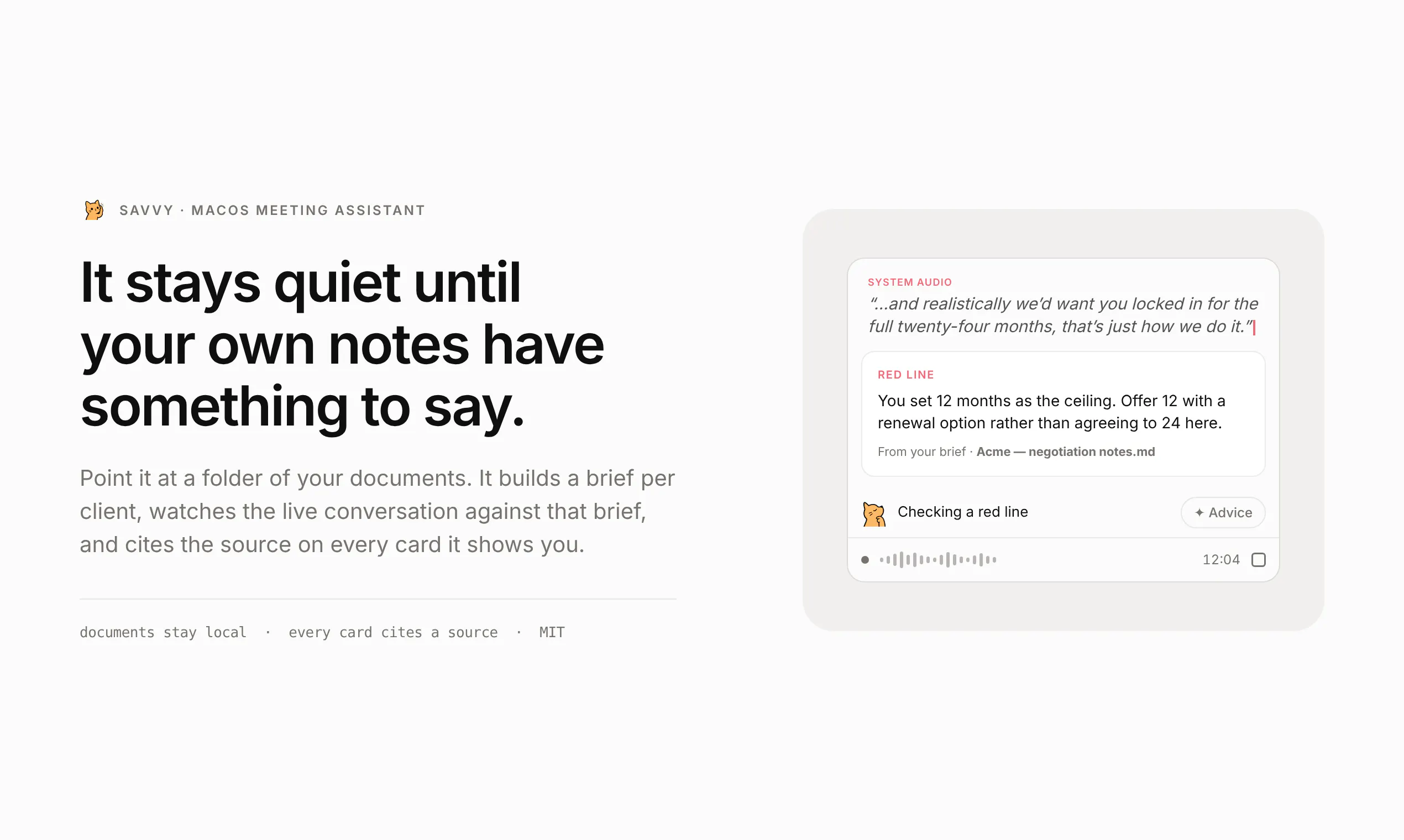
Savvy is a macOS meeting assistant grounded in your own documents, not the open web. Point it at a folder and it builds a versioned brief per client. In the meeting it stays quiet, then speaks up for exactly three reasons: they asked a question your brief answers, someone crossed a red line you set, or you pressed Advice. Every card cites its source. Documents, indexes and transcripts stay on your Mac; only excerpts and the audio stream leave. Apple Silicon, macOS 13+. Open source, MIT.
AI Analysis
Savvy is a privacy-first macOS AI meeting assistant that operates exclusively from user-provided local documents rather than web data. Users specify a folder to automatically generate versioned client briefs. In meetings, it listens silently and intervenes only for three triggers: answering a question from the brief, detecting violation of preset red lines, or on manual 'Advice' request. Every suggestion cites its exact source document. All indexing, documents, and transcripts remain on-device (Apple Silicon, macOS 13+); only audio stream and brief excerpts are processed externally. Open-sourced under MIT license. It solves pain points of forgetting key client details, crossing professional boundaries, and compromising sensitive data privacy in meetings. Value proposition: a discreet, trustworthy local whisperer enhancing meeting outcomes with full transparency and zero cloud dependency.
In 2025-2026, market timing is highly favorable due to rapid maturation of on-device AI (e.g., Apple Intelligence), heightened enterprise and individual privacy regulations, and sustained demand for productivity tools in remote/hybrid work. Post-AI hype, users seek practical, trustworthy local solutions over cloud-heavy apps. Economic pressures favor efficient, low-cost tools like this open-source option. Excellent Timing.
High feasibility. Technical challenges (local document indexing, real-time audio analysis, on-device LLM inference) are well-supported by current Apple Silicon capabilities and existing open-source frameworks. Development and operation costs are low-to-medium as it's already functional and MIT open-source, enabling community contributions. Minimal supply chain or compliance risks due to fully local data handling. Strong scalability for individual professionals; team fit is ideal for solo developers or small AI teams. Key risks are macOS version compatibility and model accuracy.
Primary segments: Tech-savvy Mac users in client-facing roles including sales professionals, consultants, lawyers, and account managers (ages 28-50). Industries: B2B services, legal, consulting, tech sales. Geographic focus: North America and Europe. Estimated TAM for AI meeting assistants ~$10B+, SAM for privacy-focused local tools ~$1B, SOM for Mac-specific apps ~$150M. Core pain points: inability to instantly recall client-specific info or boundaries during live discussions and fear of sharing sensitive docs with cloud AI. High willingness to pay for premium support or enterprise versions despite open-source core.
Medium. Direct competitors: 1. Otter.ai (otter.ai) - transcription and notes. 2. Fireflies.ai (fireflies.ai) - AI meeting assistant with search. 3. Gong.io (gong.io) - revenue intelligence for sales calls. 4. MeetGeek (meetgeek.ai) - automated insights. 5. Limitless (limitless.ai) - wearable + AI recall. Advantages: superior on-device privacy, document-grounded briefs with source citations, minimal intervention design. Disadvantages: Mac-only, lacks broad transcription/features of cloud competitors, open-source may limit polished enterprise support and monetization compared to funded rivals.
Upgrade Pro to unlock full AI analysis
Similar Products

Town
The assistant that learns how you work, then gets to work.
▲ 115 votes

CodeBurn
See where your AI coding spend actually goes
▲ 101 votes

gg-friggin-ez
Fast, cheap profanity and toxicity screening via Jev & Laya
▲ 88 votes
Patchcord
Studio sound for your mic in every Mac meeting with EQ
▲ 64 votes

Prowler Cloud
Where your AI agent becomes a cloud security defender
▲ 64 votes

Poddle
Swing your phone, play pickleball on any computer!
▲ 62 votes