
Skim
Free, open-source AI email client for Windows
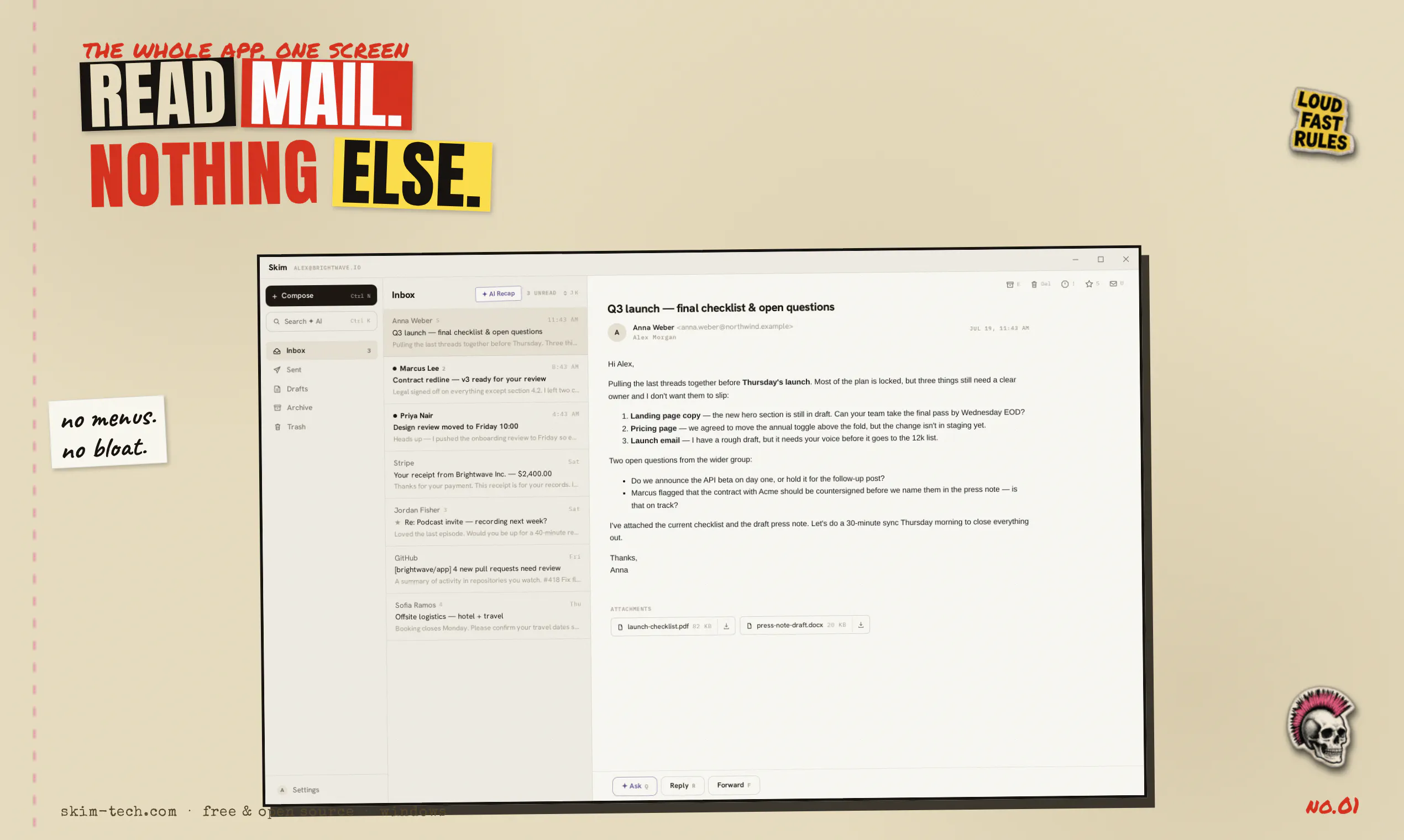
Skim is a free, open-source (MIT) email client for Windows. ✂️ Minimal on purpose: no calendar, no rules engine, no bloat. Fewer buttons, less cognitive load. ⚡ Native Rust core (Tauri 2): ~5 MB installer, sub-second cold start, instant full-text search. 🔒 Local-first, offline-ready, zero telemetry. ✦ AI on your terms: bring your own Anthropic or OpenRouter key and Skim drafts replies in your voice and answers questions across your whole mailbox.
AI Analysis
Skim is a free, open-source (MIT) minimalist AI email client for Windows. Core features include a native Rust/Tauri 2 core for a ~5MB installer, sub-second launches, instant full-text search, local-first offline operation, and zero telemetry. Its AI lets users supply their own Anthropic or OpenRouter keys to draft replies in their personal voice and query the entire mailbox. It solves key pain points of bloated, slow, privacy-invasive traditional email apps by offering reduced cognitive load through deliberate minimalism (no calendars or rules) and user-controlled AI without vendor lock-in. The value proposition is a lightweight, fast, private, and personalized email experience that prioritizes simplicity and data ownership.
The 2025-2026 period is favorable due to maturing AI APIs, rising privacy concerns against telemetry-heavy apps, and growing demand for lightweight, local-first desktop tools amid AI productivity boom. Rust/Tauri ecosystem is stable, open-source adoption is high, and users seek minimalist alternatives to bloated clients while retaining control over AI costs and data. Economic push for efficient free tools also helps. Excellent Timing.
High. Technical difficulty is low-to-medium leveraging mature Tauri 2 and Rust for lightweight cross-platform potential. Operating costs are minimal with no servers or telemetry backend required. No significant supply chain or compliance risks as it's fully local-first and open-source (MIT). Strong scalability via community contributions on GitHub; team fit is ideal for solo devs or small indie teams experienced in systems programming.
Primary segments: Tech-savvy Windows users aged 25-45, software developers, privacy-conscious professionals and indie hackers in knowledge work industries. Geographic focus: Global with heavy adoption expected in US and Europe. Estimated TAM for email clients exceeds $10B, SAM for open-source/privacy-focused desktop tools ~$500M, SOM for AI-enhanced Windows clients in low tens of millions. Core pain points: overwhelming UIs, data privacy, slow performance, and expensive proprietary AI. Willingness to pay is moderate; core app is free but users already incur costs for AI API keys and may support via donations.
Medium. Direct competitors: 1. Mozilla Thunderbird (thunderbird.net) - open-source but feature-heavy without native AI. 2. Microsoft Outlook (outlook.live.com) - comprehensive but bloated with telemetry. 3. Superhuman (superhuman.com) - fast AI-assisted email, subscription-based. 4. Spark (sparkmailapp.com) - smart inbox but not open-source or fully local. Advantages: superior minimalism, smaller footprint, true offline/local-first design, open-source transparency, and flexible BYO AI keys. Disadvantages: Windows-only (limits audience), lacks advanced features like calendars/rules, and relies on users obtaining their own AI credentials.
Upgrade Pro to unlock full AI analysis
Similar Products

Town
The assistant that learns how you work, then gets to work.
▲ 115 votes

CodeBurn
See where your AI coding spend actually goes
▲ 101 votes
buddylist
Chat with your coding agents like it's 2005
▲ 97 votes

gg-friggin-ez
Fast, cheap profanity and toxicity screening via Jev & Laya
▲ 88 votes

Prowler Cloud
Where your AI agent becomes a cloud security defender
▲ 64 votes

Poddle
Swing your phone, play pickleball on any computer!
▲ 62 votes