
StickerWords
Learn new words from the world around you
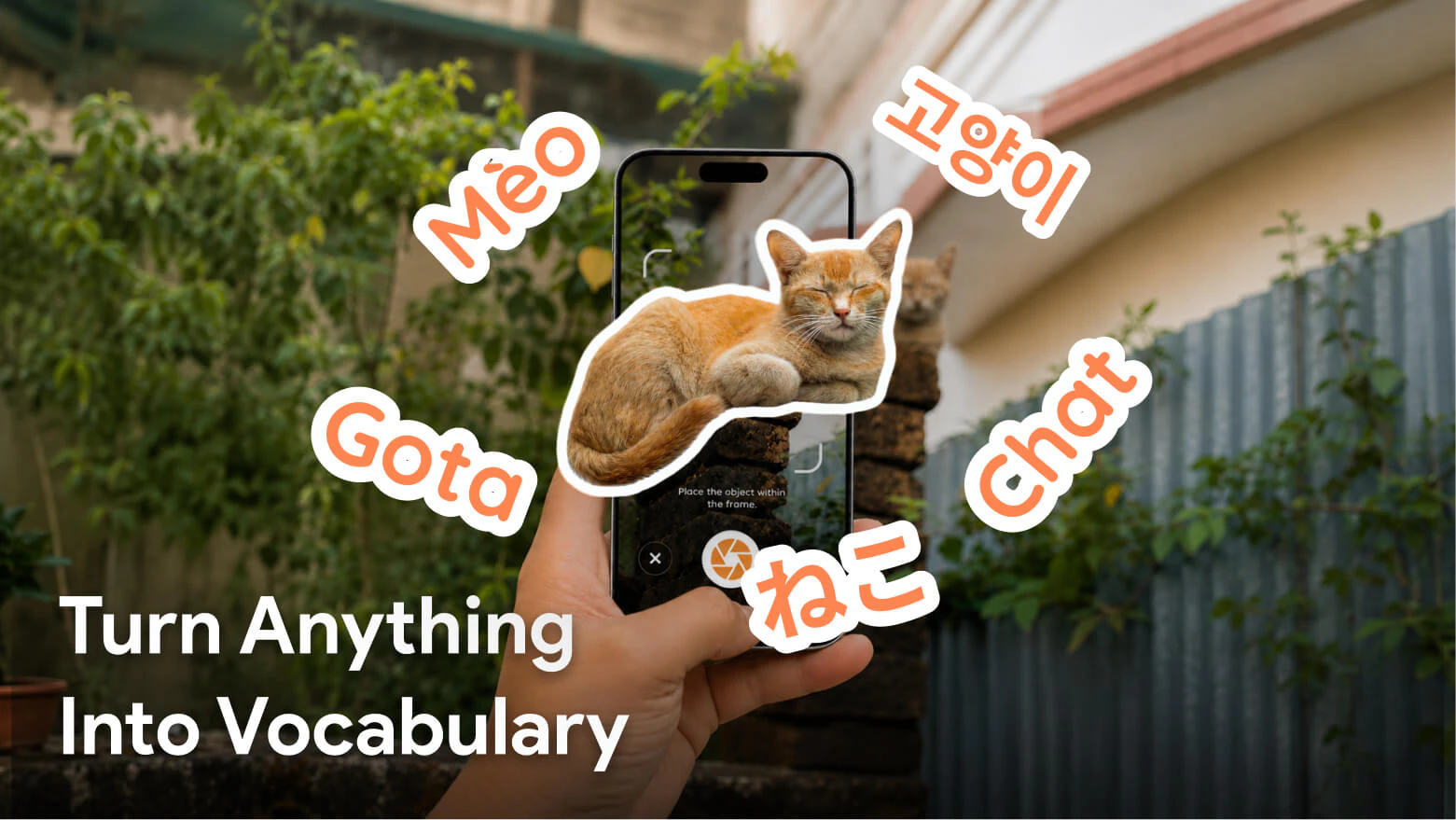
StickerWords turns the world around you into a language lesson. Snap an object, food, sign, or anything nearby, and instantly learn its word in your target language. Each word is saved to your personal vocabulary list with example sentences and spaced repetition reviews, so you don’t just learn it once. You actually remember it!
AI Analysis
StickerWords turns real-world objects into personalized language lessons. Users photograph nearby items, food, signs, or scenes, and the app instantly provides the word in the target language, along with example sentences. Learned words are saved to a personal vocabulary list that employs spaced repetition reviews for long-term retention. It solves key pain points like disconnected, abstract memorization and lack of practical context in traditional language apps. The core value is making vocabulary acquisition immersive, memorable, and integrated into daily life through visual, contextual learning.
The market timing is favorable for 2025-2026. Multimodal AI and computer vision technologies have reached sufficient maturity for accurate object recognition and translation on mobile devices. User demand is shifting toward contextual, real-world learning experiences rather than rote memorization, aligning with broader edtech and AI personalization trends. Supportive economic environment for self-improvement tools and remote learning post-pandemic further boosts potential. Excellent Timing.
Overall feasibility is High. Image recognition and translation leverage mature APIs and models (e.g., cloud vision services), while spaced repetition is a well-established algorithm with low implementation complexity. Development costs are moderate for a mobile-first app, though operational costs for AI calls exist. Scalability is strong as a digital product with minimal supply chain or compliance risks for an education tool. Team with mobile/AI experience would fit well.
Primary users are language learners aged 18-35, including students, travelers, digital nomads, and immigrants. Geographically distributed globally with strong presence in North America, Europe, and East Asia. The language learning market TAM exceeds $50 billion, with SAM for mobile apps around $15 billion and SOM for contextual/vocab-focused tools estimated at several hundred million. Core pain points include rapid forgetting of vocabulary and lack of real-world relevance. Users show strong willingness to pay for premium features like advanced languages or ad-free experience.
Competition level: Medium. Direct competitors: Duolingo (duolingo.com), Memrise (memrise.com), Drops (drops.app), AnkiApp (apps.ankiweb.net), LingQ (lingq.com). Advantages: Highly unique real-world photo snapping for contextual learning and seamless integration of spaced repetition with visual memory. Disadvantages: Potentially higher dependency on AI accuracy compared to structured lesson-based competitors; less established brand and fewer total learning tools (grammar, speaking practice).
Upgrade Pro to unlock full AI analysis
Similar Products

Paradigm
Turn any goal into a personalized, adaptive learning path.
▲ 464 votes
Nitro 4.0
The first human translation platform built for AI agents
▲ 218 votes

Build Club Campus
Virtual AI School: Upskill in AI and Become Great at it Fast
▲ 173 votes

Yomi
A little cat who loves being read to
▲ 134 votes

WebTerm Learn
Learn the terminal like a game — in a browser sandbox
▲ 127 votes

looquee
Copilot for college applications
▲ 58 votes