
SUB/WAVE
Self-hosted radio with an AI DJ and one shared stream
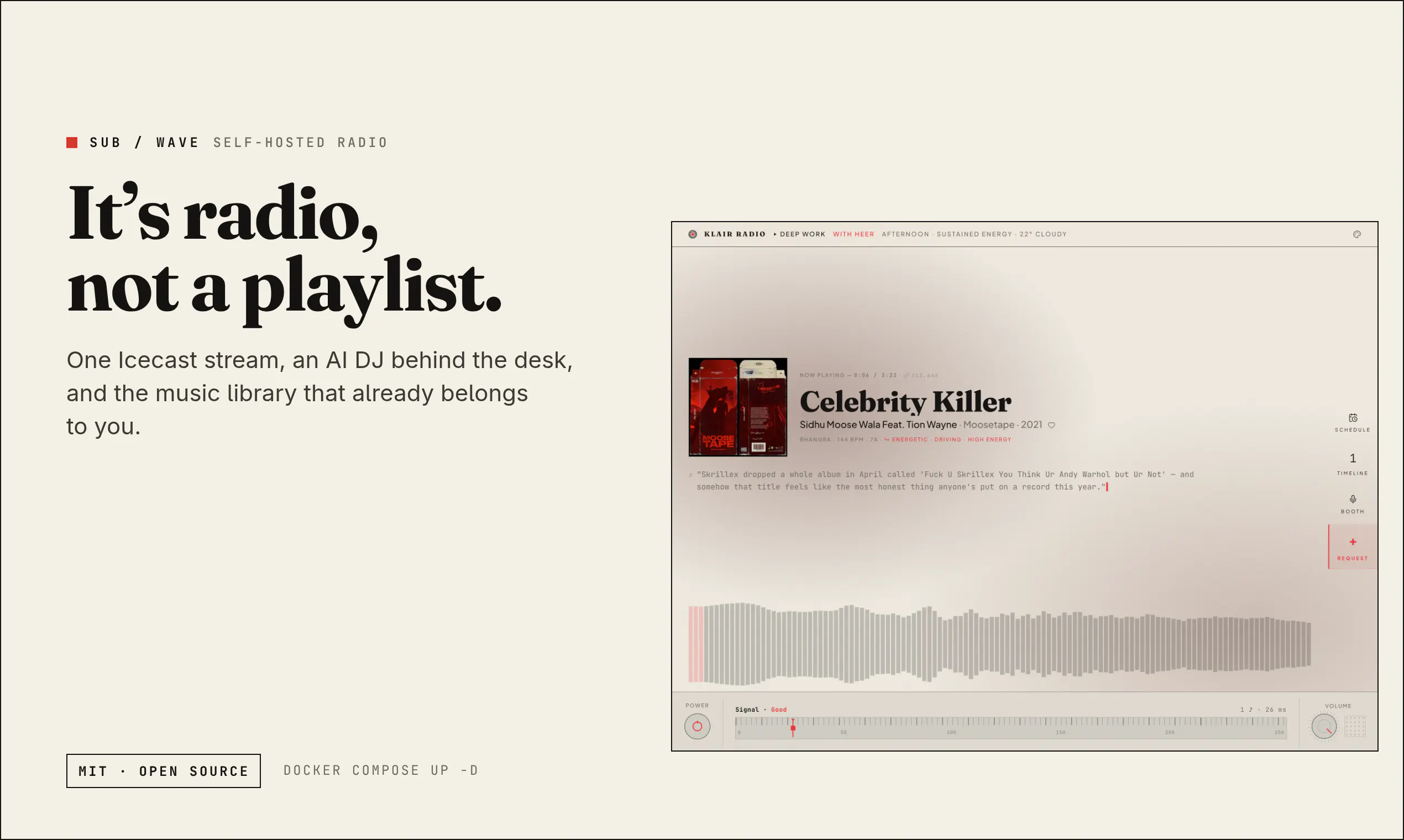
SUB/WAVE turns your music library into a real radio station: one shared stream, an AI DJ that picks tracks, reads idents and takes requests in plain language. Self-hosted, works with local LLMs, MIT licensed. Web, iOS, Android and desktop players.
AI Analysis
SUB/WAVE is a self-hosted, open-source (MIT licensed) radio platform that transforms personal music libraries into a shared streaming station featuring an AI DJ. Core features include AI-driven track selection, reading station idents, and handling plain-language requests, with compatibility for local LLMs to ensure privacy. It supports players across Web, iOS, Android, and desktop. It solves pain points like impersonal commercial streaming algorithms, data privacy concerns, and fragmented personal music experiences by creating a communal, radio-like atmosphere users control. The value proposition is a customizable, subscription-free, privacy-focused alternative that blends AI innovation with personal media for an engaging shared listening experience.
The market timing is favorable for 2025-2026 due to maturing local LLM technologies (e.g., Ollama integrations), growing user demand for privacy-focused and self-hosted alternatives amid data scandals, and the boom in AI personalization in entertainment. Economic factors like streaming subscription fatigue and open-source adoption trends support this. However, mainstream users may still prefer easy cloud services. Excellent Timing.
Feasibility is High. Technical difficulty is moderate as it builds on mature streaming protocols, existing music servers, and local LLM APIs; development costs are low due to open-source nature and community support. No significant supply chain or hardware risks. Compliance is straightforward for self-hosted software. Scalability is good for personal/small group use but may require optimization for larger shared streams. Key risks involve audio quality consistency and LLM response latency. Overall strong potential for indie developers.
Main target segments: Tech-savvy self-hosting enthusiasts and open-source developers (ages 25-45, predominantly male, in North America and Europe), music collectors and indie radio fans in the hobbyist/home-lab community. Industries: Software development, digital media. Estimated market size: TAM for self-hosted media tools ~5-10M users globally; SAM for AI-enhanced music streaming ~1M; SOM ~50-100K potential adopters. Core pain points: Lack of privacy in services like Spotify, generic recommendations, and desire for communal yet personal listening. Willingness to pay: Moderate; core product is free but users may pay for premium hosting, advanced AI models, or support services.
Competition level: Medium. Direct competitors: 1. Navidrome (navidrome.org), 2. Jellyfin (jellyfin.org), 3. AzuraCast (azuracast.com), 4. Koel (koel.dev), 5. Funkwhale (funkwhale.audio). Advantages: Unique AI DJ with natural language requests and local LLM support, true one-shared-stream radio concept not commonly found. Disadvantages: Requires self-hosting expertise (higher barrier than cloud services), potentially less polished UI/UX as a newer project, limited to user's own library vs vast catalogs. Strong differentiation in AI and privacy sets it apart from traditional self-hosted music servers.
Upgrade Pro to unlock full AI analysis
Similar Products

Orus
Claude for investing in perpetuals
▲ 121 votes
CodeBurn
See where your AI coding spend actually goes
▲ 101 votes

gg-friggin-ez
Fast, cheap profanity and toxicity screening via Jev & Laya
▲ 88 votes

Truffle
Fix messy tags, covers and duplicates in your Mac library
▲ 76 votes

Prowler Cloud
Where your AI agent becomes a cloud security defender
▲ 64 votes

AutoChart.eu
Turn any song into a full-band chart for YARG and Clone Hero
▲ 61 votes