
Termy
Learn languages from games, videos, and websites
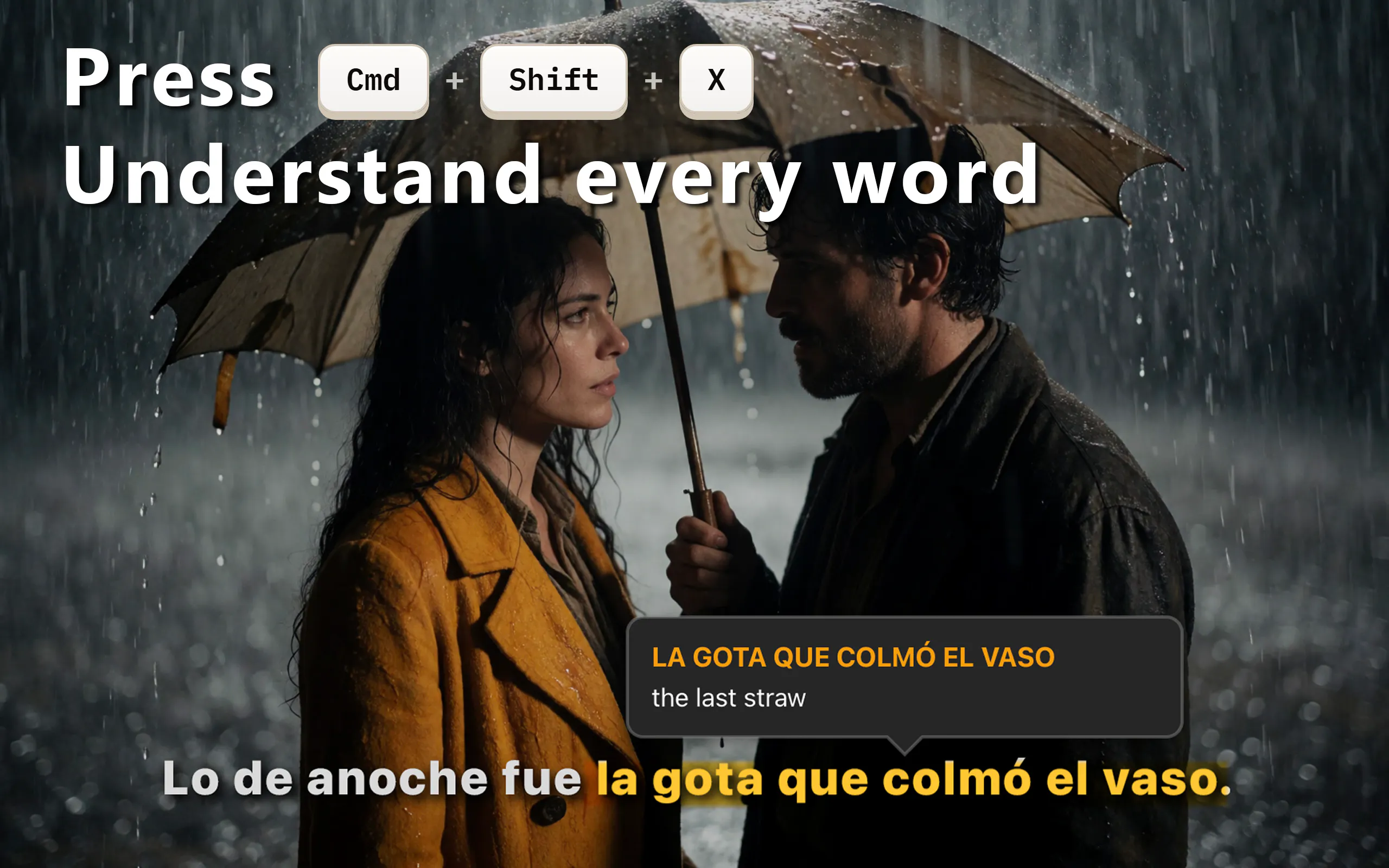
Termy turns the games, videos, and websites you love into language practice. Press one shortcut and it finds the difficult words on your screen, explains them in context, and saves them with the exact moment you discovered them—without breaking your flow. Later, those moments become adaptive exercises built around your vocabulary. Works on Windows and macOS in 30 languages. Free to start.
AI Analysis
Termy transforms games, videos, and websites into language practice by letting users press a shortcut to detect difficult words on screen, provide contextual explanations, and save the exact discovery moment without disrupting flow. It then turns these into personalized adaptive exercises. Key features include support for 30 languages on Windows and macOS, and free-to-start access. It solves pain points like boring, context-free traditional language learning and difficulty retaining vocabulary by embedding practice into users' existing entertainment. The value proposition is seamless, immersive language acquisition integrated into daily digital activities users already enjoy.
In 2025-2026, market timing is favorable due to maturing AI for contextual translations and adaptive learning, rising demand for flexible edtech amid remote work and globalization, and users seeking to integrate language practice into entertainment rather than standalone apps. Technology for real-time screen analysis is ready, with growing consumer adoption of AI tools. Economic tailwinds for personal development apps persist. Excellent Timing.
Overall feasibility is High. Technical difficulty is manageable with current OCR, computer vision libraries, and LLM APIs for explanations/adaptivity. Development costs for desktop apps are moderate; operation involves AI inference costs but scalable via cloud. Low supply chain risk, compliance mainly around data privacy (GDPR). Strong scalability potential as user base grows. Product already demonstrates viability across 30 languages.
Main segments: 18-35 year old self-directed language learners, gamers, content consumers (videos/streaming), and bilingual professionals. Demographics skew tech-savvy, urban, students and young professionals. Geographic focus: Global with strong adoption in Europe, East Asia, and Latin America. Language learning market TAM approx $15B+, SAM for digital immersive tools $3B, SOM for contextual screen-based ~$500M. Core pains: lack of immersion and context in vocab retention. High willingness to pay for premium adaptive features/subscriptions.
Competition level: Medium. Direct competitors: 1. Duolingo (duolingo.com), 2. LingQ (lingq.com), 3. Language Reactor (languagereactor.com), 4. FluentU (fluentu.com), 5. Readlang (readlang.com). Advantages vs competitors: unique any-screen integration (including games), moment-saving for exact context replay, and adaptive exercises from personal content vs structured lessons. Disadvantages: potentially less polished curriculum/structure than Duolingo, dependency on screen accuracy. Strong differentiation through seamless, flow-preserving immersion.
Upgrade Pro to unlock full AI analysis
Similar Products

Paradigm
Turn any goal into a personalized, adaptive learning path.
▲ 464 votes
Nitro 4.0
The first human translation platform built for AI agents
▲ 218 votes

Gaming services by IFTTT
Level up the way you play with Steam, Dota 2, and more
▲ 125 votes

Diiverge
Turn any picture into a playable AI adventure
▲ 106 votes

Poddle
Swing your phone, play pickleball on any computer!
▲ 62 votes
looquee
Copilot for college applications
▲ 58 votes