
World Signal
See where the world is behaving abnormally.
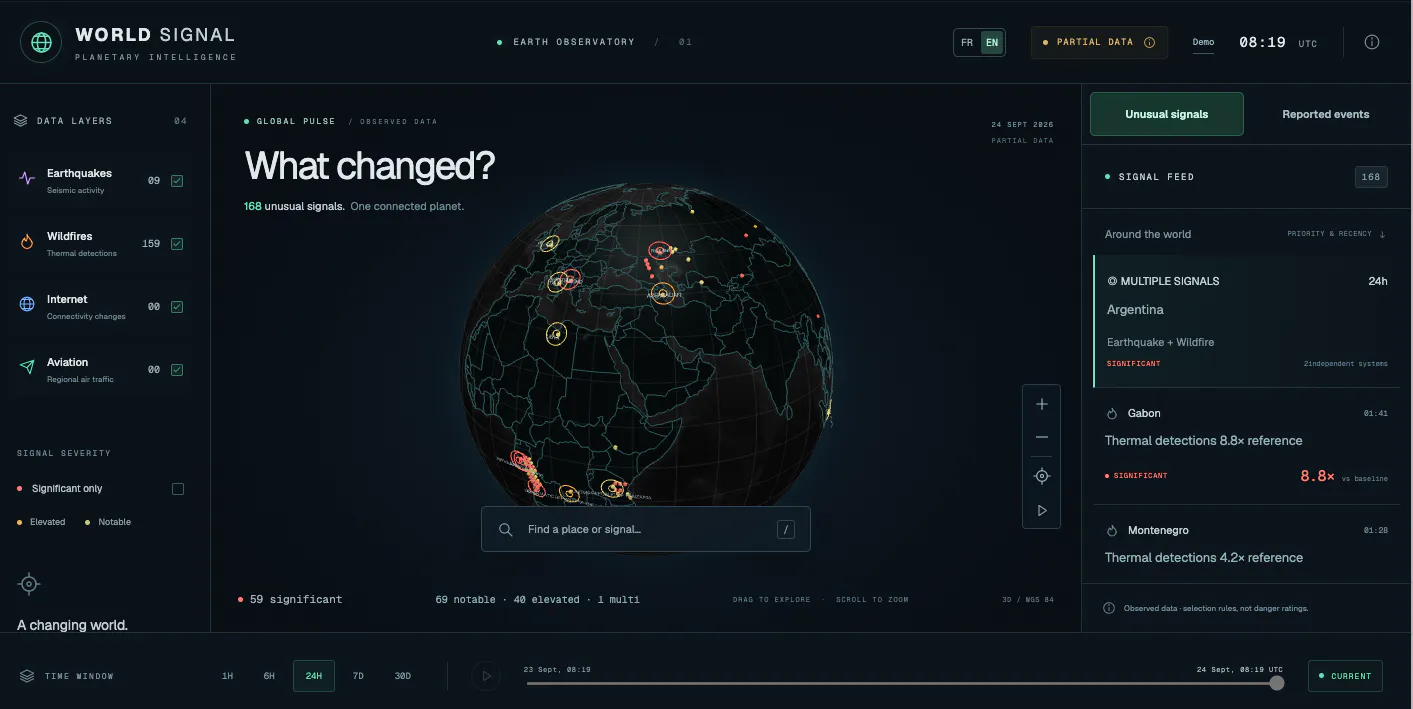
WORLD SIGNAL monitors real-world systems: earthquakes, wildfires, internet connectivity, aviation and more, to detect unusual activity across the planet. Explore anomalies, compare them with historical baselines, and investigate the evidence behind every signal.
AI Analysis
World Signal is a real-time analytics platform that aggregates data from global systems like earthquakes, wildfires, internet outages, aviation disruptions, and more to detect and highlight anomalous activities. Key features include anomaly exploration, historical baseline comparisons, and evidence investigation for each signal. Its USP is providing a unified planetary dashboard for abnormal behaviors, solving the pain of fragmented, siloed data sources across domains. The value proposition is enabling faster insights, informed decision-making, and proactive responses for users needing comprehensive global awareness.
Favorable in 2025-2026 due to accelerating climate change increasing wildfires/earthquakes, rising cyber and infrastructure vulnerabilities, AI/ML maturity for anomaly detection, and growing demand for integrated dashboards amid economic focus on resilience and sustainability. Geopolitical tensions further drive need for real-time global signals. Excellent Timing.
Medium overall. Technical difficulty is high for integrating diverse real-time data sources (seismic APIs, satellite feeds, network monitoring); development and ops costs significant for data ingestion/storage. Scalability high via cloud (Vercel mentioned). Compliance risks moderate for global data. Team needs multi-domain expertise. Strong potential if data partnerships secured.
Main segments: Disaster management agencies, environmental NGOs, data analysts/researchers in government/academia, insurance risk modelers, journalists (demographics: 28-55yo professionals). Industries: Public sector, humanitarian, finance. Geographic: Global, esp. US, EU, Asia-Pacific disaster zones. TAM ~$1.5B (global real-time analytics), SAM ~$400M (multi-hazard monitoring), SOM ~$80M. Pain points: Disconnected monitoring tools, missed correlations. High willingness to pay for enterprise alerts/dashboards.
Medium. Direct competitors: 1. USGS Earthquake Program (earthquake.usgs.gov), 2. NASA FIRMS Wildfire Mapper (firms.modaps.eosdis.nasa.gov), 3. Downdetector (downdetector.com), 4. FlightAware (flightaware.com), 5. Global Incident Map (globalincidentmap.com). Advantages: All-in-one anomaly detection with baselines and unified evidence view; broader coverage. Disadvantages: Lacks specialized depth/authority of official sources; newer product with potentially less proven accuracy or user base; may require subscriptions vs some free tools.
Upgrade Pro to unlock full AI analysis
Similar Products

Paradigm
Turn any goal into a personalized, adaptive learning path.
▲ 464 votes

Opaline
PostHog for team Claude Code and Codex sessions.
▲ 141 votes

Cito
Hybrid academic search over 236M papers, built for agents
▲ 107 votes

Coarena by Coasty
The arena where agents battle on real-world work
▲ 104 votes

FableWatch
Know the second Fable 5 is back
▲ 75 votes

Inbix
Cloudflare-native Email Infrastructure for Developers
▲ 73 votes