
YABAI
Real Japanese slang, one giant word at a time
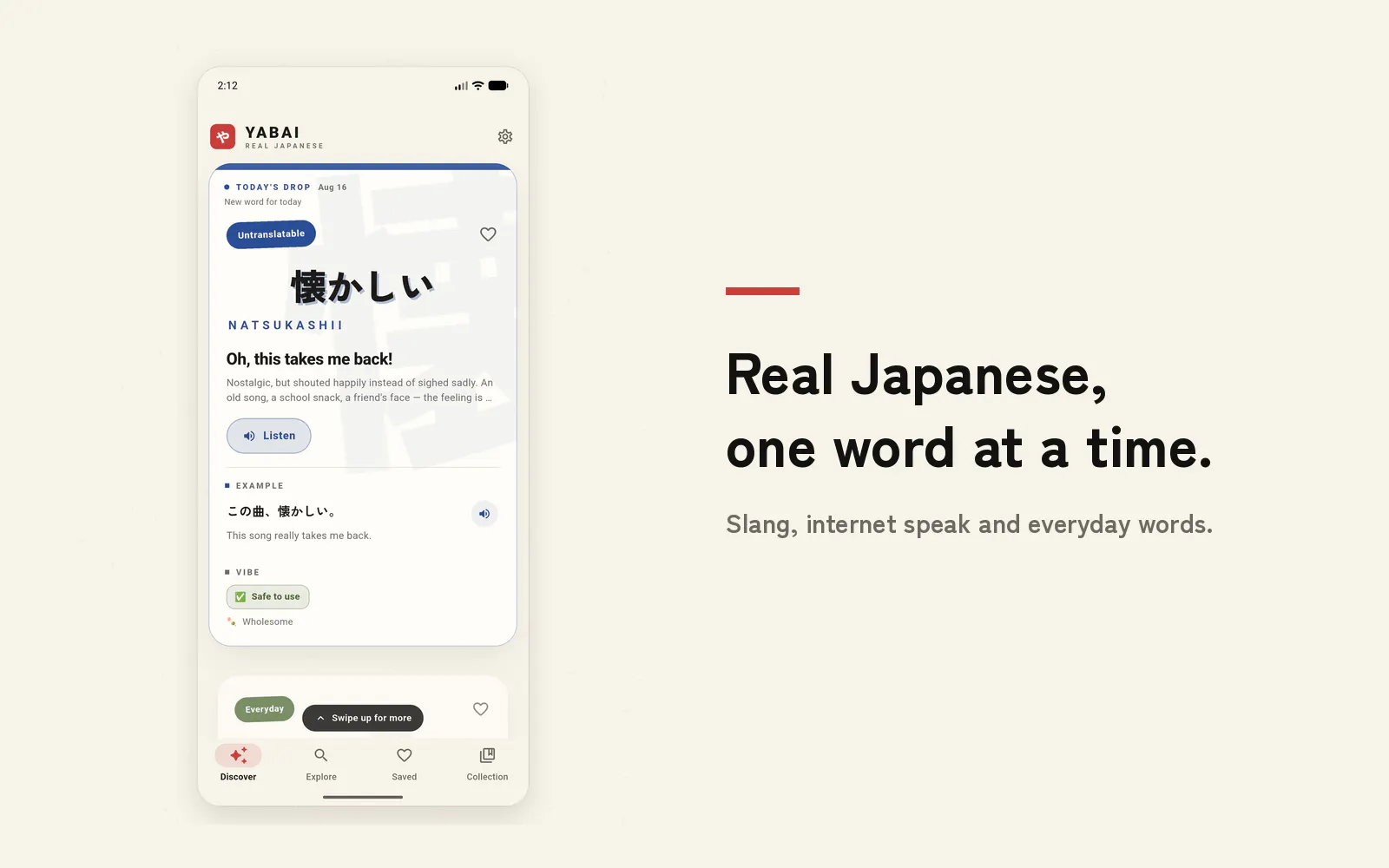
Textbooks teach Japanese that stops at the classroom door. YABAI is the other half: 308 real slang, internet and fandom words, each on a card built around giant Japanese typography. Every word has a meaning, a real example, a vibe check (safe to use? friends only? careful?) and a story — and when the origin is uncertain, it says so instead of inventing one. Built end to end with AI agents in Claude Code. 13 languages, works offline. No streaks, no tests, no XP.
AI Analysis
YABAI is an Android app teaching 308 real Japanese slang, internet, and fandom words overlooked by textbooks. Each card features giant Japanese typography, meanings, real examples, 'vibe checks' for usage safety (safe/friends only/careful), and honest origin stories. Built end-to-end with AI agents in Claude Code, it supports 13 languages, works offline, and avoids gamification like streaks, tests, or XP. It solves the pain of formal education leaving learners unprepared for authentic casual speech and online interactions. USP is practical, transparent cultural context for real-world Japanese without invented lore. Value proposition: immersive, honest slang mastery for natural communication.
Favorable in 2025-2026 due to booming global Japanese pop culture (anime, social media, fandoms) increasing demand for authentic slang beyond classroom Japanese. AI technology is mature for content creation and app building, aligning with the product's AI-agent development. User preferences are shifting to practical, real-world language skills for online communities. Edtech remains strong despite economic fluctuations. Excellent Timing.
High. Technical difficulty is low for a static, offline card-based app; already built using AI agents in Claude Code, minimizing dev time/costs. No complex servers or supply chain issues. Digital-only reduces compliance risks. Strong scalability for more languages/content. Fits solo or small AI-proficient teams well. Key reasons: low operational costs and proven offline functionality.
Primary users: Intermediate Japanese learners aged 15-35 who are anime, manga, gaming, or J-pop fans seeking authentic speech. Demographics: Students, young professionals, digital natives. Geographic: Global, concentrated in North America, Europe, East/Southeast Asia. Core pain: Inability to understand or use real slang safely in social/online settings. Market size: Large language learning sector with high Japanese demand (millions of learners); strong willingness to pay for niche, high-quality offline tools.
Low. Direct competitors: 1. Duolingo (duolingo.com) - broad gamified Japanese but minimal slang depth. 2. AnkiDroid (apps.ankiweb.net) - generic flashcards, requires user-created slang content. 3. Memrise (memrise.com) - community courses with some slang but lacks vibe checks/stories. 4. Jisho.org (jisho.org) - dictionary lookups without structured cards or context. 5. HelloTalk (hellotalk.com) - chat-based exchange, unstructured for slang learning. Advantages: Unique giant typography, honest origins, vibe checks, offline/multi-language, AI efficiency. Disadvantages: Narrow scope (308 words), no progression gamification, Android-focused.
Upgrade Pro to unlock full AI analysis
Similar Products

Paradigm
Turn any goal into a personalized, adaptive learning path.
▲ 464 votes

Grok 4.6
Frontier Intelligence for Long-Running Agents
▲ 237 votes

Gaming services by IFTTT
Level up the way you play with Steam, Dota 2, and more
▲ 125 votes

Orus
Claude for investing in perpetuals
▲ 121 votes

Poke Battle Announcer
Give your Pokémon Champions battles a live announcer
▲ 64 votes

looquee
Copilot for college applications
▲ 58 votes