GlassKit UI
AI-ready React UI for Meta's Ray-Ban Display glasses

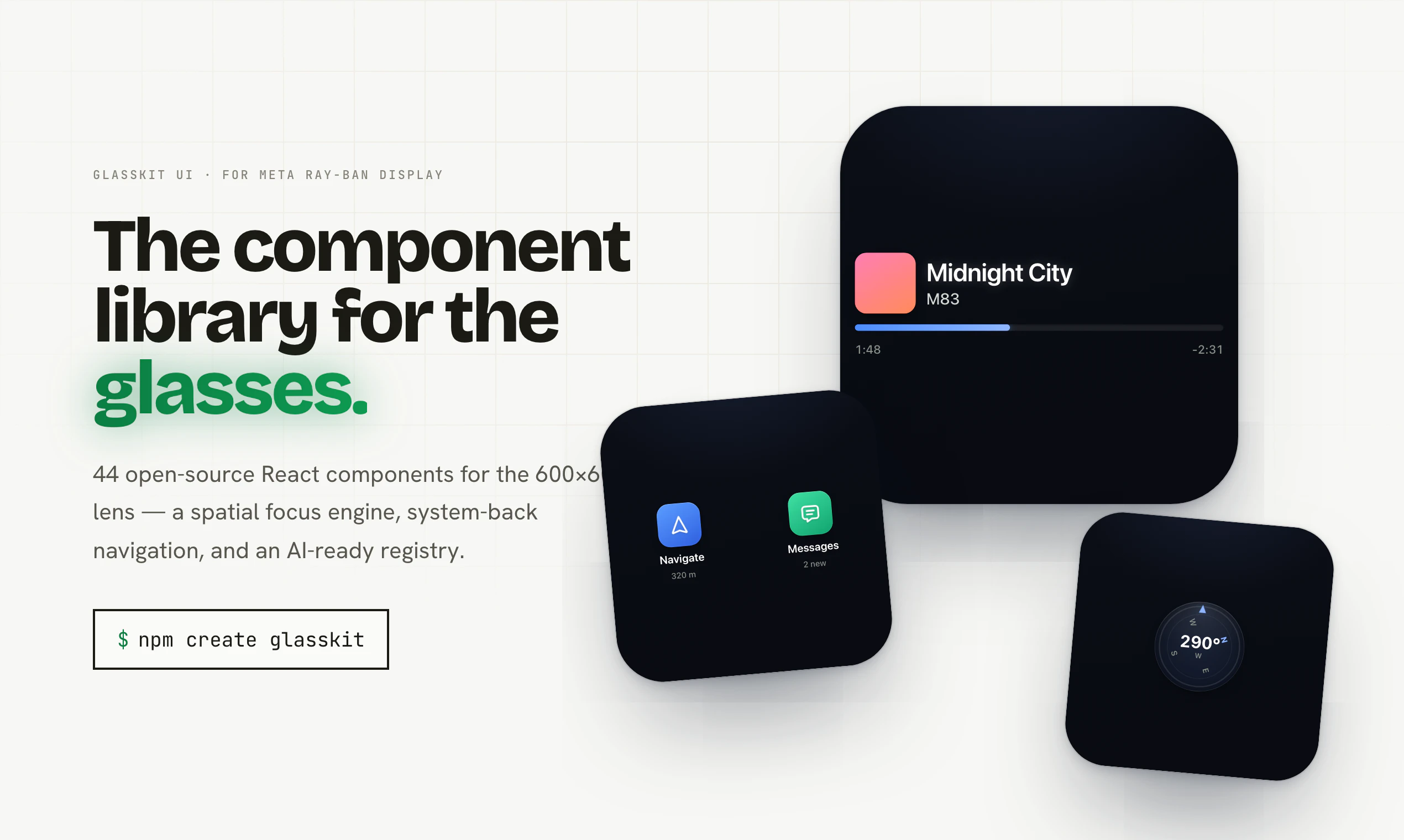
Open-source (MIT) React components for Meta Ray-Ban Display web apps. 44 components + a D-pad focus engine for the 600x600 lens, and built for AI agents: a skill, an MCP server, and llms.txt so Claude/Cursor build it right. Vendor shadcn-style; own the source.
AI Analysis
GlassKit UI is an open-source (MIT) React component library with 44 tailored UI elements and a D-pad focus engine optimized for Meta's Ray-Ban Display glasses' 600x600 lens. It follows a shadcn-style approach where users own the source code. Built for AI agents, it includes a skill, MCP server, and llms.txt to enable seamless development with tools like Claude and Cursor. It solves key pain points of building intuitive interfaces and navigation for constrained AR glass displays, accelerating creation of AI-powered web apps. The value proposition is full ownership, AI-readiness, and specialized tooling for the emerging smart glasses ecosystem.
In 2025-2026, AI wearables and smart glasses are maturing with Meta pushing display-enabled Ray-Ban models and broader industry adoption (e.g., AI agents, AR apps). User demand for seamless on-glass experiences is rising amid advancing hardware and developer ecosystems. Economic push for AI productivity tools aligns well. This is an Excellent Timing as infrastructure is ready but app tooling lags, creating an opportunity for specialized kits.
Technical difficulty is low as it leverages familiar React and shadcn patterns with a focused scope (44 components + navigation engine). Development/operation costs are minimal for an open-source project hosted on GitHub. No supply chain issues; compliance is straightforward under MIT license. High scalability via community contributions and AI-assisted building. Team fit is strong for web/AI devs. Overall rating: High.
Primary users: Frontend developers, AR/webXR engineers, and AI agent builders (ages 25-40, tech-savvy) in software, AR/VR, and consumer hardware industries, concentrated in US, Europe, and China. Estimated TAM for AR development tools ~$5-10B by 2026; SAM for smart glasses UI kits ~$100-300M; SOM for this niche ~$5-15M initially. Core pain points: Complex UI adaptation and input navigation on tiny displays. High willingness to pay for premium extensions, support, or enterprise versions despite current OSS model.
Competition Level: Low. Direct competitors: 1. shadcn/ui (https://ui.shadcn.com) - general React components; 2. Vision UI components for Apple Vision Pro (https://developer.apple.com/visionos/); 3. React AR libraries like react-three-fiber (https://github.com/pmndrs/react-three-fiber); 4. Meta's own developer tools for Ray-Ban (https://developers.meta.com/). Advantages: Hyper-specific to Ray-Ban lens with D-pad engine, AI-agent ready (MCP, llms.txt), full source ownership. Disadvantages: Extremely narrow scope limits broader appeal, dependency on Meta hardware adoption vs more general tools.
Upgrade Pro to unlock full AI analysis
Similar Products

Graphbit PRFlow - AI Code Review Agent
AI code reviewer that catches what others miss
▲ 175 votes

Recursi
Self improving vibe coding env with no API fees
▲ 92 votes

FableWatch
Know the second Fable 5 is back
▲ 75 votes

DecisionBox for Databricks
Connect DecisionBox to your Databricks to validate findings
▲ 72 votes

Stagent
Drive Claude Code through long tasks it would otherwise drop
▲ 58 votes

Tychi AI
The economic layer for autonomous capital.
▲ 58 votes