
Adject 2.0
Create hyperrealistic product visuals with AI
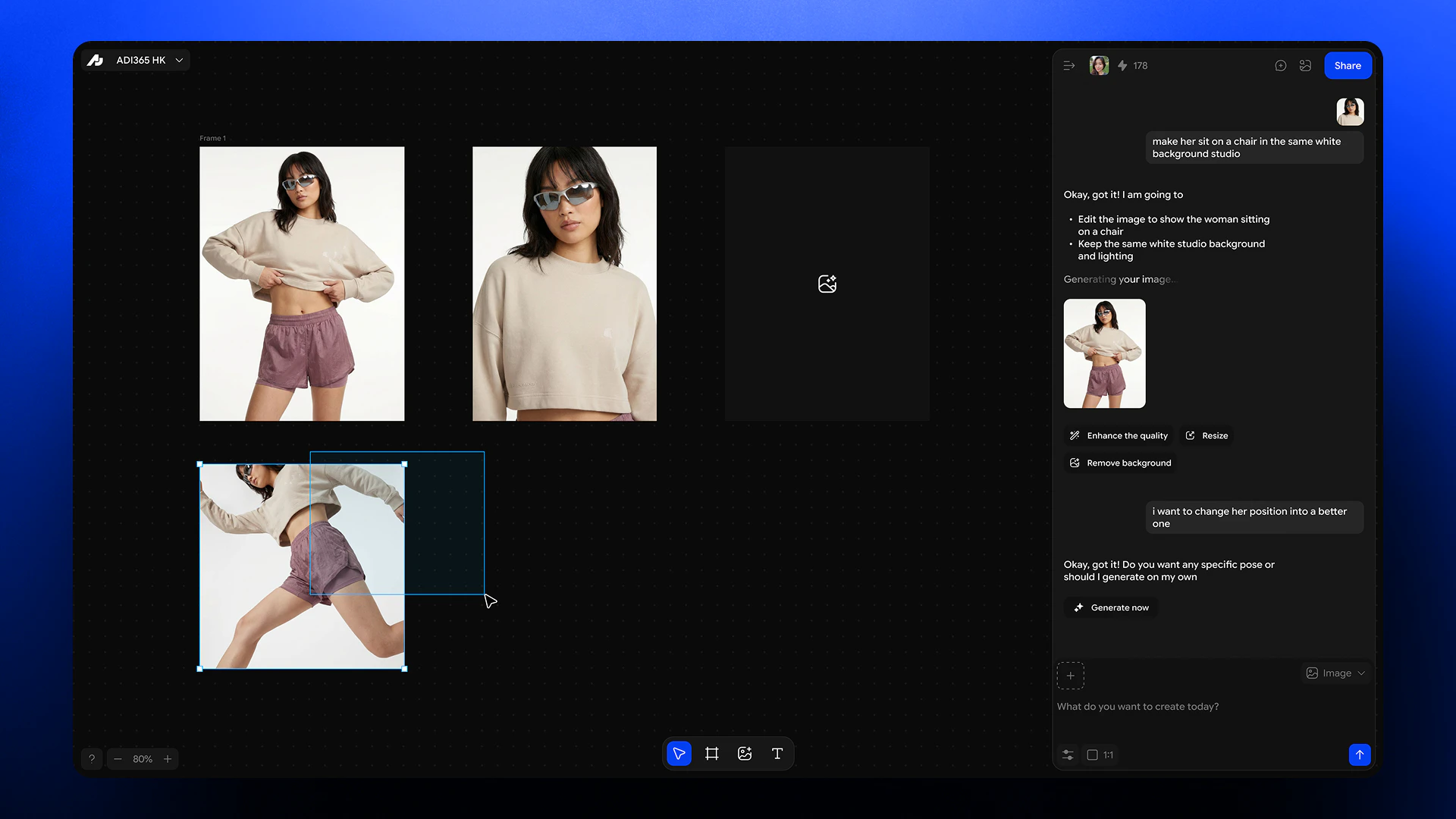
Adject 2.0 is an agentic product studio where brands can create, edit, and iterate product visuals inside an infinite creative workflow. Instead of isolated generations, products, models, edits, videos, and assets stay connected inside projects and evolve continuously over time. Upload once, generate in context, iterate visually, and build complete campaigns without fragmented tools or repetitive prompting.
AI Analysis
Adject 2.0 is an agentic AI product studio for creating hyperrealistic product visuals. Core features include connected projects where products, models, edits, videos, and assets evolve continuously, enabling upload-once contextual generation, visual iteration, and full campaign building. USPs are the infinite creative workflow replacing isolated generations and repetitive prompting. It solves pain points like fragmented tools, lack of context retention, and inefficient iteration in e-commerce and design. Value proposition: seamless, evolving visual creation that boosts efficiency for brands building campaigns.
Favorable in 2025-2026 due to maturing generative AI and agentic tech, surging e-commerce demand for cost-effective visuals amid rising content needs, and shift from traditional photography to AI tools. Economic pressures favor efficient digital solutions; policy supports AI innovation. Excellent Timing.
Medium technical difficulty for building persistent context and agentic workflows using current multimodal models, but high ongoing compute/operation costs for hyperrealistic video and iterations. Low supply chain risk, good scalability via cloud, but requires strong AI engineering team. Overall Medium feasibility due to cost management needs. Rating: Medium.
Main segments: E-commerce brands, marketing teams, product designers (ages 25-45 professionals), focused on retail/fashion/consumer goods, primarily North America and Europe. TAM for AI e-commerce visuals ~$4-6B by 2026; SAM for product imaging tools ~$800M; SOM for workflow platforms ~$80M. Core pains: fragmented AI tools, repetitive work, high photography costs. High willingness to pay for time-saving subscription tools.
Medium. Direct competitors: Pebblely (pebblely.com), Claid.ai (claid.ai), Leonardo.Ai (leonardo.ai), Ideogram (ideogram.ai), AdCreative.ai (adcreative.ai). Advantages: connected infinite workflow and agentic iteration vs. isolated generations; better context retention for campaigns. Disadvantages: potentially higher complexity/learning curve; less established than general AI tools; pricing not specified but may be premium. Strong differentiation in persistent project ecosystem.
Upgrade Pro to unlock full AI analysis
Similar Products

Auriko
Trading desk for LLM calls
▲ 332 votes

Cohere Parse 5
Turn complex docs, tables & images into AI-ready data
▲ 158 votes

Opaline
PostHog for team Claude Code and Codex sessions.
▲ 141 votes

Adapt
The company brain that gets work done
▲ 124 votes

Tapfree for Chrome
Voice dictation that adapts to what’s on your screen
▲ 122 votes

CodeBurn
See where your AI coding spend actually goes
▲ 101 votes