
Agent Interface
Give AI agents a better way to use computers
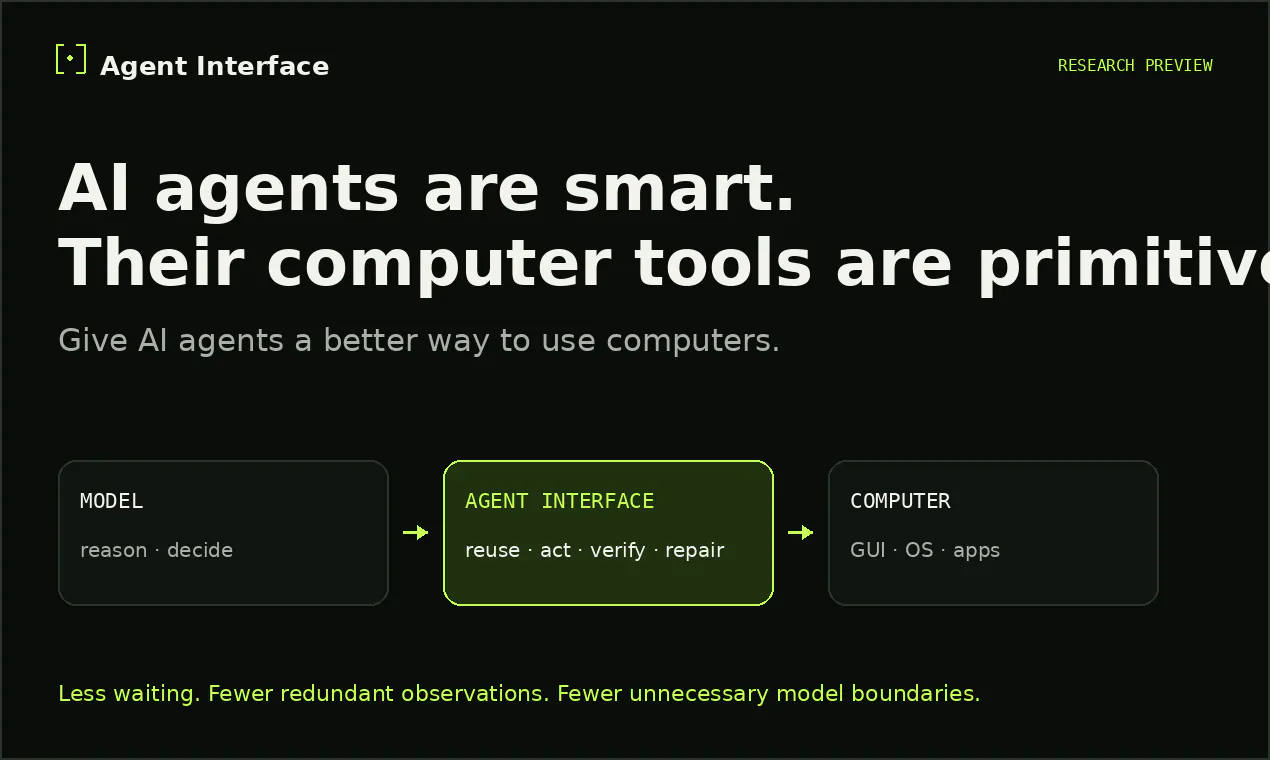
AI agents need better computer tools, not just better models. Agent Interface is an open-source layer built to cut repeated screenshots, model calls, and waiting. It reuses learned interactions, runs action-and-feedback loops locally, and asks the model when fresh judgment is needed. Start with the runnable desktop research preview, and follow the Astra/Freedoom experiments exploring control in a world that doesn't pause while AI thinks.
AI Analysis
Agent Interface is an open-source layer that improves AI agents' computer usage by reducing repeated screenshots, model calls, and latency. Key features include reusing learned interactions, running local action-and-feedback loops, and querying models only for novel judgments. It solves pain points of inefficiency and slow performance in agent workflows. Unique selling points are its focus on better interfaces over model scaling, plus experiments like Astra/Freedoom for real-time control. The desktop research preview allows immediate testing. Overall value proposition: faster, more practical AI agents for developers via open-source efficiency tools.
Favorable in 2025-2026 as AI agent adoption surges post-OpenAI advancements, with maturing multimodal tech and rising demand for practical, efficient tools beyond raw models. Open-source community thrives amid developer needs for reduced latency solutions. Economic push for AI productivity tools supports it. Excellent Timing.
High feasibility. Technical difficulty is moderate as it builds on existing models with local execution; low dev/operation costs due to open-source nature; minimal supply chain risks but some compliance for desktop tools; strong scalability in GitHub community. Key reasons: leverages current AI tech, has runnable preview, focuses on software layer without heavy hardware needs.
Main targets: AI developers, researchers, and engineers (tech-savvy, 25-45 years old) in software, automation, and AI industries, primarily in US, Europe, and China tech hubs. Estimated market: AI dev tools TAM ~$15B (2025), SAM ~$3B for agent interfaces, SOM ~$200M. Core pains: inefficient agent-computer interaction and high compute waste. High willingness to pay for premium support, hosted versions, or enterprise features.
Medium. Direct competitors: 1. Open Interpreter (openinterpreter.com), 2. Anthropic Computer Use (anthropic.com), 3. Adept (adept.ai), 4. LangChain Agents (langchain.com). Advantages: strong focus on reuse/local loops for efficiency, open-source accessibility, unique non-pausing experiments. Disadvantages: earlier stage with less maturity/integration than established frameworks; limited brand vs. big players; pricing not yet defined but open-source may limit direct revenue.
Upgrade Pro to unlock full AI analysis
Similar Products

Auriko
Trading desk for LLM calls
▲ 332 votes
Xirp
The agentic development environment built by Spotify
▲ 224 votes

React UI Kit V7
All the chat components you need. None of the complexity
▲ 115 votes

Replay QA Security Scan
Automated Penetration Testing for AI-Built Apps
▲ 102 votes

CodeBurn
See where your AI coding spend actually goes
▲ 101 votes
Blop
Describe your app and Blop tests it and repairs broken tests
▲ 80 votes