
Agnost AI
Catch agent failures your evals miss
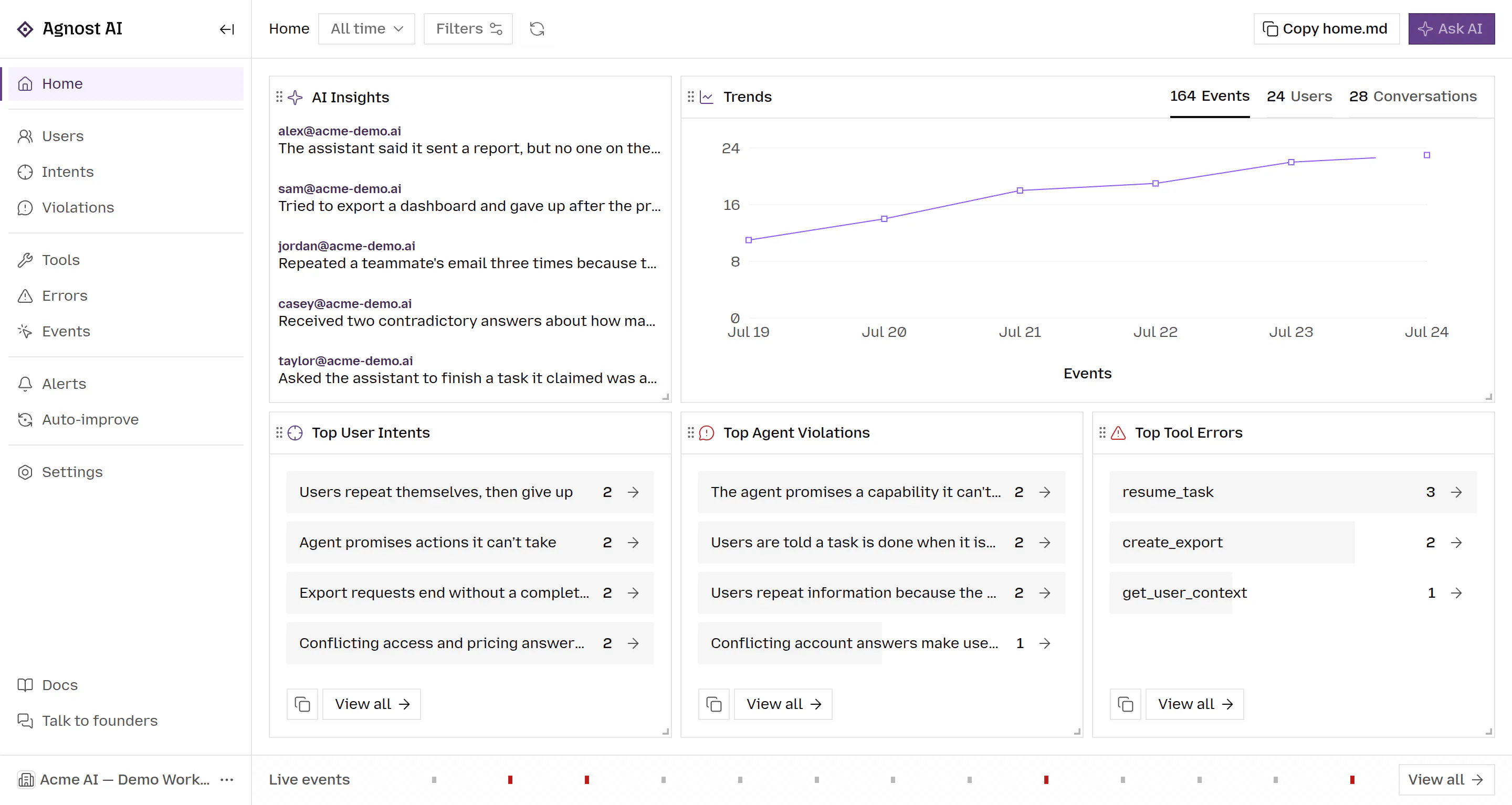
Agnost AI analyzes conversations between users and your production AI agents and discovers: silent failures, agent behavior drift, hallucinations, user frustration, hidden feature requests, and churn signals. It groups them into recurring patterns, shows the exact users and conversations behind each insight, and turns them into evals and fixes.
AI Analysis
Agnost AI analyzes conversations between users and production AI agents to detect issues missed by traditional evals, including silent failures, behavior drift, hallucinations, user frustration, hidden feature requests, and churn signals. It clusters insights into recurring patterns, provides direct links to specific users and conversations, and converts findings into actionable evals and fixes. This solves the pain of unreliable AI performance in live environments that leads to poor UX, undetected errors, and lost revenue. USP is its focus on real-world agent reliability beyond benchmarks. Value proposition: enables teams to systematically improve AI agents, reduce churn, and uncover opportunities through automated, insight-driven development.
Excellent Timing. In 2025-2026, rapid scaling of autonomous AI agents across enterprises coincides with maturing LLM technology and frameworks, yet observability lags, leading to reliability crises. User demands for trustworthy AI experiences are rising amid economic focus on AI ROI. Policy support for AI innovation and growing awareness of hallucination risks create perfect conditions for agent monitoring tools like Agnost AI.
High. Technical challenges in NLP, clustering, and LLM integration are manageable with current mature AI libraries and cloud services. Development/operation costs center on data processing but benefit from pay-as-you-go infrastructure. Low supply chain risk; compliance manageable via anonymization (GDPR considerations). Strong scalability potential for SaaS model. Best fit for teams experienced in AI/observability. Key risks are data privacy and integration breadth.
Primary segments: AI engineers, developer teams, and product managers at SaaS/tech companies deploying conversational AI agents (e.g. support, sales automation). Industries: AI startups, enterprise software, customer experience platforms. Geographic: predominantly US, Europe, with growing Asia adoption. TAM for AI observability/monitoring ~$5-10B by 2026; SAM for agent-specific tools ~$800M; SOM for early adopters ~$50M. Core pains: invisible production failures and manual debugging at scale. High willingness to pay ($100-1000+/mo) for tools preventing churn and accelerating improvements.
Medium. Direct competitors: 1. LangSmith (smith.langchain.com), 2. Langfuse (langfuse.com), 3. Helicone (helicone.ai), 4. Arize Phoenix (arize.com/phoenix), 5. AgentOps (agentops.ai). Advantages: specialized in catching 'silent failures' evals miss, automated insight-to-eval/fix pipeline, explicit focus on user frustration/churn signals with pattern grouping and conversation traceability. Disadvantages: likely newer with fewer pre-built integrations and less brand recognition than LangChain ecosystem tools; pricing may be premium without established benchmarks.
Upgrade Pro to unlock full AI analysis
Similar Products

Cohere Parse 5
Turn complex docs, tables & images into AI-ready data
▲ 158 votes

Adapt
The company brain that gets work done
▲ 124 votes

Coarena by Coasty
The arena where agents battle on real-world work
▲ 104 votes

WikiFix for Confluence
Find and fix issues in your knowledge base
▲ 86 votes

Audryo
Customer email your agent can operate.
▲ 68 votes

Refoid
Automate App Store refund responses and track every outcome
▲ 68 votes