
AI Eyes
Permission-first real-time senses for AI companions
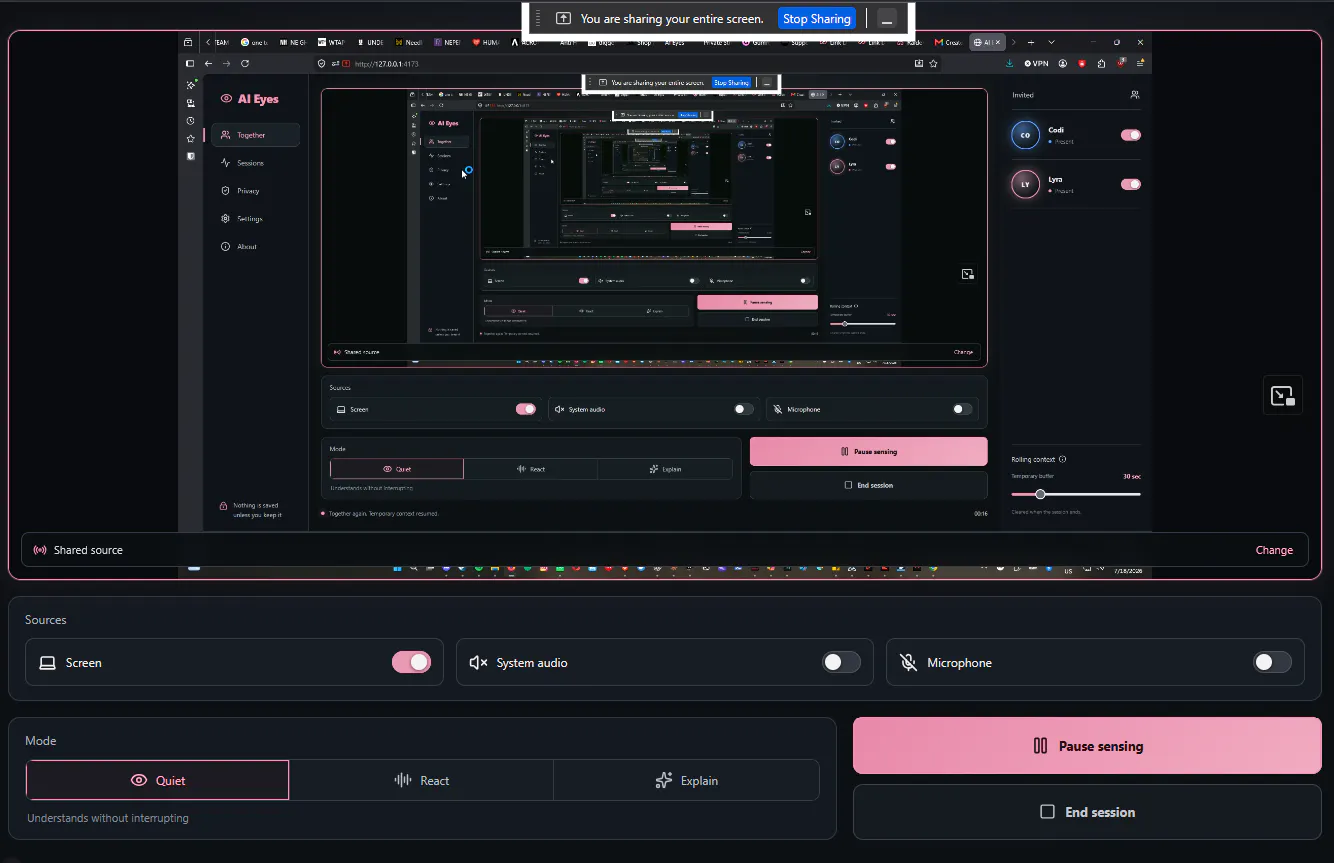
AI Eyes explores what it would take for AI companions to share the moment with you—not through hidden monitoring, but through explicit, visible permission. Choose the exact screen or window, control screen, audio, and microphone independently, invite named companions, and pause or end sensing anytime. Built with Codex and GPT‑5.6, v0.1 proves the local-first capture, presence, and session-control layer; live semantic understanding is the next milestone.
AI Analysis
AI Eyes is a permission-first tool enabling real-time screen, audio, and microphone access for AI companions through explicit user consent and granular controls. Users select specific windows, invite named companions, independently manage inputs, and pause/end sessions anytime. It addresses privacy concerns from hidden AI monitoring by emphasizing transparency, visible permissions, and local-first architecture. Built with Codex and GPT-5.6, v0.1 focuses on capture, presence, and session-control layers, with live semantic understanding upcoming. USP is ethical, consensual context-sharing for richer AI interactions without invasive surveillance. Overall value: secure, user-controlled real-time AI companionship.
The timing is favorable for 2025-2026 as AI companions and multimodal AI advance rapidly post-OpenAI innovations, with growing demand for contextual awareness. Privacy regulations are tightening globally, pushing for transparent solutions over surveillance. User demands are shifting toward ethical, consent-based AI tools amid rising concerns over data misuse. This aligns with industry trends in open-source developer tools and local-first tech. Excellent Timing.
Technical difficulty is moderate using existing OS-level capture APIs and local processing; open-source nature reduces costs. Development focuses on control layers which v0.1 has proven. Low compliance risks due to permission-first design, though privacy laws require careful implementation. Scalability to semantic understanding is viable with GPT integration. High overall, with main challenges in cross-platform compatibility and real-time performance. Rating: High.
Primary segments: AI developers and builders of companions (ages 25-40, tech professionals), privacy-conscious early adopters in AI/open-source communities, mainly in US, Europe, and global GitHub users. Estimated TAM for AI companion market ~$5-10B by 2026; SAM for privacy-focused AI tools ~$500M; SOM for permissioned real-time layers ~$50M. Core pain points: lack of safe contextual input for AI without privacy invasion. Potential willingness to pay: medium-high for premium developer features or enterprise versions.
Competition level: Low. Direct competitors: 1. Rewind.ai (rewind.ai) - continuous screen recording AI; 2. Limitless.ai (limitless.ai) - AI memory companion with wearables; 3. Hume.ai (hume.ai) - real-time empathetic AI interfaces; 4. Open Interpreter (openinterpreter.com) - open-source computer control agents. Advantages: superior explicit permission controls, named companions, independent input management, and open-source local-first focus vs. often invasive competitors. Disadvantages: early v0.1 stage lacking full semantic features; competitors may have more mature multimodal integration. Strong differentiation on privacy and consent.
Upgrade Pro to unlock full AI analysis
Similar Products

Opaline
PostHog for team Claude Code and Codex sessions.
▲ 141 votes

React UI Kit V7
All the chat components you need. None of the complexity
▲ 115 votes

Replay QA Security Scan
Automated Penetration Testing for AI-Built Apps
▲ 102 votes

CodeBurn
See where your AI coding spend actually goes
▲ 101 votes

Audryo
Customer email your agent can operate.
▲ 68 votes

Refoid
Automate App Store refund responses and track every outcome
▲ 68 votes