
AI Usage, Under Control
Stigg 2.0 - The Usage Runtime for AI Products
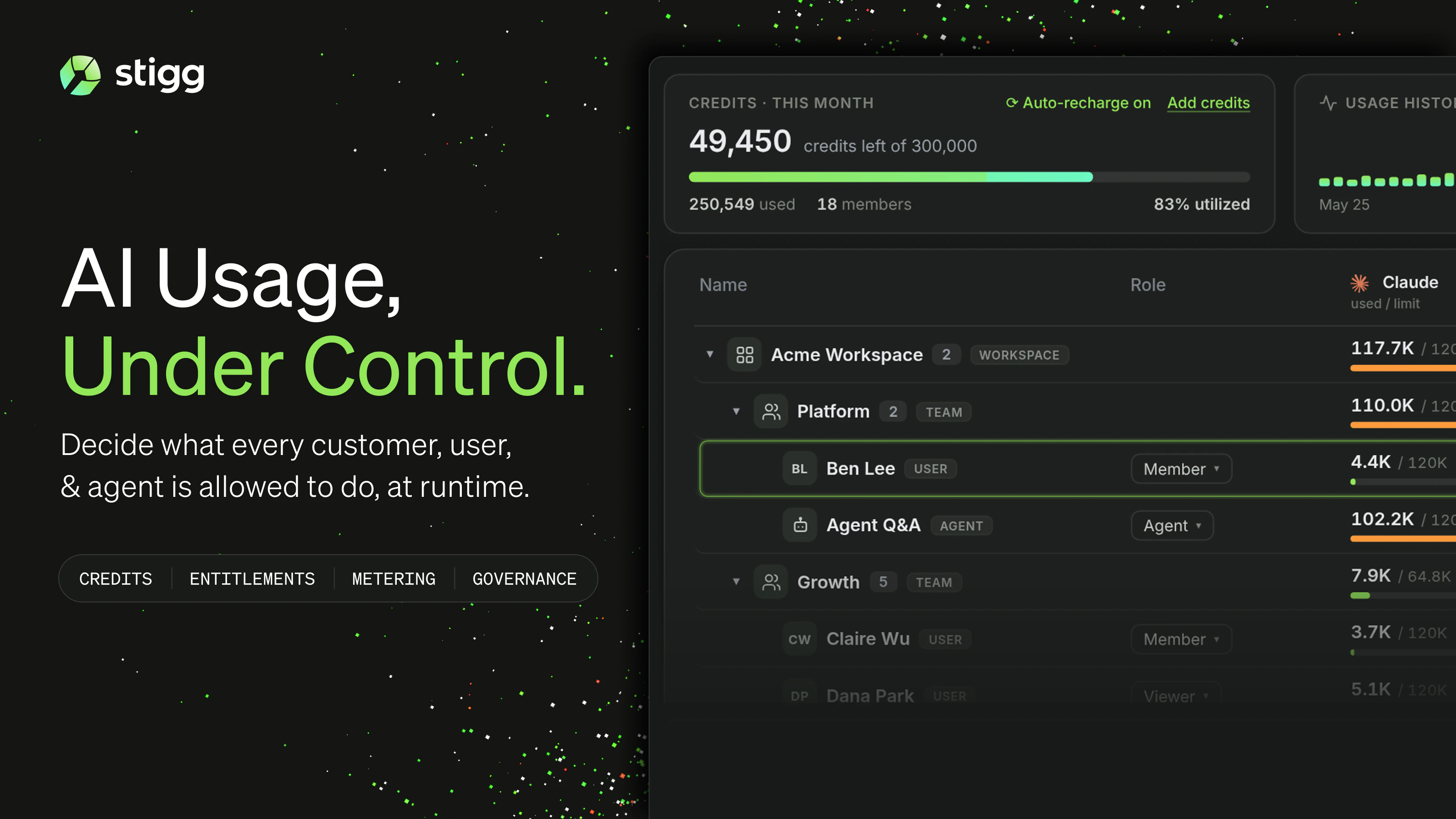
Stigg is the usage runtime for AI products: the real-time enforcement and governance layer between your app and your billing stack. It decides what every customer, user, team, and agent can do, the moment they try. Millisecond credit checks, zero overdraft, enterprise governance, and modular BYOC. Metering, credits, entitlements, and governance in one runtime. Enforce in the request path instead of reconciling on the invoice. Free forever for AI startups.
AI Analysis
Stigg 2.0 is the usage runtime for AI products, serving as a real-time enforcement and governance layer between your app and billing stack. Core features include millisecond credit checks, metering, credits, entitlements, zero-overdraft controls, enterprise governance, and modular BYOC support. It enforces decisions in the request path instead of post-invoice reconciliation. USP: combines all usage logic in one high-performance runtime, free forever for AI startups. It solves key pain points like uncontrolled AI spend, overdrafts from usage-based pricing, lack of instant governance for users/teams/agents, and complex billing integrations. Value proposition: precise, real-time control to prevent cost overruns while enabling scalable AI product monetization.
In 2025-2026, AI adoption is surging with token-based consumption, multi-agent systems, and enterprise AI platforms driving demand for real-time cost controls and governance. Technology for low-latency enforcement is mature, user demands for predictable spend are rising amid high AI inference costs, and economic pressures favor spend-optimization tools. Policy support for AI innovation further helps. This is Excellent Timing as usage-based AI billing becomes standard but remains hard to manage.
Technical difficulty is medium-high due to need for global low-latency enforcement and reliable integrations, but the product is already built and launched. Dev/ops costs are typical for SaaS with usage-based scaling. Low supply chain risk, moderate compliance risks (data privacy for enterprises). Strong scalability via cloud-native design and proven team fit for dev tools space. Overall rating: High, supported by free tier lowering adoption barriers and modular architecture.
Main segments: AI/SaaS startup founders, backend/AI engineers, product managers at AI companies, and enterprise teams building internal AI tools. Industries: artificial intelligence, developer tools, B2B SaaS. Geographic focus: primarily US and Western Europe tech hubs. Estimated market: AI infrastructure tools TAM >$50B by 2026; SAM for usage/governance platforms ~$2-5B; SOM for real-time AI runtimes ~$200-500M. Core pains: unpredictable token costs, governance for AI agents, preventing unauthorized usage. High willingness to pay for products preventing bill shocks and enabling compliance.
Competition Level: Medium. Direct competitors: 1. Orb (orb.com) - usage billing infrastructure; 2. Metronome (metronome.com) - modern usage billing; 3. Lago (getlago.com) - open-source metering/billing; 4. OpenMeter (openmeter.com) - real-time metering; 5. Stripe (stripe.com/billing) - usage-based billing add-ons. Advantages vs competitors: true real-time request-path enforcement (vs reconciliation), AI-specific agent/team governance, zero-overdraft guarantees, free forever for AI startups, all-in-one runtime. Disadvantages: potentially fewer enterprise integrations and brand recognition compared to Stripe or Orb, newer positioning in the AI runtime niche.
Upgrade Pro to unlock full AI analysis
Similar Products

Cohere Parse 5
Turn complex docs, tables & images into AI-ready data
▲ 158 votes

Opaline
PostHog for team Claude Code and Codex sessions.
▲ 141 votes

Adapt
The company brain that gets work done
▲ 124 votes

Tapfree for Chrome
Voice dictation that adapts to what’s on your screen
▲ 122 votes

Replay QA Security Scan
Automated Penetration Testing for AI-Built Apps
▲ 102 votes

Refoid
Automate App Store refund responses and track every outcome
▲ 68 votes