AirProof AI
Find the best spot for your air purifier in seconds
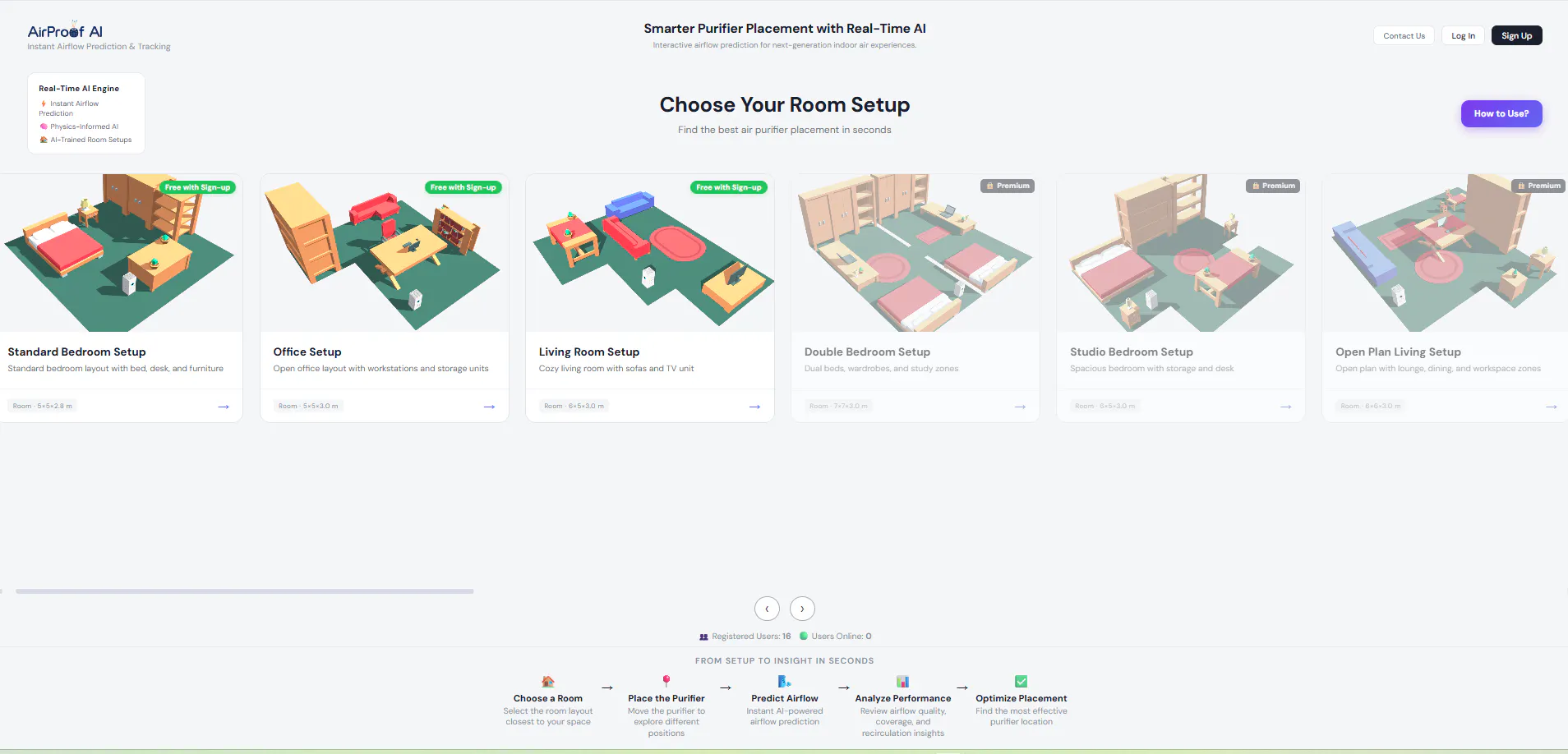
Most people don't know where to place their air purifier for maximum effectiveness.AirProof AI allows users to test different purifier locations, visualize realistic indoor airflow in seconds, and compare key performance metrics including airflow efficiency, coverage quality, recirculation risk, and overall effectiveness.Unlike generic placement recommendations by manufacturers,AirProof AI shows how airflow actually changes inside a room and can automatically optimize purifier placement using AI
AI Analysis
AirProof AI solves the key pain point that most people don't know where to place their air purifier for maximum effectiveness. Core features include testing different locations, generating realistic indoor airflow visualizations in seconds, comparing metrics such as airflow efficiency, coverage quality, recirculation risk, and overall effectiveness, plus AI-powered automatic optimization of purifier placement. Its unique selling point is delivering personalized, data-driven insights into how airflow actually changes in a user's specific room, going far beyond generic manufacturer recommendations. The overall value proposition is helping users maximize their existing air purifier's performance to achieve better indoor air quality efficiently.
The current market timing is favorable due to continued emphasis on indoor air quality and health post-pandemic, rapid AI technology maturation for simulations and optimization in 2025-2026, growing smart home adoption, and increasing consumer demand for personalized home environment tools amid climate and pollution concerns. Excellent Timing.
Overall feasibility is High. Technical difficulty is manageable by leveraging existing AI models to approximate airflow simulations rather than full CFD computations, keeping development and operation costs moderate for a SaaS platform. Low supply chain or compliance risks as it is pure software. Strong scalability potential via cloud infrastructure, though it requires quality training data and user-friendly room modeling input. Key risks are ensuring simulation accuracy across varied real-world rooms.
Main target segments: Tech-savvy homeowners and renters aged 30-55 with higher disposable income, focused on health and wellness, primarily in urban and suburban areas of North America, Europe, and Asia with elevated pollution or allergy concerns. The product fits the growing smart home and indoor air quality sector. Core pain points include uncertainty about purifier effectiveness and poor placement reducing benefits. Estimated market size is a niche within the multi-billion dollar global air purifier and IAQ market. Users show strong willingness to pay for tools that optimize expensive hardware via subscription.
Competition level is Low. Direct competitors: 1. Dyson app and placement guides (dyson.com), 2. Blueair Friend app (blueair.com), 3. Manufacturer tools from Levoit/Coway, 4. General IAQ apps like Airthings Wave (airthings.com), 5. IQAir air visual tools (iqair.com). Advantages: Highly specific AI simulation and visualization of airflow changes with auto-optimization, far beyond static advice. Disadvantages: New entrant may face challenges in building trust around simulation accuracy and requires user effort to model rooms compared to simpler manufacturer checklists.
Upgrade Pro to unlock full AI analysis
Similar Products

Auriko
Trading desk for LLM calls
▲ 332 votes

Cohere Parse 5
Turn complex docs, tables & images into AI-ready data
▲ 158 votes

Adapt
The company brain that gets work done
▲ 124 votes

Tapfree for Chrome
Voice dictation that adapts to what’s on your screen
▲ 122 votes

CodeBurn
See where your AI coding spend actually goes
▲ 101 votes

Saldor
Speed up procurement and AP.
▲ 78 votes