
Ajelix AI Agent for Work
The first truly agentic AI sidebar for Google Workspace™
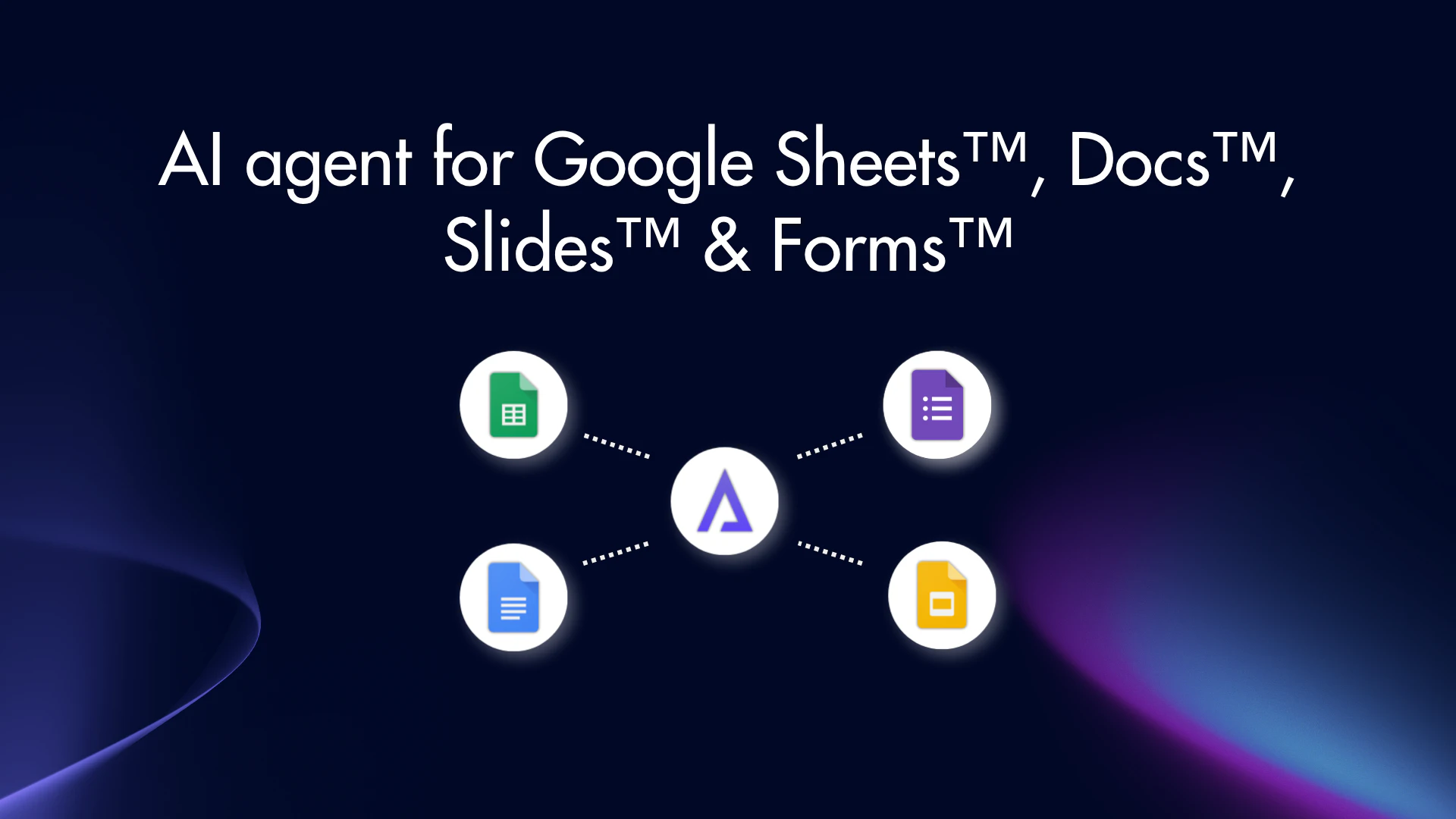
Ajelix’s AI agents are now available inside your Google Sheets™, Docs™, Slides™, and Forms™. Your selected agent can research the web, write and execute Google Apps Scripts, build charts and visualizations, design presentations, calculate and analyze data, draft content, and deliver finished, production-ready results. Built for Digital Professionals, Managers, Founders and SMBs.
AI Analysis
Ajelix AI Agent for Work is an agentic AI sidebar integrated into Google Sheets, Docs, Slides, and Forms. Core features enable agents to research the web, write and execute Google Apps Scripts, build charts/visualizations, design presentations, analyze/calculate data, draft content, and produce finished results. USP is being the first truly autonomous agentic AI for Google Workspace. It solves pain points for digital professionals, managers, founders, and SMBs including time-consuming manual tasks, limited scripting skills, tool-switching overhead, and slow workflow execution. Value proposition: Boosts productivity by automating complex, multi-step processes directly within familiar Google apps to deliver production-ready outputs.
Favorable in 2025-2026 as agentic AI matures with better LLM reasoning, tool-use capabilities, and reliability. Google Workspace's 3B+ users demand deeper AI automation amid remote work trends and efficiency pressures on SMBs. Economic environment favors productivity tools that reduce labor costs. AI policy support for business innovation is positive. Excellent Timing.
Technically feasible using existing LLMs, Google APIs, and Apps Script execution, though challenges remain in agent reliability, hallucination control, and permission management. Moderate dev/operation costs from API calls and maintenance; low supply chain risk but data privacy/compliance (GDPR, Google add-on policies) essential. Strong scalability as SaaS. High team fit for AI productivity tools. High.
Main segments: Digital professionals (analysts, marketers), managers, founders, and SMB employees (25-45 years old, tech-savvy). Industries: Marketing, operations, finance, general business. Geographic: Global with concentration in US, Europe. TAM: AI-powered productivity market ~$50B+ by 2026; SAM: Google Workspace add-ons/AI tools ~$2-5B; SOM: $50-200M. Core pains: Repetitive manual work, lack of coding expertise, slow insight generation. High willingness to pay ($10-50/user/mo) for time savings.
Medium. Direct competitors: 1. Gemini for Google Workspace (gemini.google.com), 2. Coefficient (coefficient.io), 3. GPT for Sheets (gptforsheets.com), 4. Julius (julius.ai), 5. Rows (rows.com). Advantages: True agentic autonomy with script execution, multi-app coverage (Sheets/Docs/Slides/Forms), focus on production-ready deliverables. Disadvantages: Potentially higher learning curve, less established brand than Google Gemini, dependency on underlying LLMs for consistency. Strong differentiation via 'first truly agentic' positioning and deep Workspace scripting integration.
Upgrade Pro to unlock full AI analysis
Similar Products

Auriko
Trading desk for LLM calls
▲ 332 votes

Cohere Parse 5
Turn complex docs, tables & images into AI-ready data
▲ 158 votes

Opaline
PostHog for team Claude Code and Codex sessions.
▲ 141 votes

Adapt
The company brain that gets work done
▲ 124 votes

Tapfree for Chrome
Voice dictation that adapts to what’s on your screen
▲ 122 votes

CodeBurn
See where your AI coding spend actually goes
▲ 101 votes