
Arkor
Fine-tune and Deploy Open-weight Models in TypeScript
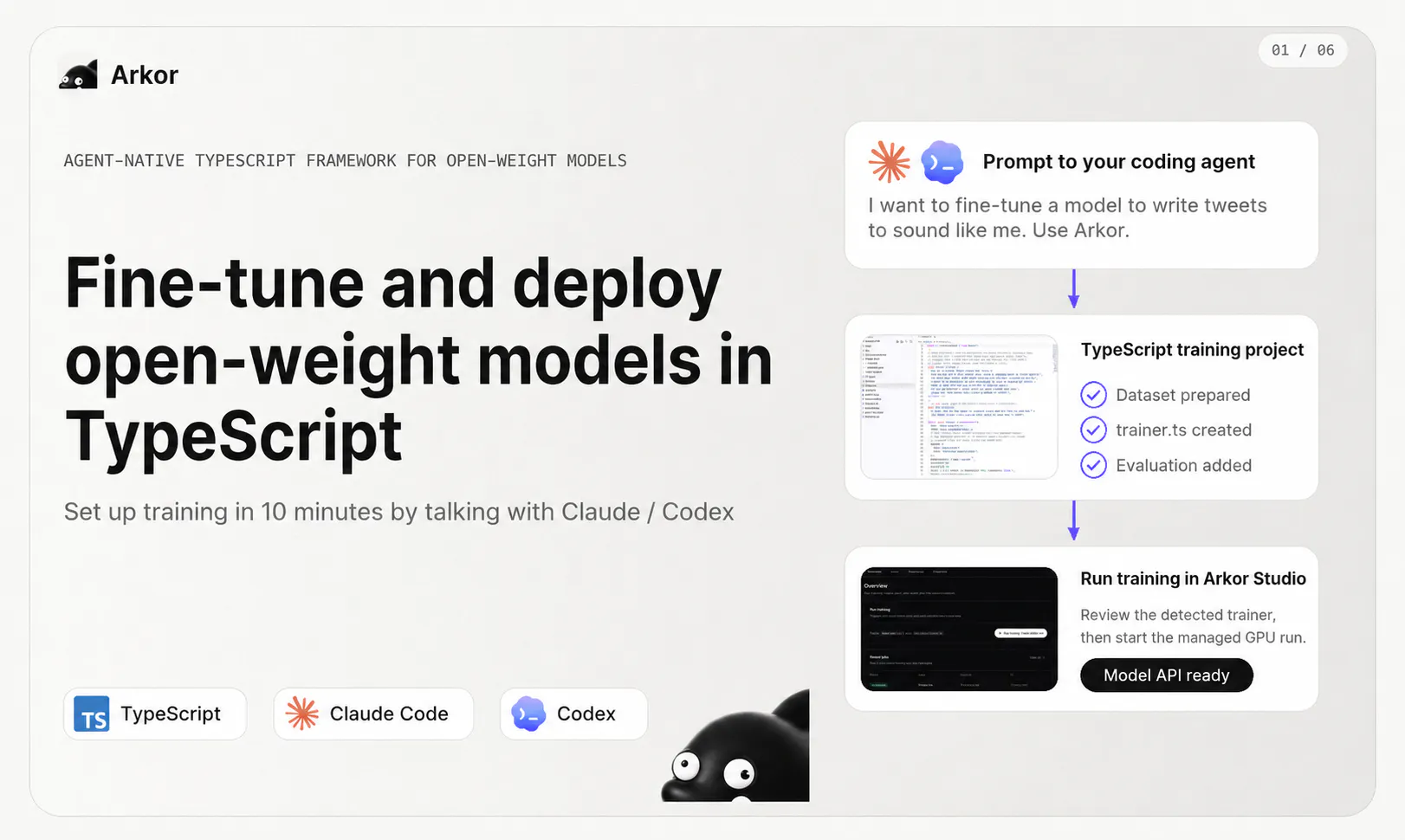
Start a real LLM training in 10 minutes. Tell Claude Code or Codex what the model is for; they prepare the datasets and create the training project. Click "Run Training" in the local studio. Arkor runs the training, and deploys the trained model as an OpenAI-compatible API. Think Next.js and Vercel for fine-tuning: code you can review, infrastructure you do not have to manage, and a model your app can call. No GPU setup. No ML expertise required. No Python training code to write.
AI Analysis
Arkor allows developers to fine-tune and deploy open-weight LLMs in TypeScript without GPUs, ML expertise, or Python code. Users describe the model purpose to Claude/CodeX, which auto-generates datasets and a training project. Training runs via a local studio with one click, then deploys as an OpenAI-compatible API. It solves steep learning curves, complex infra setup, and opaque training processes. USP is a Next.js/Vercel-like experience: auditable code, zero management overhead, and instant app integration for custom models.
In 2025-2026, exploding adoption of open-source LLMs (Llama, Mistral), rising demand for customization without deep ML skills, maturing cloud AI infrastructure, and developer shift toward integrated TS/JS workflows make this highly favorable. Economic focus on AI efficiency further supports it. Excellent Timing.
Medium technical difficulty via cloud abstraction and existing fine-tuning libs (likely LoRA), but high GPU/compute operation costs during training pose risks. Strong scalability potential once abstracted; low compliance issues for dev tool. Requires AI infra expertise for reliable execution. Medium
Primary users: TypeScript/JavaScript developers, indie hackers, AI app builders, small SaaS teams. Industries: web/SaaS development, consumer AI apps. Mostly global with concentration in US/Europe tech hubs. TAM for AI dev tools ~$20B+, SAM for fine-tuning platforms ~$2-5B, SOM for accessible TS-focused tools ~$300-500M. Pain points: complex setup and expertise barriers. High willingness to pay for simplified workflows ($29-99/mo likely).
Medium. Direct competitors: 1. Hugging Face AutoTrain (huggingface.co), 2. OpenPipe (openpipe.ai), 3. Predibase (predibase.com), 4. Together AI (together.ai), 5. Replicate (replicate.com). Advantages: TS-native, AI-assisted project gen, Vercel-like simplicity, no-code training start. Disadvantages: newer entrant, potentially higher per-training costs, less enterprise features or model variety than incumbents.
Upgrade Pro to unlock full AI analysis
Similar Products

Opaline
PostHog for team Claude Code and Codex sessions.
▲ 141 votes

React UI Kit V7
All the chat components you need. None of the complexity
▲ 115 votes

Replay QA Security Scan
Automated Penetration Testing for AI-Built Apps
▲ 102 votes

CodeBurn
See where your AI coding spend actually goes
▲ 101 votes

Audryo
Customer email your agent can operate.
▲ 68 votes

Refoid
Automate App Store refund responses and track every outcome
▲ 68 votes