Atlas
Every AI tool you use should know how your company works
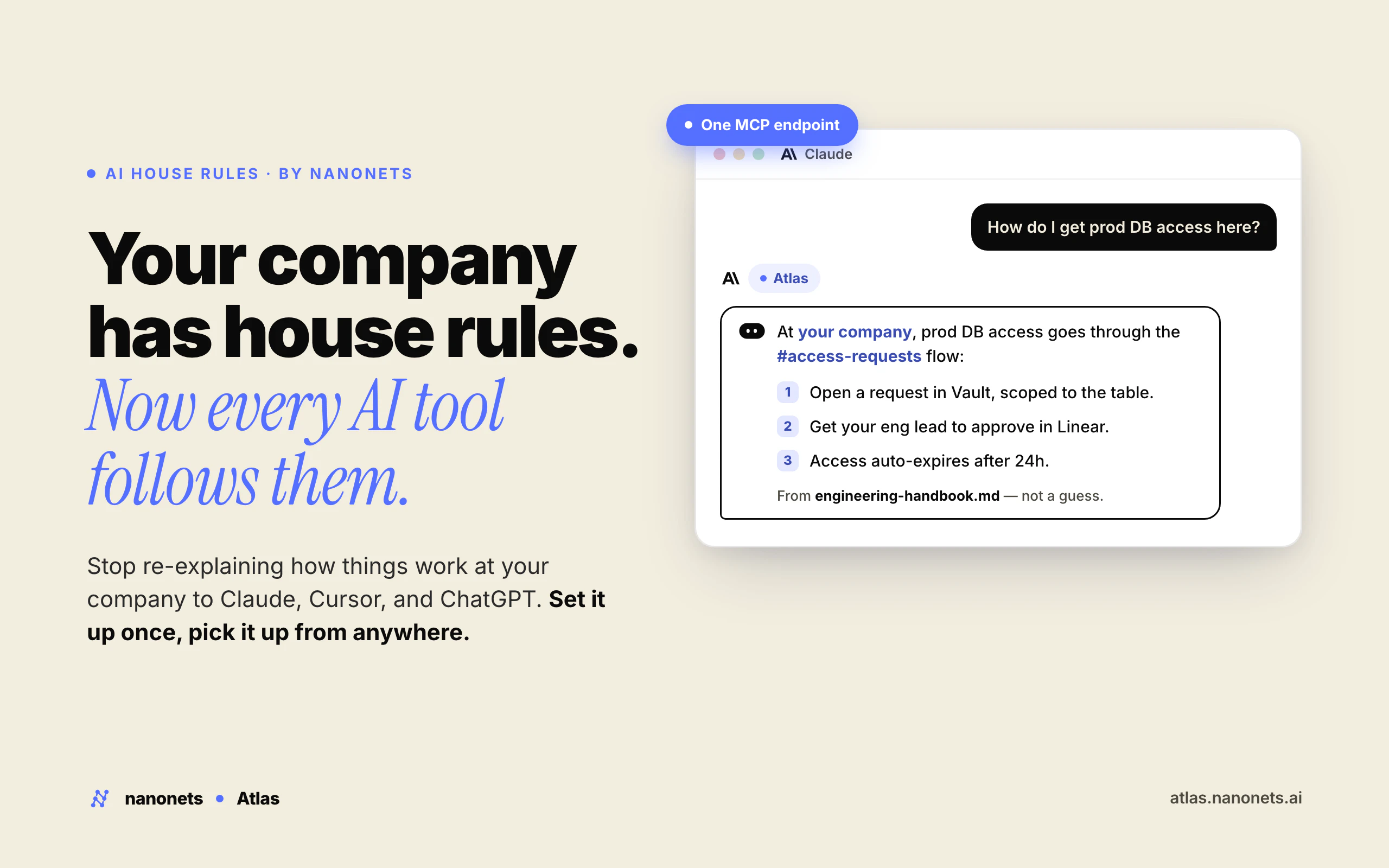
Your company has house rules. Now every AI tool follows them.
AI Analysis
Atlas allows companies to define house rules, policies, knowledge, and guidelines so every AI tool (like ChatGPT, Claude) automatically follows them. Core features include centralized rule management and seamless integration across AI platforms for consistent outputs. It solves key pain points: inconsistent or non-compliant AI responses, lack of company context, brand misalignment, and repeated manual prompting. USP is transforming generic AI into organization-aware tools without per-tool customization. Value proposition: Enables safe, efficient, on-brand AI adoption at scale for enterprises.
In 2025-2026, enterprise AI adoption is surging with mature LLM APIs and rising demand for governance, compliance, and customization amid regulatory scrutiny (e.g., EU AI Act). User needs have shifted from experimentation to controlled scaling. Excellent Timing as companies seek solutions to manage AI chaos precisely when tool proliferation peaks.
High feasibility. Technical difficulty is medium via API wrappers, prompt injection, and RAG without training custom models. Moderate dev/ops costs as SaaS. Low supply chain risks; compliance focuses on data privacy (addressable). Strong scalability in cloud. Team fit good for AI/SaaS builders. Key risks are integration maintenance with evolving AI providers.
Main segments: Mid-to-large SaaS/tech companies, marketing/ops teams in regulated industries (finance, healthcare), primarily US/Europe-based knowledge workers. TAM for enterprise AI management software ~$10B+, SAM for context/governance tools ~$2B, SOM ~$300M. Core pains: AI outputs violating policies or missing internal knowledge. High willingness to pay for per-seat or usage-based enterprise plans to mitigate risks.
Medium. Direct competitors: 1. Dust (dust.tt), 2. Glean (glean.com), 3. CustomGPT.ai (customgpt.ai), 4. Dify.ai (dify.ai). Advantages: Broad 'any AI tool' enforcement of house rules with simple setup vs building separate assistants; strong focus on company-wide consistency. Disadvantages: Newer entrant may have fewer pre-built integrations and less brand recognition than established players; potentially higher dependency on third-party AI updates.
Upgrade Pro to unlock full AI analysis
Similar Products

Cohere Parse 5
Turn complex docs, tables & images into AI-ready data
▲ 158 votes

Deliveryman.ai
Cold email infrastructure on autopilot without Gsuite
▲ 155 votes

Opaline
PostHog for team Claude Code and Codex sessions.
▲ 141 votes

Adapt
The company brain that gets work done
▲ 124 votes

Tapfree for Chrome
Voice dictation that adapts to what’s on your screen
▲ 122 votes

CodeBurn
See where your AI coding spend actually goes
▲ 101 votes