
Aye
Your teachable AI intern for everyday browser work
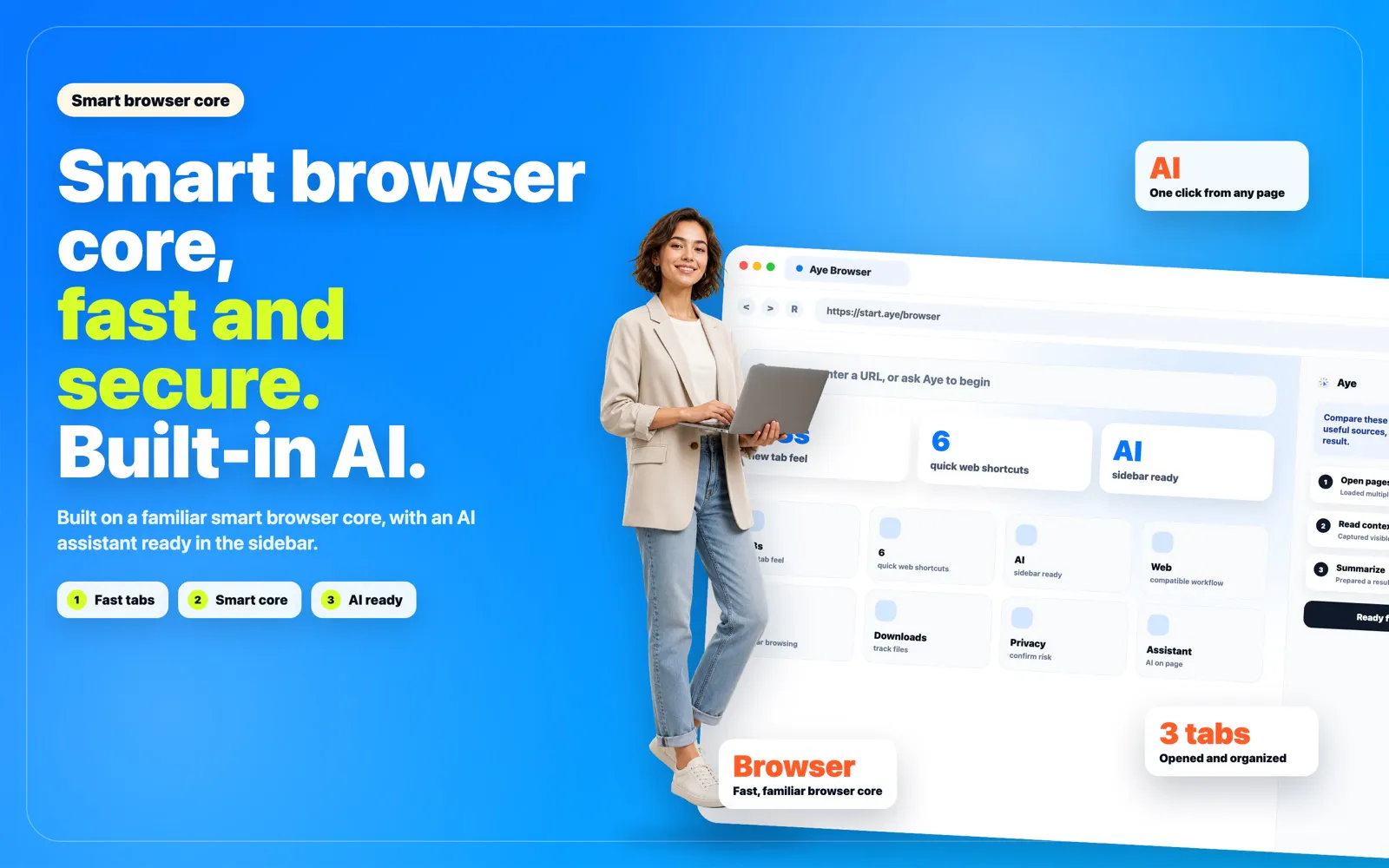
Aye is a Chromium-based AI browser for macOS and Windows that gives web work a teachable AI intern. It reads visible pages, plans steps, and works through normal browser actions: clicking, typing, scrolling, switching tabs, and checking results. Summarize pages, research across tabs, draft replies, and automate repeatable workflows. Turn recurring tasks into reusable skills, separate accounts with profiles, and stay in control with reviewable progress and approval for sensitive steps.
AI Analysis
Aye is a Chromium-based AI browser for macOS and Windows acting as a teachable AI intern for web work. It reads visible pages, plans steps, and executes native browser actions like clicking, typing, scrolling, tab switching, and verifying results. Key features include page summarization, cross-tab research, email drafting, and turning repeatable tasks into reusable skills. It supports separate profiles for multiple accounts and maintains user control via reviewable progress and approvals for sensitive actions. It solves pain points of repetitive manual browsing, inefficient research, and lack of automation in traditional browsers, delivering major productivity gains through controllable AI automation.
The market timing is favorable entering 2025-2026. AI agent technology with vision and action capabilities is rapidly maturing (e.g. multimodal LLMs), user demand for browser automation and productivity tools is surging due to information overload and remote/hybrid work trends. Economic pressures favor tools that amplify individual output. No major regulatory barriers specific to AI browsers are apparent. Excellent Timing.
Technical difficulty is significant: requires robust visual page understanding, reliable cross-site action execution, and error recovery. Inference and compute costs for real-time AI are high. Privacy/compliance risks exist with automated browsing of user accounts. However, leveraging Chromium lowers base engineering barriers and cloud scaling is feasible. Team fit depends on AI engineering expertise. Overall feasibility is Medium due to real-world web UI variability and reliability challenges.
Primary users are knowledge workers, researchers, digital marketers, virtual assistants, and SMB owners (ages 25-45) in tech, consulting, finance, and e-commerce. Geographically concentrated in North America, Europe, and Asia-Pacific English-speaking markets. AI productivity TAM exceeds $100B; SAM for web automation ~$5B; SOM for teachable browser agents ~$200-500M. Core pain points: time lost on repetitive browsing, multi-tab research, and manual workflows. High willingness to pay for proven time savings (subscription model expected).
Competition level is Medium. Direct competitors: 1. MultiOn (multion.ai), 2. Bardeen (bardeen.ai), 3. Skyvern (skyvern.com), 4. Browserbase (browserbase.com), 5. Anthropic Claude with Computer Use. Advantages: native Chromium browser integration, teachable/reusable skills, account profiles, and explicit human-in-the-loop approvals for control. Disadvantages: potentially higher learning curve and resource demands than lightweight plugins, newer player with less established trust, and AI reliability may vary across complex sites compared to specialized automation tools.
Upgrade Pro to unlock full AI analysis
Similar Products

Cohere Parse 5
Turn complex docs, tables & images into AI-ready data
▲ 158 votes

Opaline
PostHog for team Claude Code and Codex sessions.
▲ 141 votes

Adapt
The company brain that gets work done
▲ 124 votes

Kosshi
Simple, fast outliner for Mac and iPhone.
▲ 90 votes

WikiFix for Confluence
Find and fix issues in your knowledge base
▲ 86 votes

Refoid
Automate App Store refund responses and track every outcome
▲ 68 votes