
BearDrive
Turn your AI agents' files into your team's work
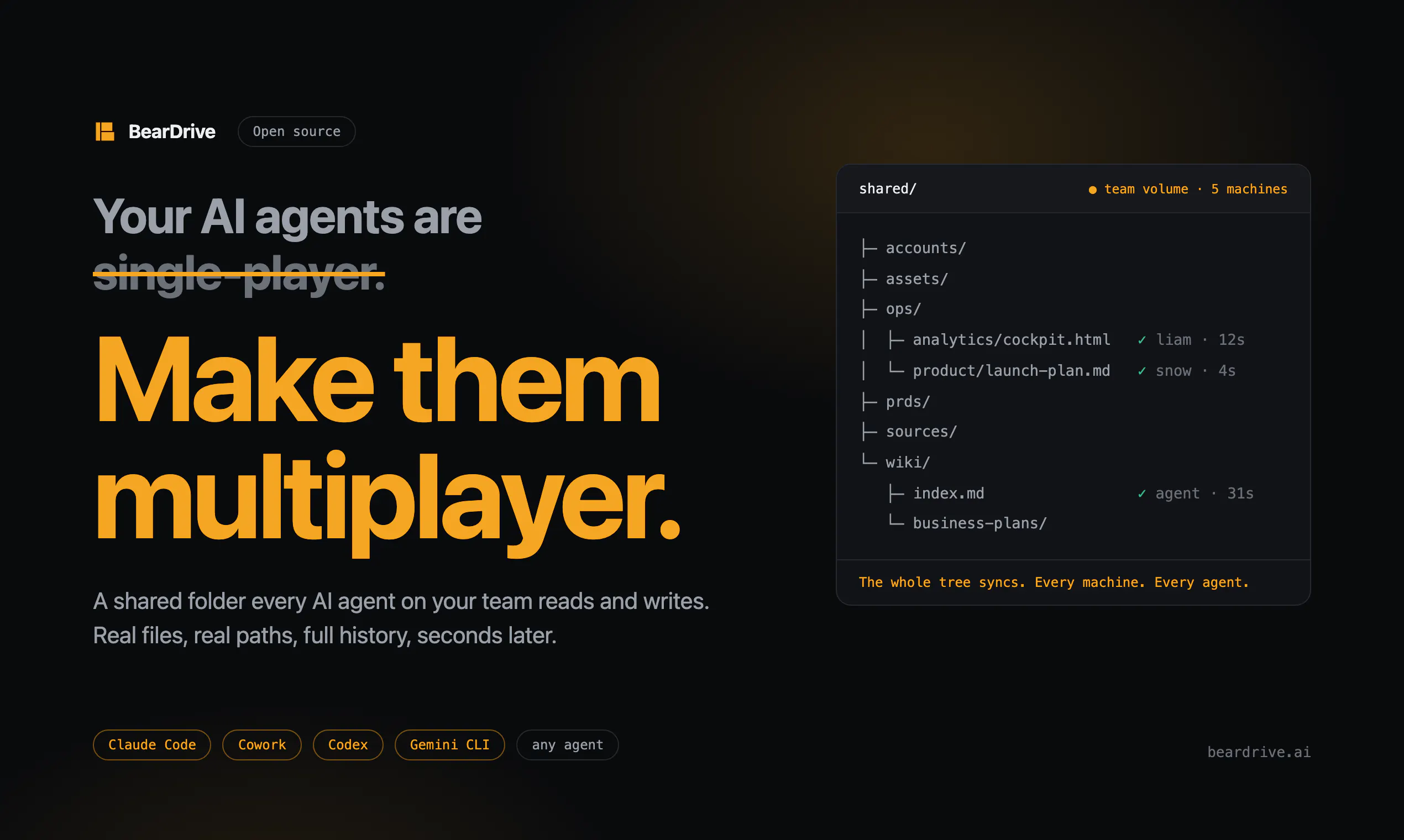
Your AI agents create real files on your laptop: research, plans, decks, data. BearDrive syncs them to your team with versions, authorship, and links, so teammates and their agents can reuse them. No new workspace to adopt. Your filesystem is the shared surface.
AI Analysis
BearDrive turns files generated by AI agents on personal laptops (research, plans, decks, data) into shareable team assets by syncing them with versions, authorship tracking, and reusable links. It eliminates the need for new workspaces or tools, using the existing filesystem as the collaborative surface. This solves key pain points like isolated AI outputs, lack of visibility into agent-generated content, and inefficient reuse across teams. The value proposition is seamless integration of AI and human workflows, boosting productivity without disrupting established habits.
In 2025-2026, explosive growth in AI agents and multi-agent systems, combined with rising enterprise adoption of AI for content creation, creates strong demand for tools bridging AI outputs with team collaboration. Technology maturity in LLMs and local agent execution is high, user demands for frictionless AI-human workflows are increasing, and economic focus on AI productivity tools supports this. Excellent Timing.
Technical difficulty is medium as it extends familiar file sync mechanisms with AI agent monitoring and metadata layers. Development costs are manageable for a sync service; operational costs involve cloud storage. Low supply chain risk but data privacy compliance (GDPR) is key. Strong scalability via cloud. Overall High feasibility for teams experienced in dev tools. High
Main segments: AI engineers, developers, product teams in tech startups and mid-size software companies (demographics: 25-40 years old tech professionals), primarily US and Europe. TAM for AI productivity software is large (~$100B+ by 2026), SAM for team AI collaboration tools ~$10B, SOM for agent-file sync niche ~$500M. Core pains: fragmented AI-generated files and poor team reusability. High willingness to pay for time-saving integration (subscription model likely).
Medium. Direct competitors: 1. Dropbox (dropbox.com) - broad file sync without AI agent focus; 2. Google Drive (drive.google.com) - collaborative storage but no native AI file attribution; 3. GitHub (github.com) - version control mainly for code; 4. Notion (notion.so) - AI-enhanced workspace but requires new adoption; 5. Coda (coda.io) - doc platform with AI. Advantages: deep AI agent integration and zero new workspace friction. Disadvantages: narrower scope than general drives, potentially higher learning curve for non-technical teammates.
Upgrade Pro to unlock full AI analysis
Similar Products

Cohere Parse 5
Turn complex docs, tables & images into AI-ready data
▲ 158 votes

Opaline
PostHog for team Claude Code and Codex sessions.
▲ 141 votes

Adapt
The company brain that gets work done
▲ 124 votes

Replay QA Security Scan
Automated Penetration Testing for AI-Built Apps
▲ 102 votes

Kosshi
Simple, fast outliner for Mac and iPhone.
▲ 90 votes

Refoid
Automate App Store refund responses and track every outcome
▲ 68 votes