
BrickForgerAI
Turn any prompt into a brick set you can actually build
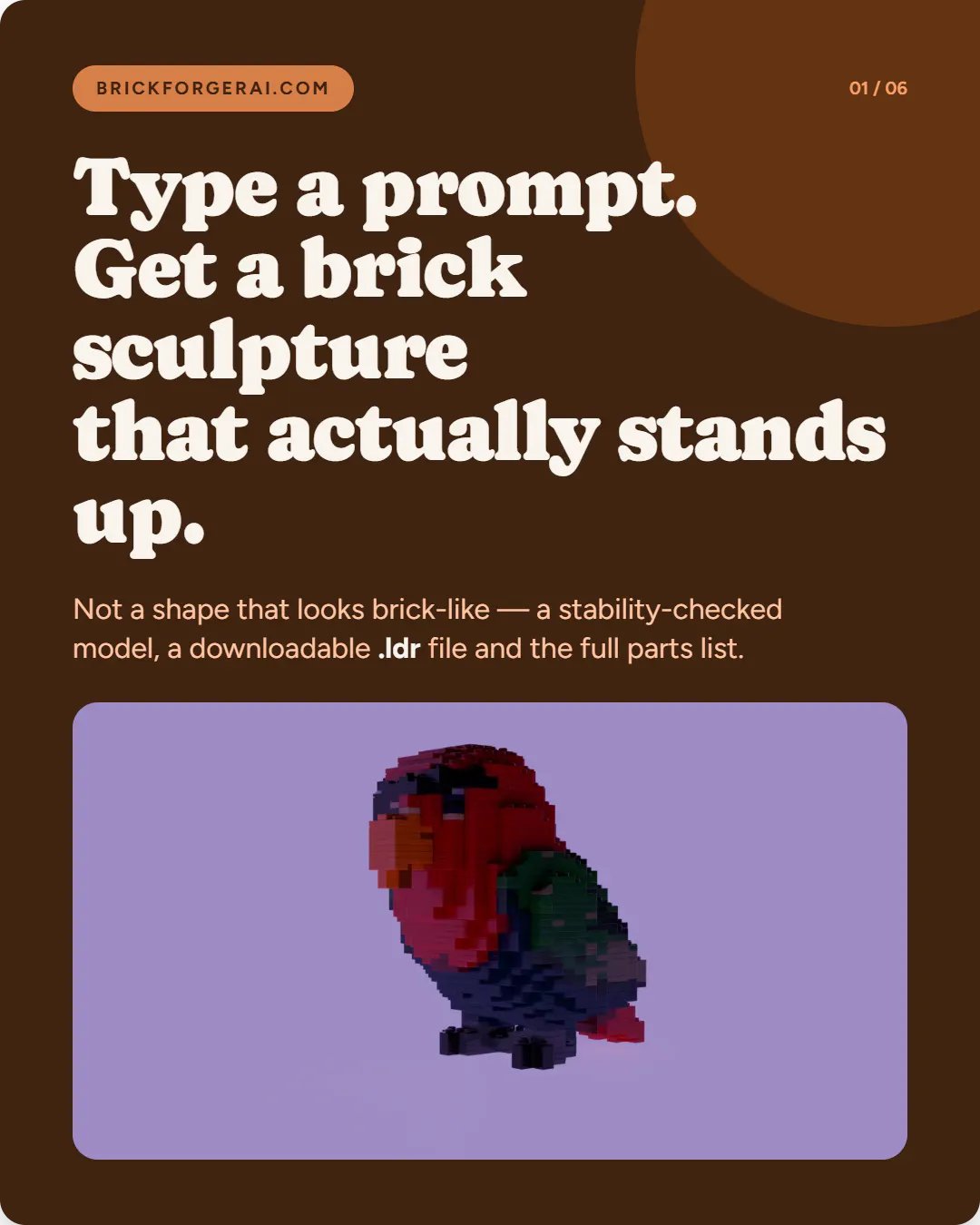
Type a prompt, get a buildable brick model. The AI (image + mesh gen) is just the front door. The real work is the brick-placing engine: voxelizing the shape, tiling it with actual LEGO-compatible parts, staggering seams for strength, running structural analysis (gravity load) to catch weak points, then refining with slopes and tiles (currently a 55 part brick library). You get a realldr file, parts list, and step-by-step PDF instructions. Renders below done with the Mecabricks Advanced add-on.
AI Analysis
BrickForgerAI turns any text prompt into a physically buildable brick model compatible with LEGO. Core features include AI-driven image and mesh generation followed by a specialized brick-placing engine that voxelizes the model, tiles it with real LEGO-compatible parts from a 55-piece library, performs gravity-based structural analysis, and refines with slopes/tiles for strength. Outputs are real LDraw (.ldr) files, parts lists, and step-by-step PDF instructions. It solves key pain points like unstable or unbuildable AI designs and the expertise barrier in manual LEGO engineering. USP is delivering structurally sound, real-world constructible sets rather than just visuals. Value proposition: Enables anyone to create custom, buildable brick sets easily.
In 2025-2026, generative AI for 3D content is maturing rapidly with improved multimodal models, while demand for personalized STEM toys, DIY creativity, and customizable hobbies grows amid economic emphasis on experiential learning and maker culture. User expectations for instant, practical AI outputs are rising. LEGO-compatible digital tools align well with this. No major negative policy or economic barriers apparent. Excellent Timing.
Technical difficulty is high due to integrating AI generation with precise voxelization, LEGO-part tiling algorithms, and structural physics simulation. Development and AI inference operational costs are substantial. Potential compliance risks around LEGO trademarks/IP for 'compatible' parts. However, a functional prototype with 55-part library and Mecabricks integration demonstrates viability. Scalability is good as a cloud service. Team requires specialized AI + mechanical engineering fit. Overall rating: Medium.
Main segments: Adult Fans of LEGO (AFOLs), creative hobbyists, parents/educators using STEM building toys, 3D design enthusiasts. Demographics: ages 18-45, tech-savvy, higher disposable income, primarily North America, Europe, East Asia. Core pain points: difficulty creating stable custom designs without engineering skills and lack of easy prompt-to-physical instructions. Estimated market: large global building toys sector (TAM >$10B for LEGO-like), niche for AI customization tools (SAM ~$200-500M). High willingness to pay for reliable outputs via one-time or subscription fees.
Medium. Direct competitors: 1. BrickLink Studio (studio.bricklink.com) - manual digital LEGO design. 2. Mecabricks (mecabricks.com) - LEGO 3D modeling/rendering platform. 3. LEGO Builder (lego.com/builder) - official app for official sets, limited customization. 4. General AI 3D tools like Meshy.ai (meshy.ai) or Luma AI - text-to-3D but no brick compatibility or instructions. Advantages: full automation from prompt with structural validation and build instructions; true physical build focus. Disadvantages: currently limited 55-part library vs broader manual tools; newer/less established than legacy platforms.
Upgrade Pro to unlock full AI analysis
Similar Products

Cohere Parse 5
Turn complex docs, tables & images into AI-ready data
▲ 158 votes

Opaline
PostHog for team Claude Code and Codex sessions.
▲ 141 votes

Adapt
The company brain that gets work done
▲ 124 votes

Tapfree for Chrome
Voice dictation that adapts to what’s on your screen
▲ 122 votes

CodeBurn
See where your AI coding spend actually goes
▲ 101 votes

WikiFix for Confluence
Find and fix issues in your knowledge base
▲ 86 votes