
BrowserAct
Web browser automation for AI agents
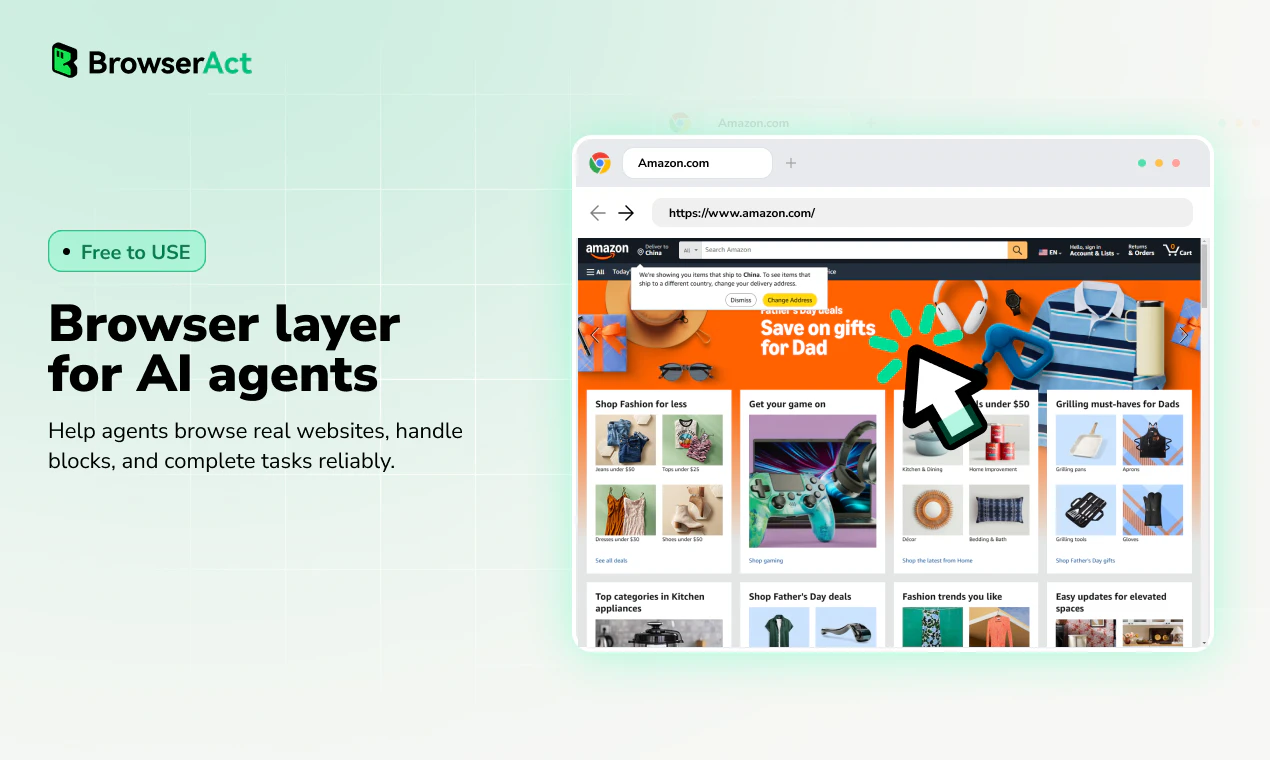
BrowserAct is built for agents using the web. It gives agents a browser layer for real websites, so they can pass blocked pages, adapt to real scenarios, run multiple tasks safely, and return clean web data for reasoning. Use BrowserAct when an agent needs to browse, click, extract, fill forms, upload files, work inside logged-in sites, handle verification, or run repeatable browser workflows.
AI Analysis
BrowserAct is a browser automation tool built specifically for AI agents, providing a reliable layer to interact with real websites. Core features include bypassing blocks, adapting to dynamic scenarios, performing actions like click, extract, form fill, file upload, managing logged-in sessions, handling verifications, and executing repeatable workflows. It returns clean, structured data optimized for AI reasoning. USP lies in its agent-centric design for safe multi-tasking on live web environments. It solves key pain points such as AI agents failing due to anti-bot measures, inconsistent navigation, and messy data outputs. Overall value proposition is enabling more autonomous and powerful AI agents for complex web tasks, boosting productivity in automation and data-driven workflows.
The timing is highly favorable for 2025-2026 as AI agents and LLM-based autonomous systems see explosive growth and mainstream adoption. Browser automation technology is mature (e.g. via Playwright integrations), while user demand shifts toward reliable real-web interfaces for agents amid rising needs for automation in business and research. Economic environments favor efficiency tools, with supportive policies for AI innovation and no major barriers. This positions BrowserAct well in the expanding agent ecosystem. Excellent Timing.
Overall feasibility is high. Technical difficulty is medium as it leverages mature browser frameworks with added anti-detection and AI integration layers. Development and operation costs are moderate, primarily cloud compute for browser instances. Supply chain risks are low; compliance risks (e.g. privacy laws for logged-in sessions) are manageable with proper design. Strong scalability via APIs and good fit for teams with web/AI expertise. High
Main target segments: AI/ML engineers, developers building autonomous agents, AI startups, and enterprises in automation (demographics: tech professionals 25-45 years old). Industries: Artificial Intelligence, software development, data extraction services. Geographic distribution: Global with concentration in US, Europe, and Asia tech hubs. Estimated market size: TAM for AI automation tools exceeds $50B by 2026; SAM for agent web interfaces ~$1-2B; SOM for specialized browser layers ~$100-300M. Core pain points: unreliable web interaction and data quality for agents. High willingness to pay for reliable, time-saving SaaS/API solutions.
Competition level: Medium. Direct competitors: 1. Browserbase (browserbase.com), 2. Skyvern (skyvern.com), 3. Axiom.ai (axiom.ai), 4. Bardeen (bardeen.ai), 5. MultiOn (multion.ai). Advantages vs competitors: stronger focus on clean structured data for AI reasoning, specialized support for logged-in sites, verifications and safe repeatable agent workflows. Disadvantages: newer entrant with potentially less brand recognition and ecosystem integrations compared to more established automation platforms; pricing and feature maturity may need time to compete on breadth.
Upgrade Pro to unlock full AI analysis
Similar Products

Cohere Parse 5
Turn complex docs, tables & images into AI-ready data
▲ 158 votes

Adapt
The company brain that gets work done
▲ 124 votes

Tapfree for Chrome
Voice dictation that adapts to what’s on your screen
▲ 122 votes

Kosshi
Simple, fast outliner for Mac and iPhone.
▲ 90 votes

Thoughts for Mac
Capture notes from your menubar using text, images or voice
▲ 90 votes

Refoid
Automate App Store refund responses and track every outcome
▲ 68 votes