
buildpipe
Compose, run and automate multi step AI developer workflows
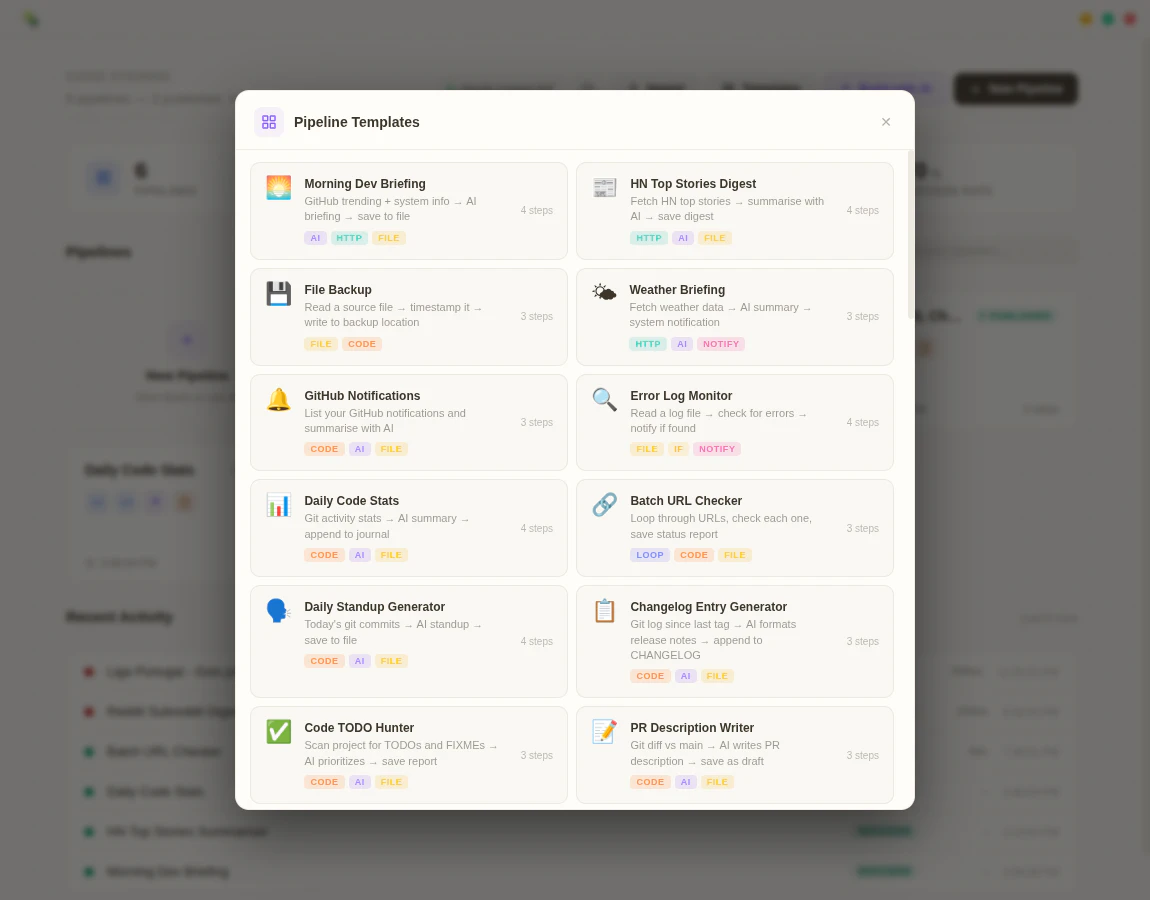
A local-first pipeline automation app for developers powered by AI, running natively on your machine. Think of it as a local Zapier or n8n, built specifically for developers who want to chain shell commands, AI calls, HTTP requests, and file operations into reusable pipelines then trigger them on a schedule, on a file change, or via webhook.
AI Analysis
Buildpipe is a local-first, AI-powered pipeline automation app for developers that runs natively on your machine. Core features include chaining shell commands, AI calls, HTTP requests, and file operations into reusable multi-step workflows, triggerable by schedules, file changes, or webhooks. It positions itself as a developer-focused alternative to cloud tools like Zapier or n8n. Unique selling points are privacy-focused local execution, seamless AI integration for dev tasks, and native machine performance without cloud dependency. It solves key pain points such as repetitive manual tasks, context switching between tools, reliance on internet for automation, and lack of customizable dev-centric pipelines. Overall value proposition is boosting developer productivity through automated, reusable AI-enhanced workflows executed securely and offline.
In 2025-2026, AI adoption in developer tools is accelerating with maturing local LLMs (e.g. via Ollama) and rising privacy concerns over cloud AI services. Demand for automated dev workflows is growing amid increasing complexity in software projects and need for efficiency. Local-first movement is trending, supported by economic focus on productivity tools. This aligns perfectly with shifting user demands away from purely cloud solutions. It is an Excellent Timing.
Technically feasible using existing frameworks for local apps (e.g. Tauri/Electron), workflow engines, and AI API integrations. Development and operation costs are moderate for a desktop tool with no heavy infrastructure needs. Low supply chain or compliance risks as it's pure software; main challenges are robust trigger handling and AI reliability. Strong scalability for individual/local use with potential for team extensions. Overall rating: High, supported by its current alpha status indicating viable core implementation.
Main target segments: Individual software developers, AI/ML engineers, indie hackers, and small dev teams. Demographics: Tech professionals aged 25-45, proficient in coding/shell. Industries: Software development, AI startups, DevOps. Geographic distribution: Global with concentration in US, Europe, and Asia tech hubs (e.g. Silicon Valley, Berlin, Shenzhen). Estimated market size: TAM for dev productivity tools ~$15B, SAM for automation platforms ~$2B, SOM for local AI dev pipelines ~$100-200M. Core pain points: Time wasted on repetitive tasks and brittle scripts. Potential willingness to pay: High ($10-30/mo) for tools saving multiple hours weekly.
Competition level: Medium. Direct competitors: 1. n8n (n8n.io) - self-hosted automation; 2. Zapier (zapier.com) - no-code cloud integrations; 3. Pipedream (pipedream.com) - code-first workflows; 4. Activepieces (activepieces.com) - open-source alternative; 5. Node-RED (nodered.org) - IoT/dev flows. Advantages vs competitors: Truly local-first with no cloud required, deep integration for shell commands and file triggers tailored to devs, AI-native for 2025 workflows. Disadvantages: Alpha stage means fewer polished integrations and community compared to mature n8n/Zapier; limited to local hardware resources vs cloud scalability. Strong differentiation in privacy and dev-specific focus reduces direct pressure.
Upgrade Pro to unlock full AI analysis
Similar Products

Opaline
PostHog for team Claude Code and Codex sessions.
▲ 141 votes

React UI Kit V7
All the chat components you need. None of the complexity
▲ 115 votes

Replay QA Security Scan
Automated Penetration Testing for AI-Built Apps
▲ 102 votes

CodeBurn
See where your AI coding spend actually goes
▲ 101 votes

Audryo
Customer email your agent can operate.
▲ 68 votes

Refoid
Automate App Store refund responses and track every outcome
▲ 68 votes