
DecisionBox for Databricks
Connect DecisionBox to your Databricks to validate findings
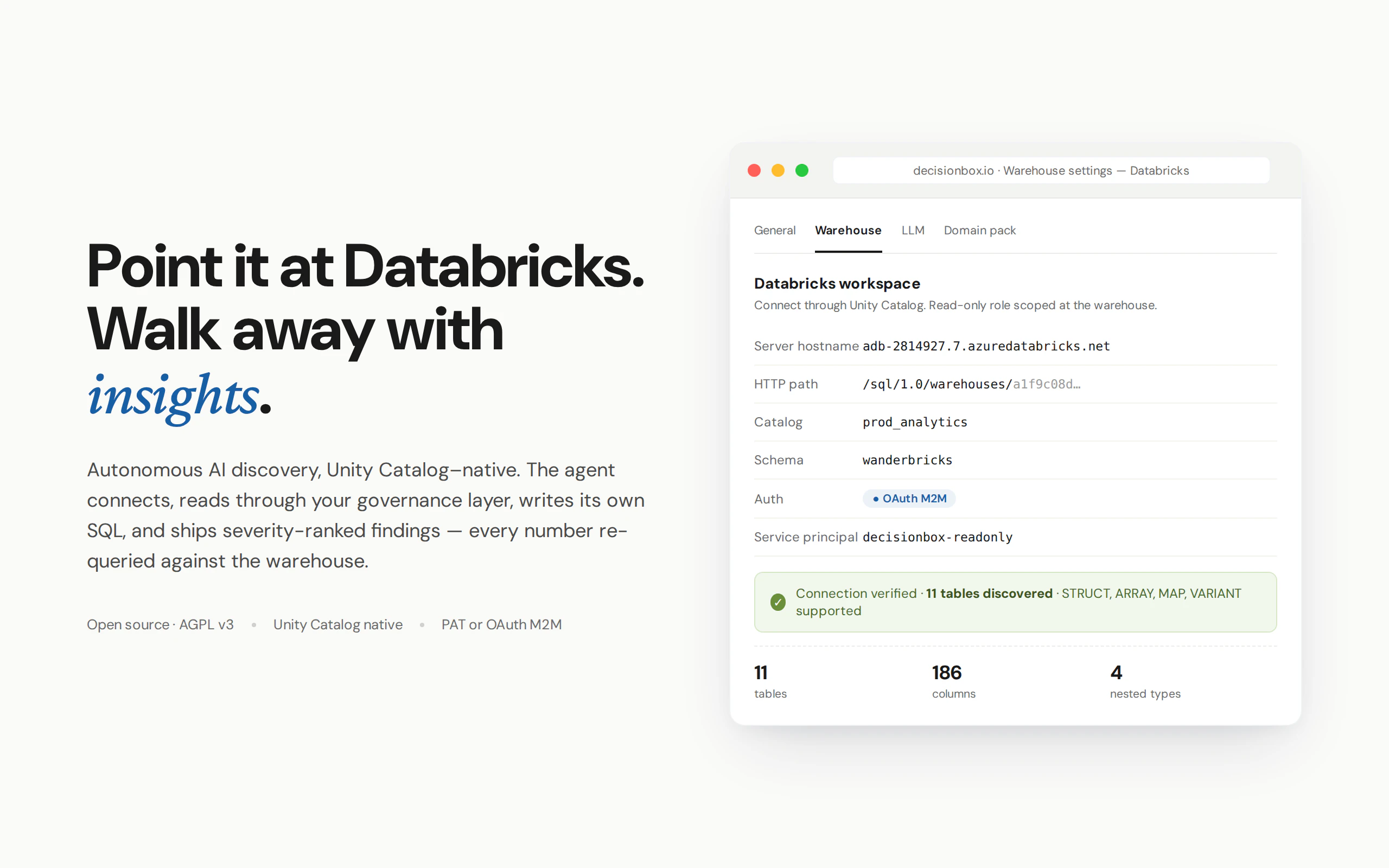
Connect DecisionBox to your Databricks workspace. The agent writes its own SQL, validates every finding against your data, and ships a ranked backlog — no prompting. Read-only, Unity Catalog–scoped. Works with Serverless, Pro, or Classic SQL warehouses. Open source, AGPL v3.
AI Analysis
DecisionBox for Databricks is an open-source AI agent (AGPL v3) that connects directly to Databricks workspaces. It autonomously writes SQL, validates every finding against real data in read-only Unity Catalog scope, and delivers a ranked backlog of insights with no prompting required. Compatible with Serverless, Pro, or Classic SQL warehouses. It solves key pain points for data teams including time-consuming manual querying, unverified AI outputs, and constant prompt engineering. The value proposition is secure, trustworthy, data-grounded decision support that accelerates insight generation while maintaining strict security boundaries.
The current market timing is favorable. In 2025-2026, AI agent adoption and LLM integration with data platforms like Databricks are accelerating rapidly amid demands for trustworthy AI that reduces hallucinations. Enterprise focus on data-driven efficiency, combined with Databricks' growing ecosystem and trends in autonomous analytics, creates strong demand. Policy emphasis on AI governance further supports validation-focused tools. Rating: Excellent Timing.
Overall feasibility is High. Technical integration leverages mature Databricks APIs, Unity Catalog, and existing LLM SQL generation capabilities, with moderate difficulty. Open-source model reduces costs via community contributions; operational expenses are low as it runs read-only on customer warehouses. Compliance risks are minimal due to scoped access. Strong scalability in cloud environments. Key risks involve agent accuracy on complex data; best fit for teams experienced in AI and data platforms. Rating: High.
Main target segments are data scientists, analysts, and engineers at mid-to-large enterprises using Databricks, primarily in tech, finance, healthcare, and retail industries, concentrated in North America and Western Europe. Core pain points are slow/unreliable insight validation and heavy manual effort. Estimated TAM for AI data analytics tools exceeds $10B, with SAM for Databricks ecosystem AI solutions in hundreds of millions; SOM for this niche tool is smaller but growing. Users show high willingness to pay for time-saving, trustworthy solutions, likely via support or enterprise editions despite open-source availability.
Competition level: Medium. Direct competitors: 1. Databricks Assistant/Genie (databricks.com), 2. LangChain SQL Agents (langchain.com), 3. Hex Magic (hex.tech), 4. ThoughtSpot SpotIQ (thoughtspot.com). Advantages: fully autonomous no-prompt operation, strict read-only validation with ranked backlog, deep Databricks-native integration, and open-source transparency. Disadvantages: newer/less established than commercial platforms, potential dependency on underlying LLMs for accuracy, and limited to Databricks users compared to broader SaaS tools.
Upgrade Pro to unlock full AI analysis
Similar Products

Equitybee Benchmark
Compare your startup equity grant for free.
▲ 218 votes

Cohere Parse 5
Turn complex docs, tables & images into AI-ready data
▲ 158 votes

Opaline
PostHog for team Claude Code and Codex sessions.
▲ 141 votes

Adapt
The company brain that gets work done
▲ 124 votes

Tapfree for Chrome
Voice dictation that adapts to what’s on your screen
▲ 122 votes

WikiFix for Confluence
Find and fix issues in your knowledge base
▲ 86 votes