
Capecho
Capture the new words you're reading & remember them later
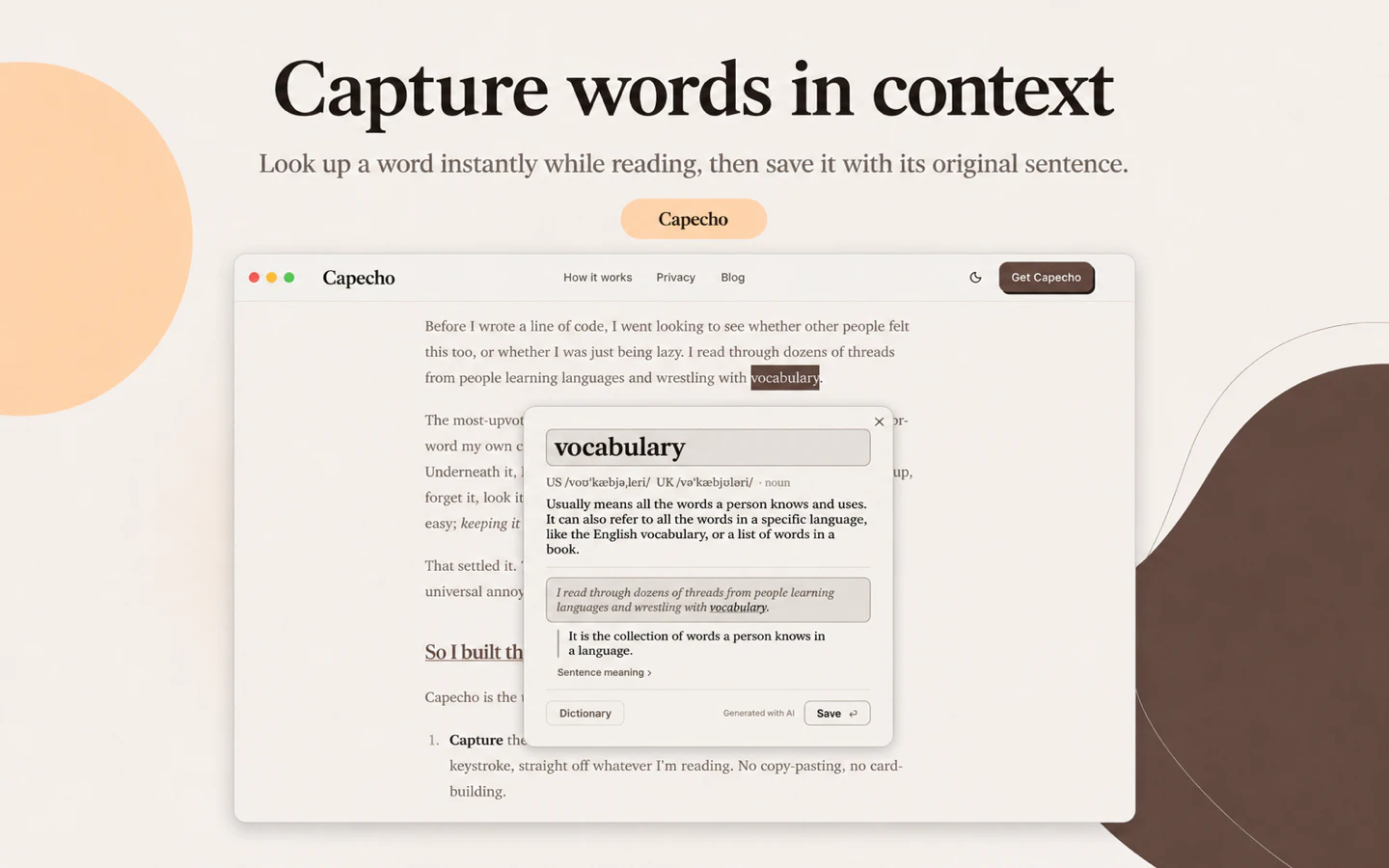
Capture the new words you're reading with best-effort OCR, understand the word and its sentence with AI, and review them before they fade with FSRS.
AI Analysis
Capecho enables users to capture unfamiliar words while reading using best-effort OCR, often from physical books or screens. AI analyzes the word and its original sentence for definitions, usage, and context. It then employs FSRS (an advanced spaced repetition algorithm) to schedule intelligent reviews, preventing words from being forgotten. It solves key pain points for language learners: manual lookup friction, lack of contextual understanding, and rapid vocabulary decay. The value proposition is seamless, AI-powered vocabulary acquisition that turns casual reading into effective, long-term language retention without disrupting the reading flow.
In 2025-2026, AI capabilities for contextual language understanding have reached high maturity with accessible APIs, while OCR accuracy continues to improve. Global demand for efficient, self-directed language learning tools is rising due to remote work, immigration, and personal development trends. Edtech investment remains strong despite economic caution. FSRS as an open algorithm aligns with the shift toward personalized, science-backed learning. This is Excellent Timing because the combination of mature AI, smartphone cameras, and proven retention science creates a compelling product-market fit now.
High feasibility. Core technologies (OCR libraries, LLM APIs for explanation, open-source FSRS scheduler) are readily available and integrable into a mobile app. Development costs are moderate, primarily involving frontend capture UX and backend AI orchestration. Main risks are OCR accuracy variability across lighting/fonts and ongoing AI API expenses, which can be mitigated with hybrid local/cloud processing. No significant supply chain or compliance barriers for a SaaS education tool. Scalability is strong via cloud services. Suitable for small technical teams with AI experience.
Primary users: Adult language learners and students aged 18-35 interested in foreign languages (especially English learners in Asia, Europe, Latin America). Includes avid readers, polyglots, and professionals needing specialized vocabulary. Geographically global with concentration in China, India, EU, and US. TAM for digital language learning exceeds $15B; SAM for AI-assisted vocabulary tools approx $2B; SOM for OCR+ SRS niche around $100-200M. Core pain points are inefficient word retention and fragmented learning workflows. Users show strong willingness to pay for subscriptions ($4-10/month) if retention results are demonstrably superior to free alternatives like Anki.
Medium. Direct competitors: 1. Anki (apps.ankiweb.net) - powerful SRS but requires manual card creation. 2. Readwise (readwise.io) - excels at importing highlights and spaced reviews but weaker on live OCR and language-specific AI. 3. LingQ (lingq.com) - imports texts and tracks known words with contextual learning. 4. Memrise (memrise.com) - gamified vocab with user content. 5. Pleco (pleco.com) - popular for Chinese learners with OCR dictionary. Advantages: tighter integration of capture-AI-explain-review loop and use of advanced FSRS. Disadvantages: newer entrant with likely smaller content library and dependency on AI API costs which may affect pricing. Strong differentiation in effortless 'in-the-moment' capture during physical reading.
Upgrade Pro to unlock full AI analysis
Similar Products

Load Nova
Dispatchers AI Co-Pilot and Dashboard that care about speed
▲ 131 votes

Adapt
The company brain that gets work done
▲ 124 votes

Tapfree for Chrome
Voice dictation that adapts to what’s on your screen
▲ 122 votes

Buddy AI Note
Your daily memo that turns notes into a plan
▲ 94 votes

Kosshi
Simple, fast outliner for Mac and iPhone.
▲ 90 votes

Thoughts for Mac
Capture notes from your menubar using text, images or voice
▲ 90 votes